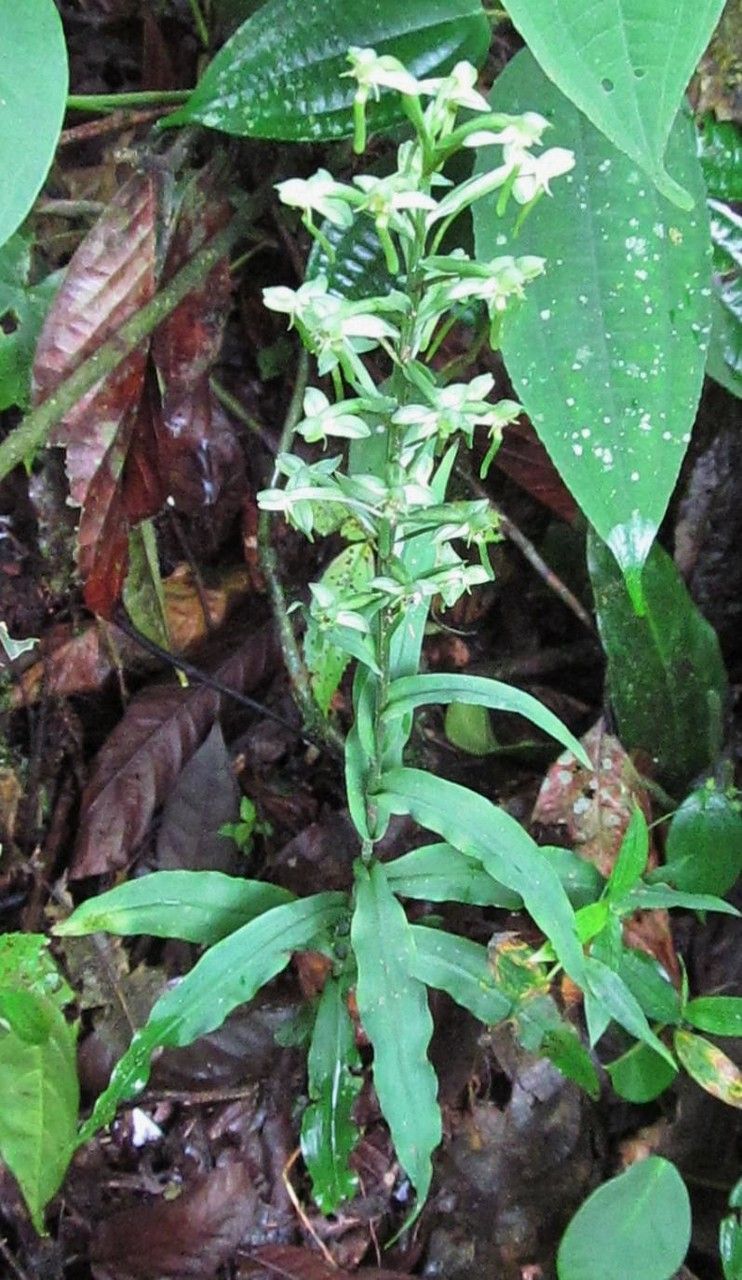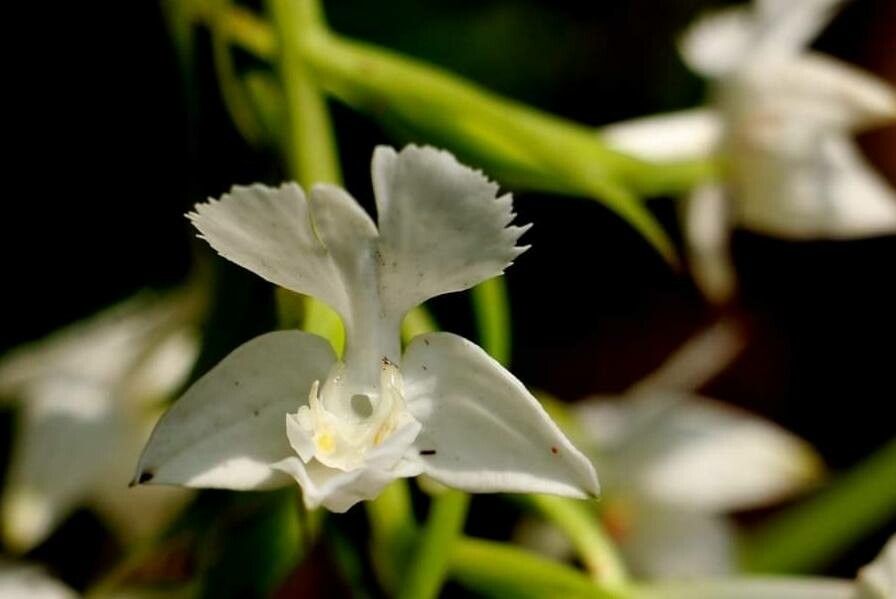
Habenaria dentata is a species of orchid native to the Himalaya, China, India, Indochina, Thailand and Myanmar. It is also found at Phalee. The whole plant is about 35 to 80 cm in height. It has a smooth round tuber that give rise to a single plant. Lower part of stem sheathed, middle leafy and upper part bracteate. Leaves 4 to 6 cm long, oblong to elliptic, 5 nerved, sometimes 7 also, the base of the leaf narrowed into a long tubular sheath. Spike 4 to 8 cm long, laxly flowered. Sepals sub-equal, broadly ovate, acute, spreading, the lateral pair sub-erect. Petals narrowly oblong, sub-acute, curved inwards, shorter than the sepals. Lip as long as the sepals, variable in breadth, with large cuneate or rounded, fimbriate or crenate side lobes and a small oblong entire apical lobe. Spur infundibuliform at the base, slender laterally compressed, geniculte, sub-clavate below the knee, longer than the shortly stalked beaked ovary. Stigmas separated by the area in the centre by the orifice of the spur. It generally blooms in August- September.
Habenaria dentata ist allgemein gut gegen Krankheiten gefeit und hat vergleichsweise wenige Insektenprobleme. Die Pflege wird als schwierig eingestuft, da die Pflanze eine hohe Luftfeuchte bei gleichzeitig guter Belüftung und möglichst wenigen schädlichen Erregern benötigt. Übermäßiges Gießen kann zu Wurzelfäule führen. Das Anbauen von Habenaria dentata ist für jedermann geeignet, doch um sie gesund zu halten und erneut zur Blüte zu bringen, ist mehr Anbauerfahrung nötig.
How to keep Habenaria Dentata.
Light
The plant Habenaria dentata is indigenous to habitats like forest undergrowth or stony regions, where it is naturally shielded from the sun. While it favors semi-sunlit conditions, it can withstand either full sun exposure or complete shade, showcasing its robust and adaptable character.
Water
Habenaria dentata thrives in moist environments, preferring consistent hydration and high humidity. To keep this plant lush, it's best to water it weekly. It does particularly well indoors, where moisture levels can be controlled. For the best growth and floral health, it's important to keep the soil evenly moist but avoid waterlogging.
Temperature
Habenaria dentata possesses the capacity to adjust to diverse temperature ranges, however, its spread might still be restricted by varying combinations of heat and water conditions. It flourishes optimally in hot climates during summertime where there is sufficient rainfall or irrigation. Extended periods of overcast and rainy weather, in addition to prolonged high temperature conditions, can elevate the risk of Habenaria dentata perishing. During winter, suitable safeguarding against the cold enhances the survival probability of the plant.
Fertilizer
The optimal period to apply fertilizer to a Habenaria dentata is during the early spring, as it transitions from dormancy to active development. Fertilization delivers essential nutrients for robust growth. While Habenaria dentata's fertilization requirements are pretty modest, yearly fertilization can boost its longevity and stimulate superior and more durable blossoms.
Pruning
Habenaria dentata is known for its attractive foliage and delicate flowers. To encourage growth and reblooming, prune the plant from early to late spring by removing damaged stems and spent flowers. Make sure to use sterilized tools to prevent disease. Improving air circulation and light exposure will also help support the plant's overall health.
Botanical profile.
- Plant Type
- Herb
- Life Cycle
- Perennial
- Genus
- Habenaria
- Family
- Orchidaceae
- Hardiness Zone
- 9-11
- Mature Height
- 30 cm to 61 cm
- Mature Spread
- 15 cm to 30 cm
- Leaf Color
- Green
- Leaf Type
- Deciduous
- Flower Color
- White
- Flower Size
- 1.02 cm to 2.03 cm
- Bloom Time
- Early summer, Mid summer
- Planting Time
- Spring, Summer, Autumn
- Harvest Time
- Late summer, Early fall
- Native Area
- Nepal, India, Malaysia, Cambodia, Vietnam, Myanmar, Japan, Philippines, Bhutan, Laos, Thailand, China