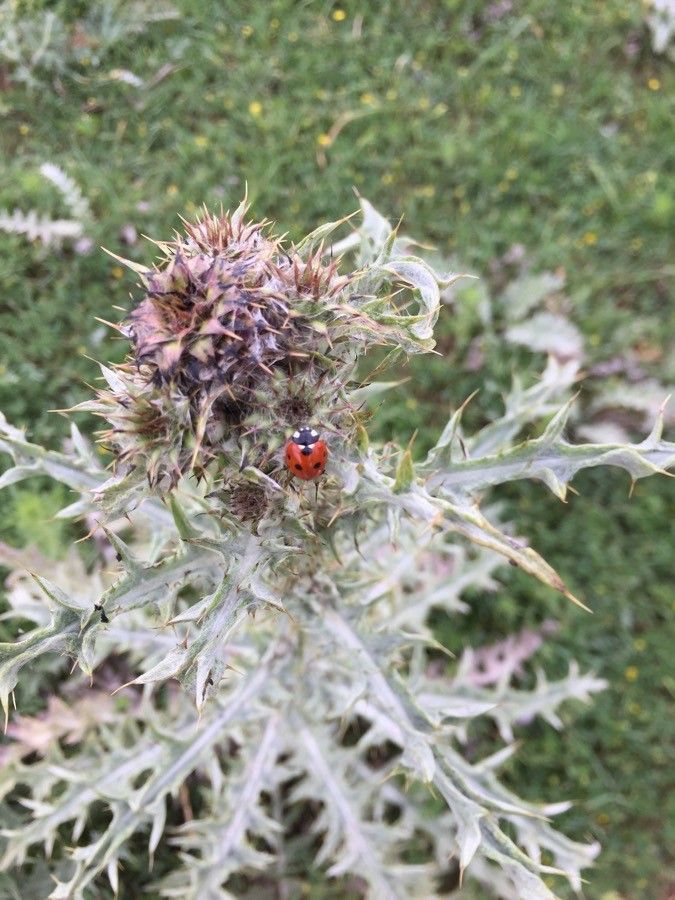
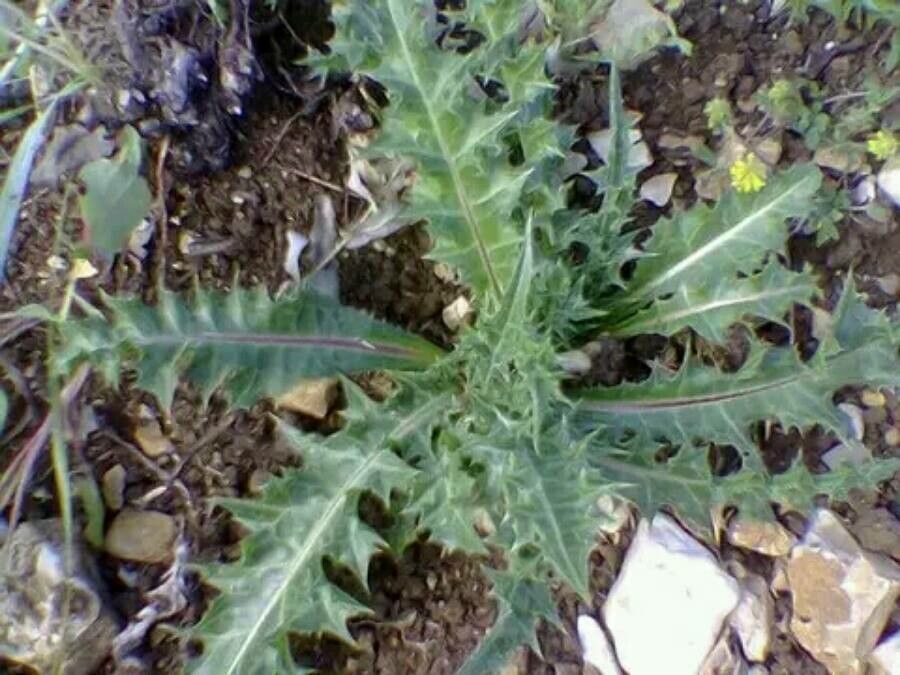
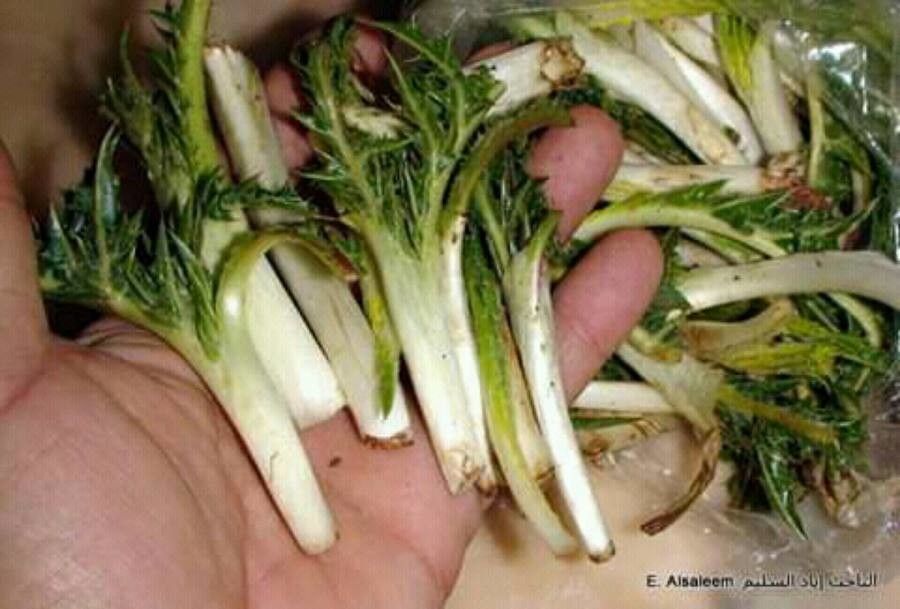
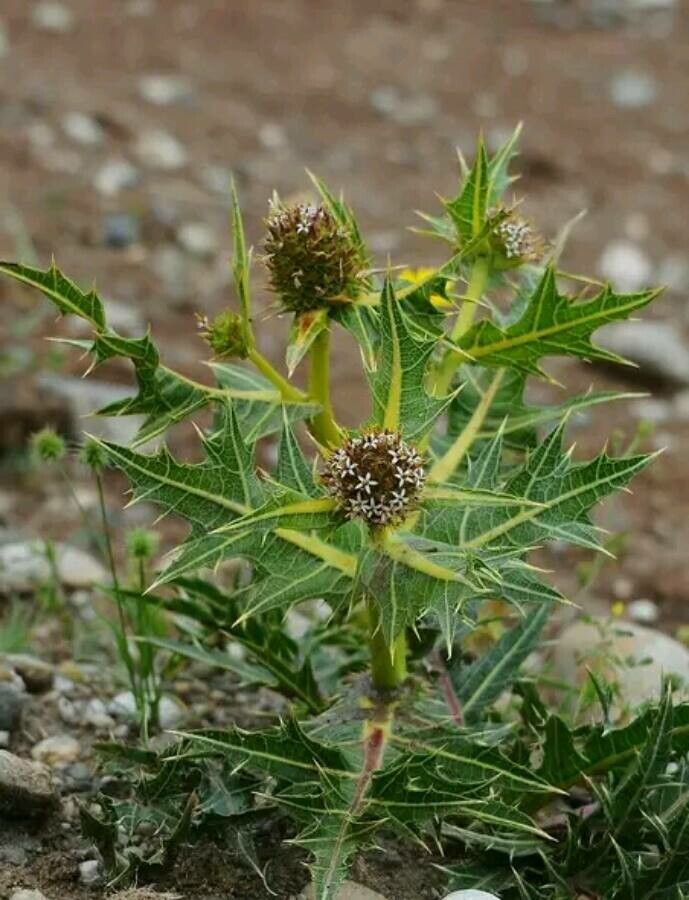
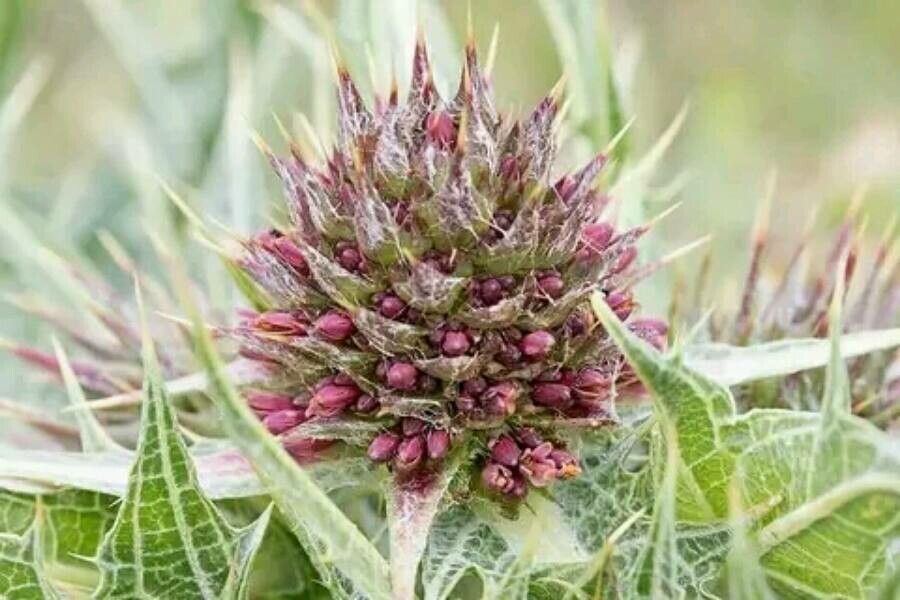
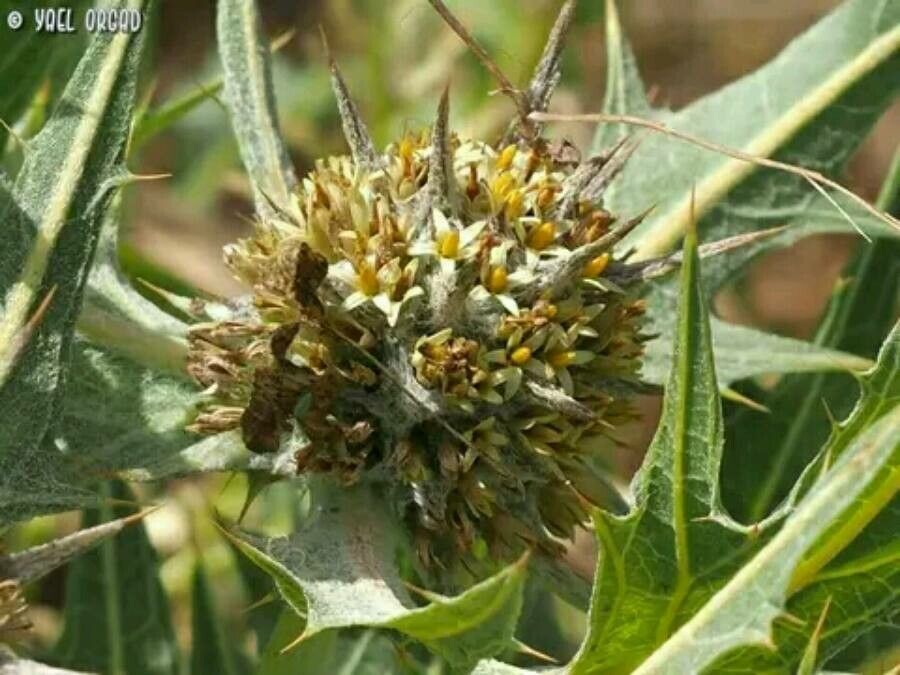
Gundelia is a low to high (20–100 cm) thistle-like perennial herbaceous plant with latex, spiny compound inflorescences, reminiscent of teasles and eryngos, that contain cream, yellow, greenish, pink, purple or redish-purple disk florets. It is assigned to the family Asteraceae. Flowers can be found from February to May. The stems of this plant dry-out when the seeds are ripe and break free from the underground root, and are then blown away like a tumbleweed, thus spreading the seeds effectively over large areas with little standing vegetation. This plant is native to the eastern Mediterranean and the Middle-East. Opinions differ about the number of species in Gundelia. Sometimes the genus is regarded monotypic, Gundelia tournefortii being a species with a large variability, but other authors distinguish up to nine species, differing in floret color and pubescence. Young stems are cooked and eaten in the Middle-East and are said to taste like a combination of artichoke and asparagus. The plant also contains compounds that have been demonstrated to be effective against a range of ailments. A large quantity of pollen assigned to Gundelia has been found on the Shroud of Turin, which may suggest that the crown of thorns was made from Gundelia, but this finding has been contested.It is called Akkoub (Arabic: عكوب) in Arabic, silifa in Greek, Akuvit ha-Galgal (Hebrew: עַכּוּבִית הַגַּלְגַּל) in Hebrew, Kangar (Armenian: կանկառ), ( Persian: كنگر) in Armenian and Persian, Kenger in Turkish (derived from Persian), and Kereng in Kurdish. It's called tumble thistle in English.
Tournefort's gundelia has moderate resistance to disease and can be prone to issues such as leaf spot. Its vulnerability to insect pests may differ by variety, though most varieties are relatively less resistant to pests. In terms of care, Tournefort's gundelia requires regular watering and fertilizing, as well as frequent removal of yellow leaves. It is important to address pests and diseases when they occur and to harvest the plant in a timely way. Tournefort's gundelia is appropriate for people who can dedicate some time and effort to routine care.
How to keep Gundelia Tournefortii.
Light
Tournefort's gundelia prospers with regular exposure to sunlight. Native to areas where sunlight is plentiful, it has adapted to prefer places with freely available sun. Excessive exposure does not harm it, while insufficient light can affect its healthy growth, especially during key stages of development.
Water
Tournefort's gundelia flourishes with moderate watering, echoing its native environment's occasional rainfall. While it is drought-tolerant, it thrives when it receives consistent moisture, making weekly watering ideal in cultivation. Its growth cycle is heavily influenced by seasonal rain patterns, which dictate its active growth and dormancy periods.
Temperature
Tournefort's gundelia is native to areas with average temperatures of about 41 to 95 °F (5 to 35 ℃). It naturally thrives in such moderate temperatures and can tolerate slight temperature fluctuations. However, make sure it is not exposed to temperatures below 59 °F (15 ℃), particularly during colder seasons.
Fertilizer
Tournefort's gundelia species do well with one or two applications of natural organic fertilizers that contain potassium and phosphorus. Apply the fertilizer before planting, working it into the soil and watering thoroughly. Usually a single application suffices, though a second can be applied after seedlings have become established. Avoid overusing fertilizer to prevent harming the plants.
Pruning
Proper pruning of Tournefort's gundelia from early to late spring is essential for promoting healthy growth. This process involves removing dead stems, which improves airflow around the plant. Regular thinning helps prevent overcrowding and reduces the risk of disease, while using sterilized tools minimizes the chances of infection. These practices significantly enhance the plant's health and appearance, as supported by the Royal Horticultural Society.
Botanical profile.
- Plant Type
- Herb
- Life Cycle
- Perennial
- Genus
- Gundelia
- Family
- Asteraceae
- Hardiness Zone
- 7-10
- Mature Height
- 34 cm to 49 cm
- Mature Spread
- 40 cm to 61 cm
- Leaf Color
- Green, Dark Green
- Leaf Type
- Semi-evergreen
- Flower Color
- Green, Yellow
- Flower Size
- 6.35 cm
- Bloom Time
- Mid spring, Late spring
- Planting Time
- Spring
- Harvest Time
- Early summer, Mid summer
- Native Area
- Afghanistan, Iraq, Turkey, Syria, Iran, Cyprus, Azerbaijan, Armenia, Turkmenistan, Lebanon
Other names.
Reader questions.
How should I water my Tournefort's gundelia to keep it healthy?
The Tournefort's gundelia has specific preferences for both the amount and method of watering. Failing to water it correctly could harm your tomatoes. To properly water this plant, it is best to apply water directly to the soil in a slow and gentle manner. Avoid pouring all the water into the soil at once or using overhead watering methods. It is important to water slowly and deeply to ensure the entire soil where the plant grows remains adequately moist.
What are the sunlight requirements for Tournefort's Gundelia?
Tournefort's Gundelia (Gundelia tournefortii) requires a substantial amount of sunlight, specifically more than 6 hours of direct exposure daily, to thrive. Its adaptation to environments with abundant sunlight makes excessive exposure tolerable and even beneficial, though a lack of sufficient light can adversely affect its growth, particularly during crucial growth stages. Gardeners are advised to observe how sunlight moves through their gardens throughout the day to select planting spots that offer an ideal balance of light and shade, ensuring the plants' health and happiness.
What is the ideal temperature range for growing Tournefort's gundelia?
Tournefort's gundelia thrives in environments with temperatures between 41 to 95°F (5 to 35°C). It prefers moderate warmth and can adjust to slight temperature changes. However, it is crucial to maintain temperatures above 59°F (15°C) during colder seasons to prevent damage. In winter, especially when the outdoor temperature approaches -5°C (25°F), it's advisable to bring the plant indoors or protect it by setting up a temporary greenhouse or wrapping it with materials like plastic film or fabric to prevent freezing damage.
What should I do if I give too much or too little water to my Tournefort's gundelia plant?
If you realize that you have given too much water to your Tournefort's gundelia and are worried about the risk of disease, you should take action right away. A good approach for an overwatered Tournefort's gundelia is to remove it from its current spot. Let the roots dry out a bit before replanting it in a new location with well-draining soil. If you grow it in a pot, you might also consider moving it to a pot with more or bigger drainage holes. On the other hand, if your plant is not getting enough water, simply increase the frequency of watering.
How does insufficient sunlight affect Tournefort's Gundelia when grown indoors?
When grown indoors with limited light, Tournefort's Gundelia may exhibit symptoms such as smaller new leaves, leggy or sparse growth, faster leaf drop, slower or halted new growth, lighter-colored new leaves, chlorosis (yellowing leaves), sunscald, leaf curling, wilting, and leaf scorching. These symptoms indicate light deficiency, which can go unnoticed but significantly impact the plant's health by affecting its ability to photosynthesize and grow properly.
How should I care for Tournefort's gundelia in low temperatures?
Tournefort's gundelia has a moderate tolerance to low temperatures but thrives best between 15°C and 35°C. During winter, keep it above -10°C. If the temperature falls below -15°C, you may notice the leaves darken, and in severe cases, experience water-soaked necrosis, wilting, drooping, and leaves turning brown. To protect the plant, trim away frost-damaged parts and either move it indoors to a warm environment or create makeshift greenhouse protection. Ensure it's placed near a south-facing window for sufficient sunlight and consider using supplemental lighting if necessary.
How frequently should I give water to my Tournefort's gundelia?
Tournefort's gundelia, in general, requires a lot of water during its growing season. To meet this high water requirement, you should water it frequently, especially in the spring and summer. At the beginning of the growing season, it is recommended to water your Tournefort's gundelia once or twice a week. As the season progresses, you should increase the frequency of watering. In the summer, depending on the weather, you may need to water it twice a day or even more. After the Tournefort's gundelia has completed its main growth phases, you can decrease the frequency of watering to about once a week until the end of the growing season.
What are the solutions for Tournefort's Gundelia facing insufficient sunlight?
To address insufficient sunlight for Tournefort's Gundelia, consider the following solutions: For indoor plants, gradually move them to sunnier locations to achieve at least 6 hours of direct sunlight daily, utilizing a south-facing window and keeping curtains open during the day. If moving the plant isn't feasible, supplement with artificial lighting, such as desk, ceiling, or professional plant grow lights, for at least 8 hours daily. For outdoor plants, transition them gradually to sunnier spots to prevent sunburn, understanding that parts of the plant damaged by insufficient sunlight may not recover, but new growth should be healthy post-adjustment. Additionally, for ground-level improvement, minimize obstructions by pruning or transplanting smaller plants during their dormant period to areas with better sunlight and drainage.
What are the signs of high temperature stress in Tournefort's gundelia, and how can I mitigate them?
When the temperature exceeds 35°C, Tournefort's gundelia's growth may slow, leaves can lighten in color, and it becomes prone to sunburn if temperatures soar above 41°C. If this happens, trim away any sunburned or dried-up parts and relocate the plant to a shaded area, particularly from the harsh afternoon sun. It's important to water the plant in the morning and evening to keep the soil moist and reduce stress from high temperatures.
How much water does my Tournefort's gundelia plant need?
Tournefort's gundelia is a highly popular plant and many gardeners, both professional and amateur, have been successful in growing them. With this popularity, we now have a good understanding of how to properly care for these plants. Part of this understanding involves knowing the specific water needs of Tournefort's gundelia. In general, these plants require about 1-1.5 inches of water per week, which should be evenly distributed during your weekly watering routine. As the weather gets warmer, you may need to increase the amount of water supplied, but generally, a baseline of two inches per week should suffice.
Can artificial lighting be used for Tournefort's Gundelia, and if so, how?
Yes, artificial lighting can be an effective solution for growing Tournefort's Gundelia indoors, especially in locations with insufficient natural sunlight. It's crucial to select the right type of light, with LED lights being a preferred option due to their efficiency and ability to provide specific light wavelengths needed by plants. For full sun plants, 30-50W per square foot is recommended; 20-30W per square foot for partial sun plants; and 10-20W per square foot for full shade plants. Position the artificial light source 12-36 inches above the plant to mimic natural sunlight and set the duration to mimic natural daylight hours, which is generally 8-12 hours per day.
How do I know if I am watering my Tournefort's gundelia plant enough?
Both underwatering and overwatering can be problematic for your Tournefort's gundelia and they can cause similar symptoms. These symptoms include foliage discoloration and wilting, which can be caused by either too much or too little water. When your Tournefort's gundelia is underwatered, its leaves will curl and droop initially, and you will notice a decrease in leaf vitality. Since this plant requires a high amount of water, underwatering can also lead to stunted growth and poor overall development, affecting both flowers and the plant as a whole. On the other hand, overwatering is more likely to result in disease, such as rot, and unpleasant smells coming from the soil. The symptoms of underwatering appear sooner than those of overwatering. Additionally, you can identify overwatering by observing soil conditions – if you notice excessive standing water or waterlogged soil, overwatering is likely the cause.