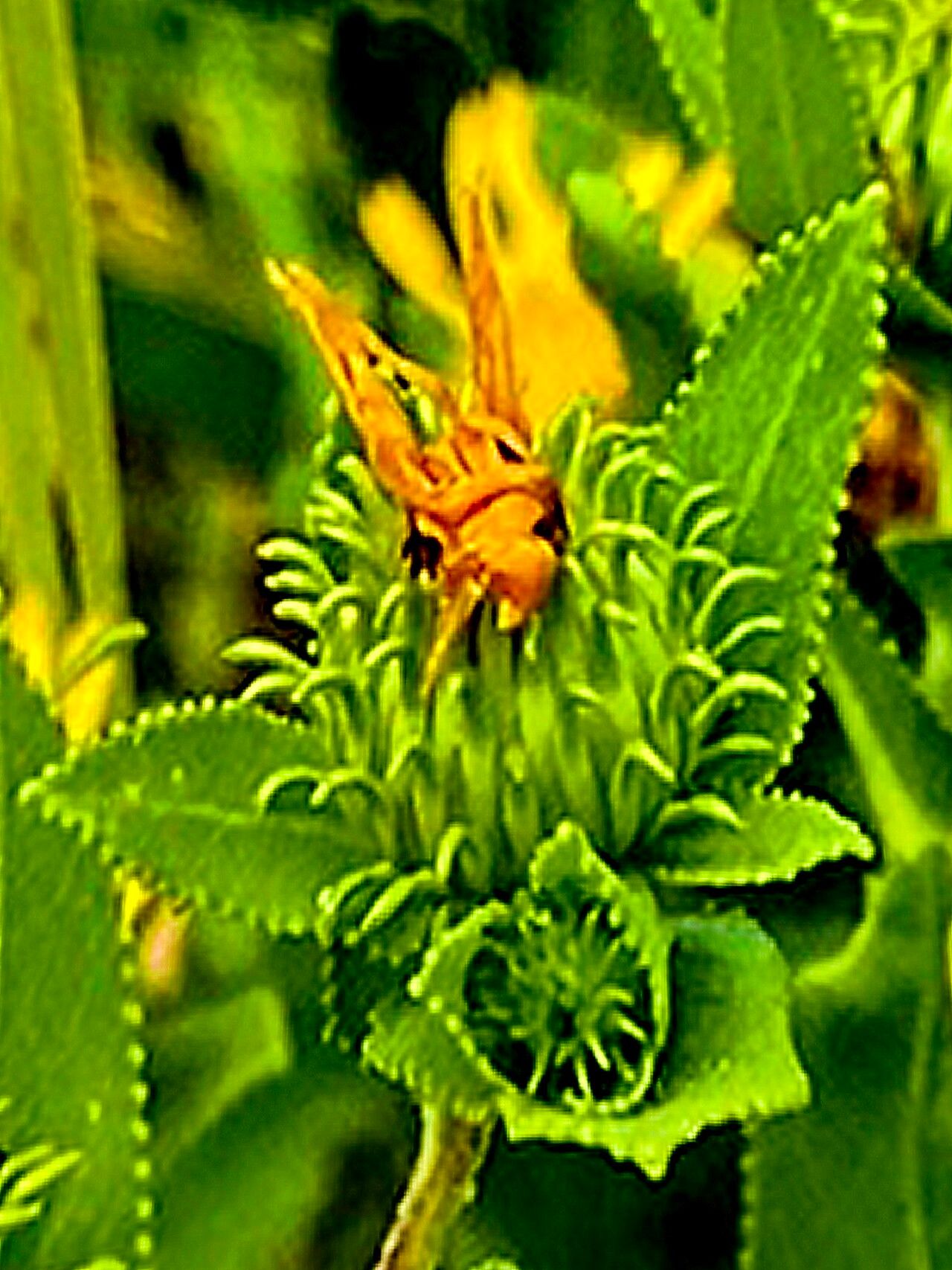
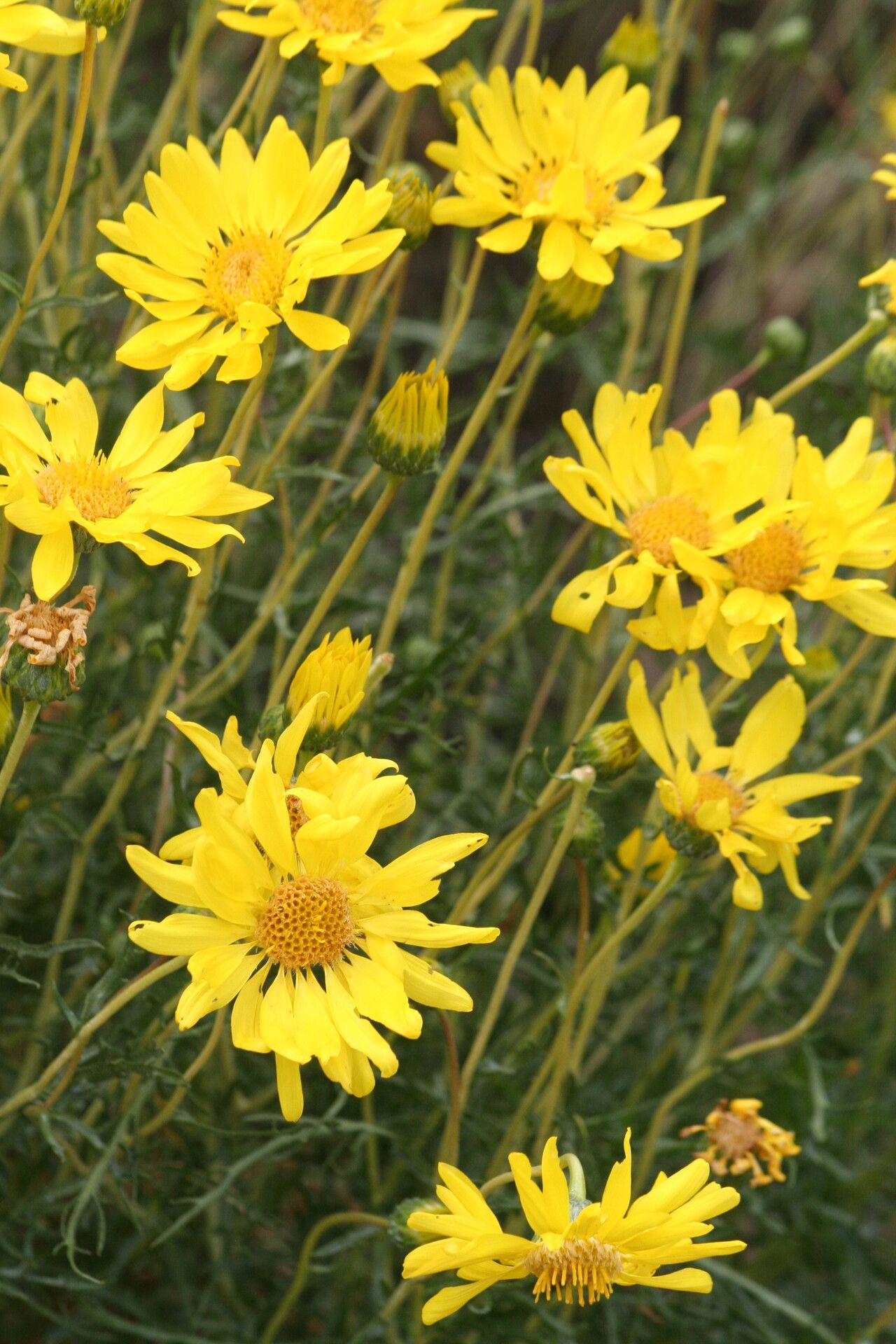
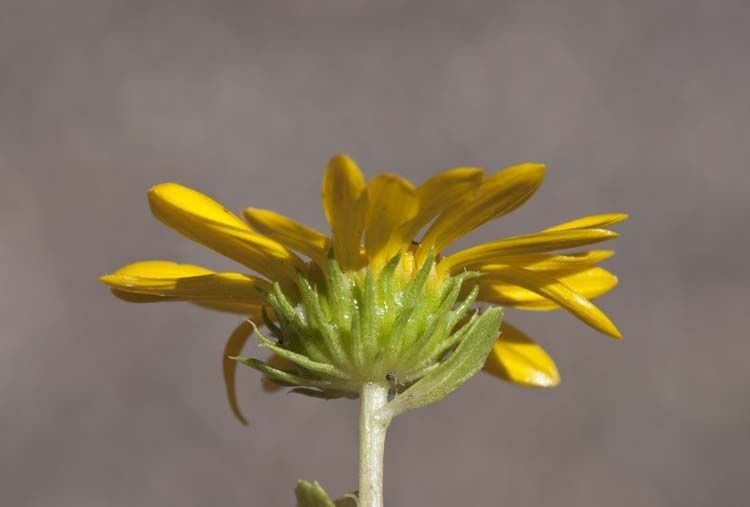
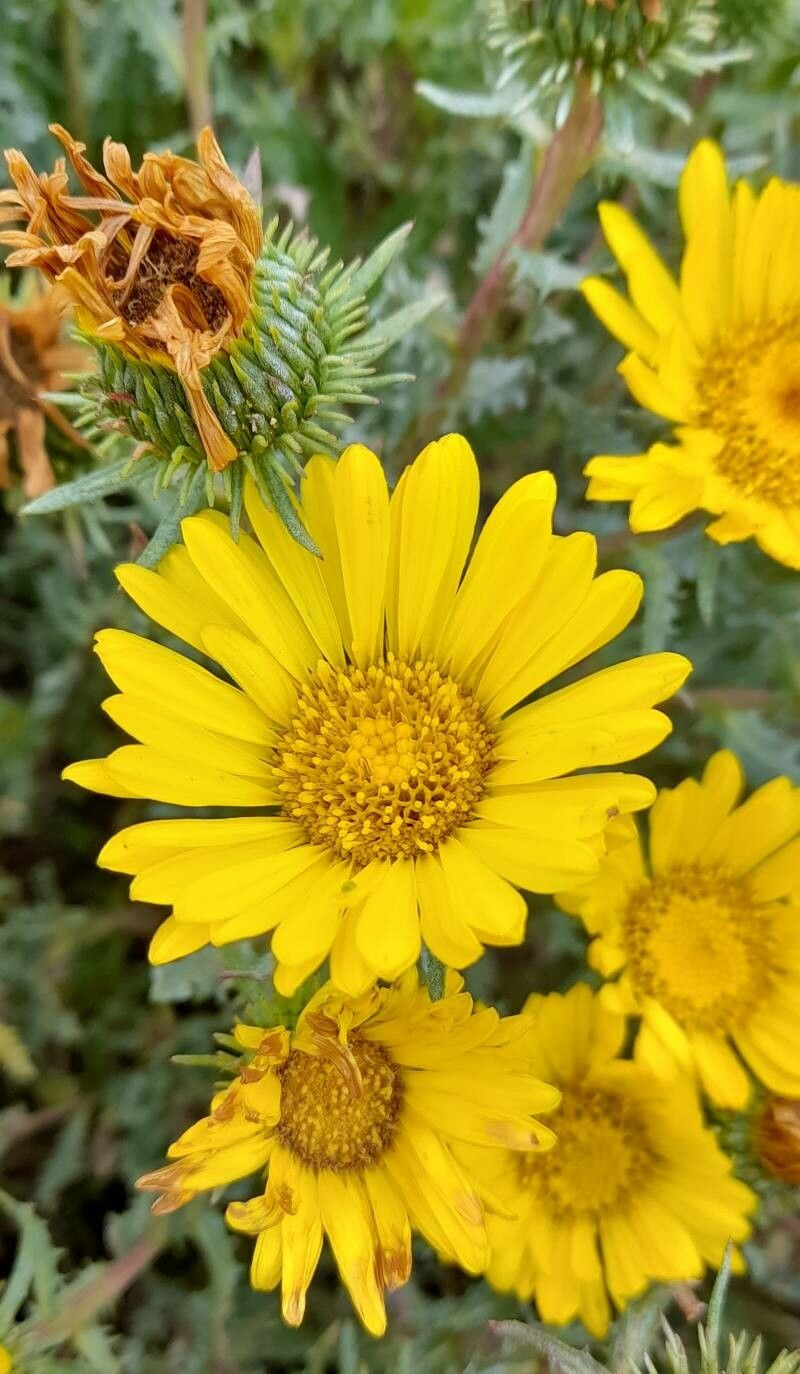
Grindelia ciliata (syn. Grindelia papposa, Haplopappus ciliatus, and Prionopsis ciliata) is a species of flowering plant in the family Asteraceae known by the common names Spanish gold, goldenweed, and waxed goldenweed. Grindelia ciliata is native to sections of the central United States, primarily the Great Plains from Iowa and Nebraska south to Texas and New Mexico. There are also isolated populations in Arizona and apparently naturalized populations in California, Maryland, Michigan, and the Mississippi Valley.Grindelia ciliata grows in prairies and grasslands, and in disturbed areas such as roadsides and along railroad tracks.Grindelia ciliata is an annual or biennial shrub sometimes as much as 150 cm (5 feet) tall, its upper stem branching. It is hairless. The leaves are alternately arranged, up to 8 cm (3.2 inches) long, their spiny-toothed blades longer than wide. The top of the stem is occupied by an inflorescence of several flower heads, their hemispheric bases up to 2.5 centimeters (one inch) wide and lined with many small, green phyllaries with curving tips. Each flower head may have up to 30 narrow, pointed yellow ray florets between 1 and 2 centimeters (0.4-0.8 inches) long, surrounding a center of yellow disc florets. The fruit is a brown achene about a centimeter (0.4 inches) long including its long pappus of bristles.
Goldenweed is resistant to disease and is generally unlikely to be affected by illnesses. Regarding care, this plant is fairly low-maintenance. When grown outdoors it needs little watering, and larger specimens typically do not require pruning. Smaller plants, however, should be trimmed after they have finished blooming. Goldenweedt is suitable for anyone with an outdoor area, such as a garden or deck, and does not need extensive care experience.
How to keep Grindelia Ciliata.
Light
Goldenweed is native to open habitats, such as sunny meadows and forest edges, which provide abundant light. It performs best in Full Sun but can tolerate Partial Sun, adapting well to different sunlight conditions.
Water
Goldenweed, native to arid regions, is highly drought-tolerant and thrives in low-moisture environments. It needs watering only every 2-3 weeks, making it perfect for xeric landscapes. With its efficient root system that stores water, goldenweed is an ideal choice for rock gardens or areas with dry soil.
Temperature
Goldenweed is very adaptable to a wide range of climate conditions, from blazing summers to frosty winters. Still, it has an optimal temperature range for development. If temperatures become too high, the plant is susceptible to heat and humidity stress, which can lead to its death. In locations where temperatures approach the lower limit of its cold tolerance, insulating measures should be used to protect the plant.
Pruning
To help your goldenweed thrive, it's important to focus on pruning from early to late spring. Start by removing any dead stems to promote better growth and air circulation. Pinching young shoots encourages a bushier plant, while avoiding heavy pruning helps support more blooms. By using proper techniques, you can improve the health and flower production of your goldenweed. For the best results, consult trusted horticultural sources for guidance.
Botanical profile.
- Plant Type
- Shrub
- Life Cycle
- Annual, Biennial
- Genus
- Grindelia
- Family
- Asteraceae
- Hardiness Zone
- 7-10
- Mature Height
- 1.52 m
- Mature Spread
- 30 cm to 46 cm
- Leaf Color
- Green, Dark Green
- Leaf Type
- Semi-evergreen
- Flower Color
- Yellow
- Flower Size
- 2.54 cm
- Bloom Time
- Mid summer, Late summer, Early fall
- Planting Time
- Spring, Summer, Autumn
- Harvest Time
- Early fall, Mid fall
Other names.
Reader questions.
What are the sunlight requirements for Goldenweed?
Goldenweed thrives in environments that provide ample light, such as sunny meadows and forest edges, and requires full sun exposure, which is defined as more than 6 hours of sunlight daily. However, it can also tolerate partial sun, receiving about 3-6 hours of sunlight. Monitoring how sunlight moves through your garden is crucial for finding spots that offer the right balance of light and shade, ensuring the plants' well-being.
How can artificial lighting supplement sunlight for Goldenweed?
When natural sunlight is inadequate, especially in winter or in less sunny spaces, artificial lights serve as an essential alternative to promote healthy growth in Goldenweed. Ideal artificial lighting conditions include choosing the right type of light, such as LED lights which can be customized to provide specific wavelengths needed by the plant. For plants needing full sun, 30-50W per square foot is recommended; for partial sun plants, 20-30W per square foot; and for full shade plants, 10-20W per square foot. The light source should be placed 12-36 inches above the plant, mirroring natural sunlight exposure, and the duration should mimic natural daylight hours, generally 8-12 hours per day.
What are the key symptoms of light deficiency or excessive sunlight in Goldenweed?
Goldenweed shows specific symptoms under suboptimal lighting conditions, such as smaller new leaves, leggy or sparse growth, faster leaf drop, slower or halted new growth, lighter-colored new leaves, and conditions like chlorosis and sunscald from excessive sunlight. Leaf curling, wilting, and leaf scorching are also common symptoms when the plant is overexposed to sunlight. These symptoms indicate the plant's struggle with either too little or too much light, affecting its overall health and growth.
How can optimal lighting conditions be achieved for Goldenweed, both indoors and outdoors?
To ensure optimal growth for Goldenweed, gradually adjust the plant to receive at least 6 hours of direct sunlight daily for indoor plants. Utilizing a south-facing window and keeping curtains open during the day maximizes sunlight exposure. For large or immovable plants, consider supplementing with artificial light, keeping lamps on for at least 8 hours daily. Outdoors, transition your plants to sunnier locations gradually to avoid sunburn. Removing obstructions and, for smaller plants, considering transplanting during the dormant period to a sunny, well-drained location can also improve light exposure. Note that parts of the plant affected by insufficient light may not recover, but new growth will be healthier with improved lighting conditions.