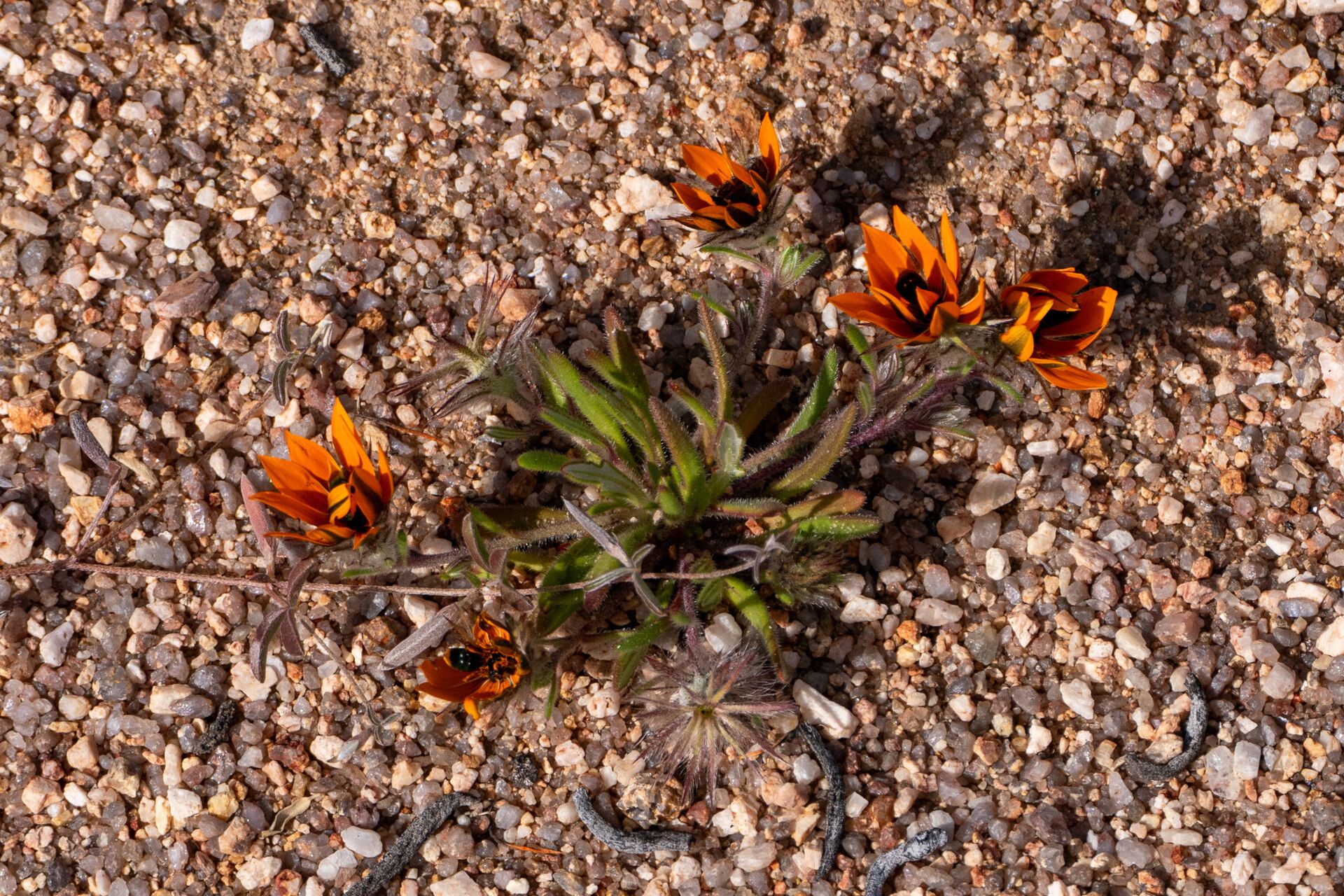
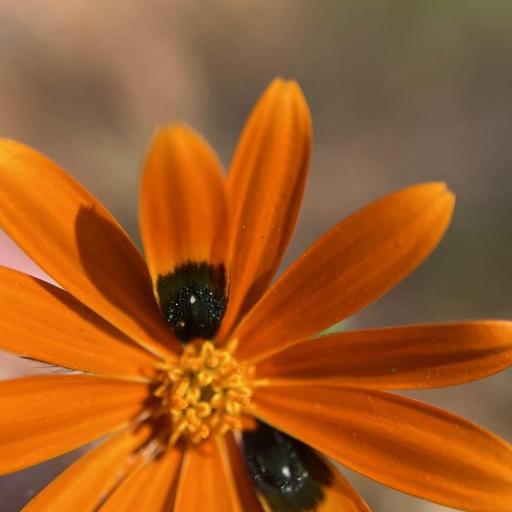
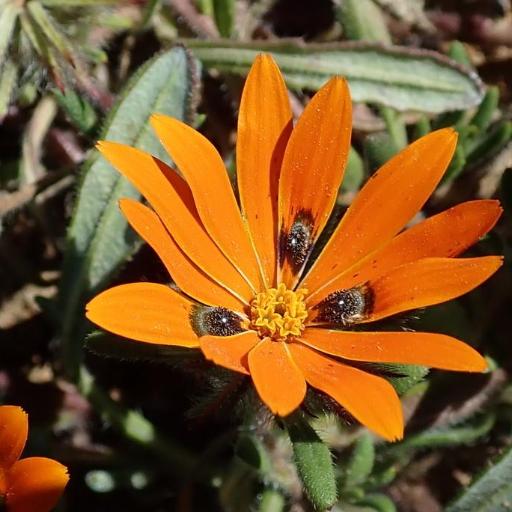
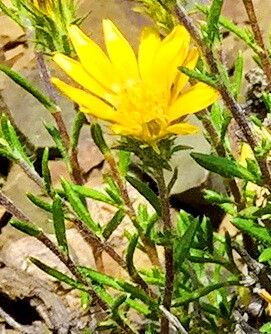
Gorteria diffusa is a highly variable, small annual herbaceous plant or rarely a shrublet that is assigned to the daisy family (Compositae or Asteraceae). Like in almost all Asteraceae, the individual flowers are 5-merous, small and clustered in typical heads, and are surrounded by an involucre, consisting of in this case several whorls of bracts, which are merged at their base. In G. diffusa, the centre of the head is taken by relatively few male and bisexual yellow to orange disc florets, and is surrounded by one complete whorl of 5–14 infertile cream to dark orange ray florets, sometimes with a few ray florets nearer to the centre. None, some or all of them may have darker spots at their base. The fruits remain attached to their common base when ripe, and it is the entire head that breaks free from the plant. One or few seeds germinate inside the flower head which can be found at the foot of plants during their first year. The species flowers between August and October. It is called beetle daisy in English and katoog (cat eye) in Afrikaans. It can be found in Namibia and South Africa.
Tyre daisy has strong disease resistance and is generally not prone to illnesses. Still, it can be affected by pests and diseases present in its environment, though such infections are typically mild. Regarding care, this plant needs a moderate level of maintenance. Regular pruning is required to keep a neat appearance and support healthy growth. Applying fertilizer can also encourage flowering. Tyre daisy is well-suited for anyone with an outdoor area, such as a garden or patio, and does not demand extensive care experience. It may need extra attention when grown indoors.
How to keep Gorteria Diffusa.
Temperature
Tyre daisy comes from tropical areas, where the weather is generally warm and humid. As a result, it is suited to high temperatures and moisture. It does not tolerate abrupt temperature changes and prefers a stable thermal environment, so avoiding temperature fluctuations indoors is important. It usually cannot endure cold and needs higher temperatures to grow. If the surrounding temperature becomes too low, the plant may stop growing or even die.
Fertilizer
When the Tyre daisy has opened most of its blooms to full size, resume fertilizing. While blooms are at their peak, feed it every three to four weeks, as the weather allows. After the Tyre daisy begins producing fewer new blooms, stop fertilizing; there’s no need to feed the plant when it can no longer produce more flowers.
Botanical profile.
- Plant Type
- Herb
- Life Cycle
- Annual
- Genus
- Gorteria
- Family
- Asteraceae
- Hardiness Zone
- 9-11
- Mature Height
- 10 cm to 30 cm
- Mature Spread
- 15 cm to 25 cm
- Leaf Color
- Green, Dark Green
- Leaf Type
- Deciduous
- Flower Color
- Yellow, Orange
- Flower Size
- 3.05 cm to 5.08 cm
- Bloom Time
- Spring
- Planting Time
- Spring, Summer
- Harvest Time
- Late spring, Early summer, Mid summer
Other names.