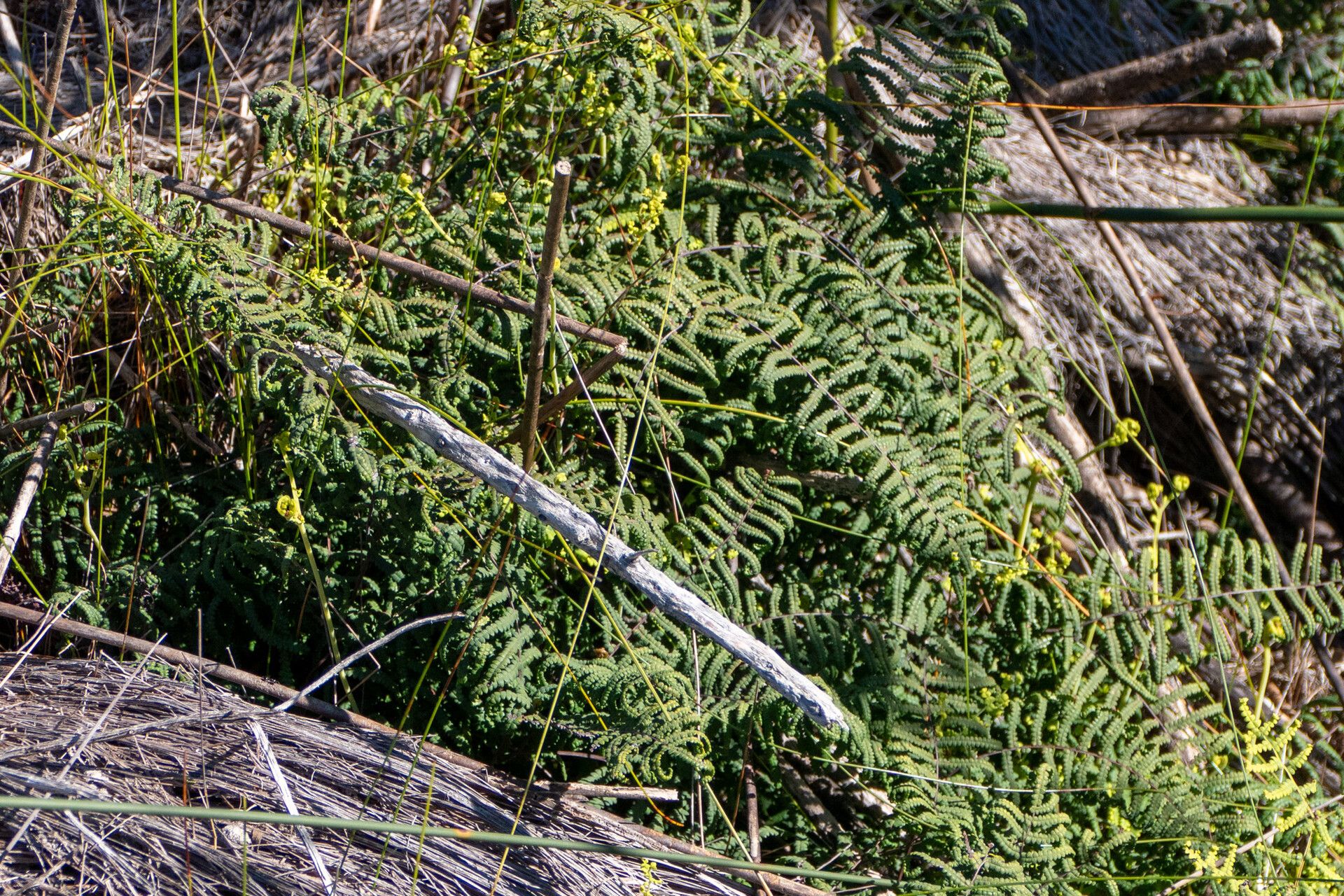
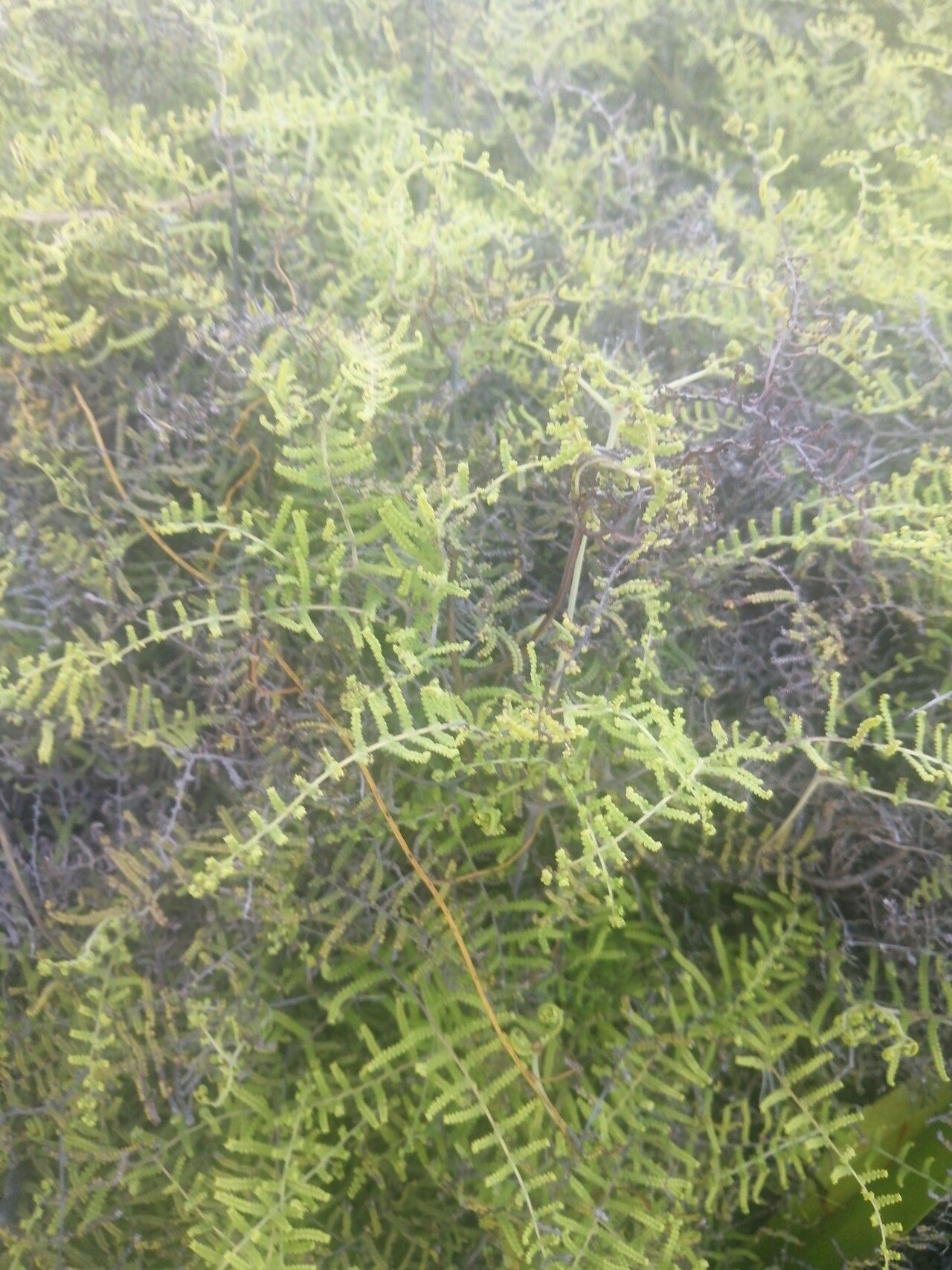
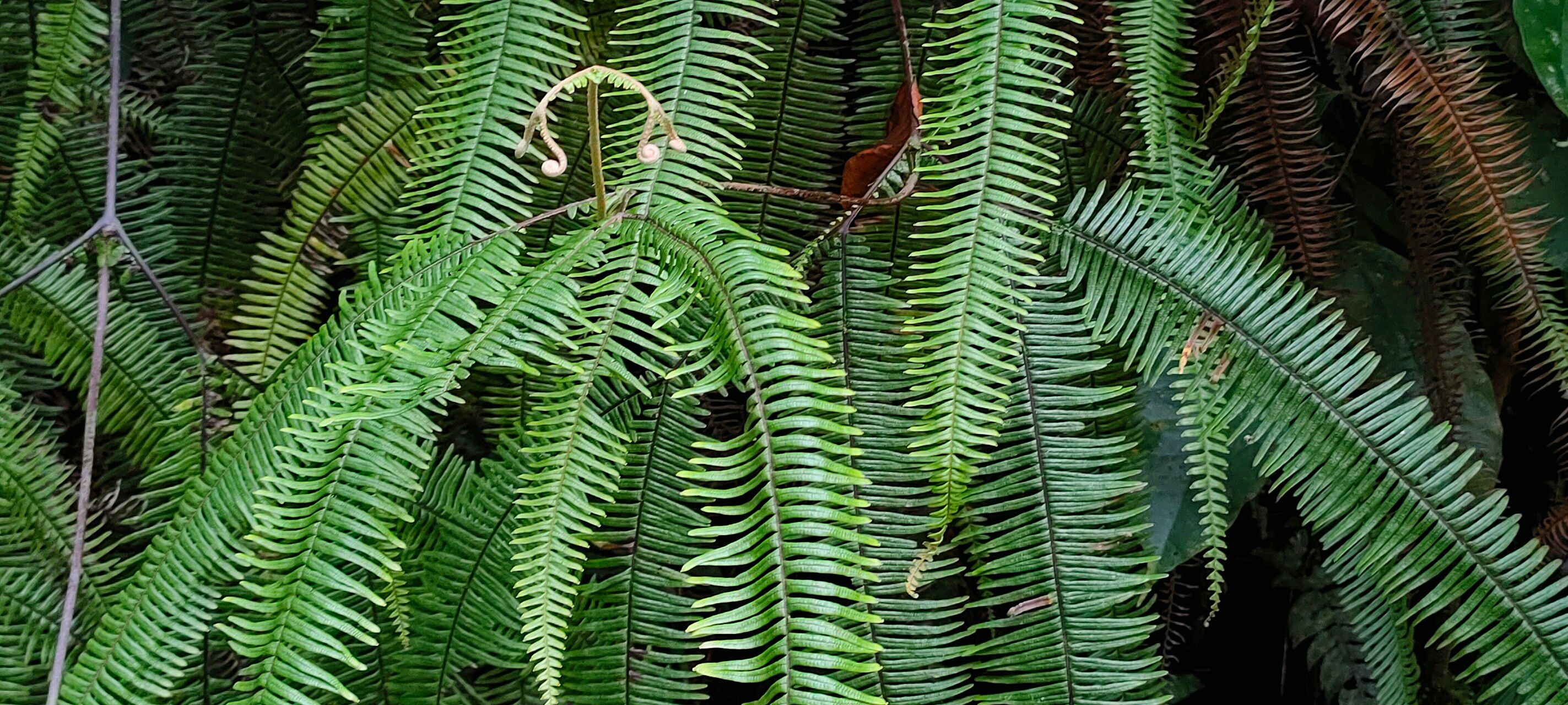
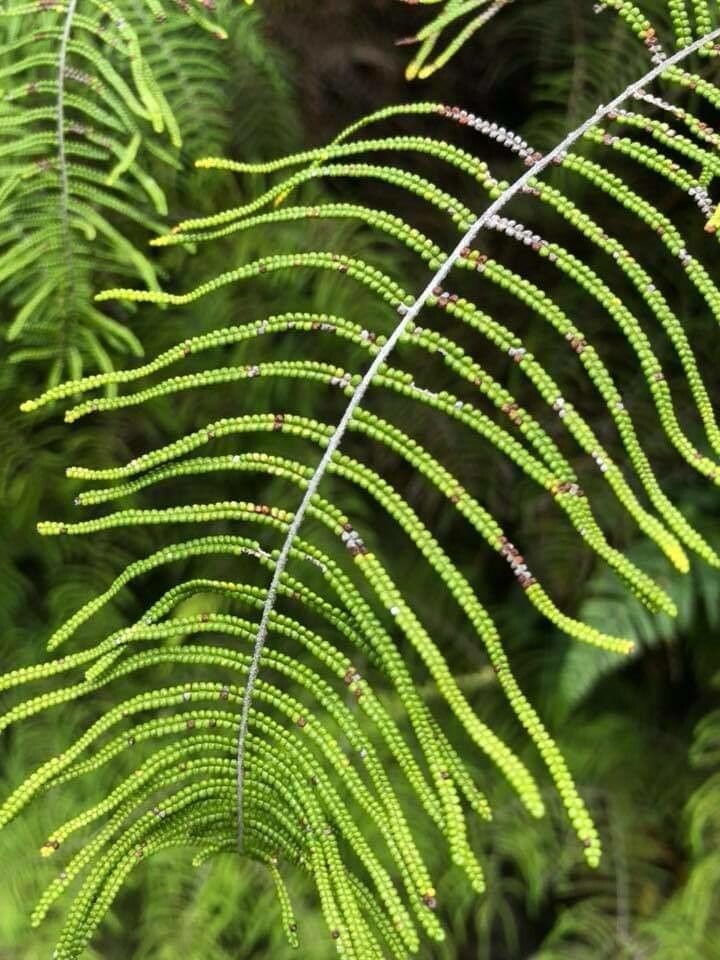
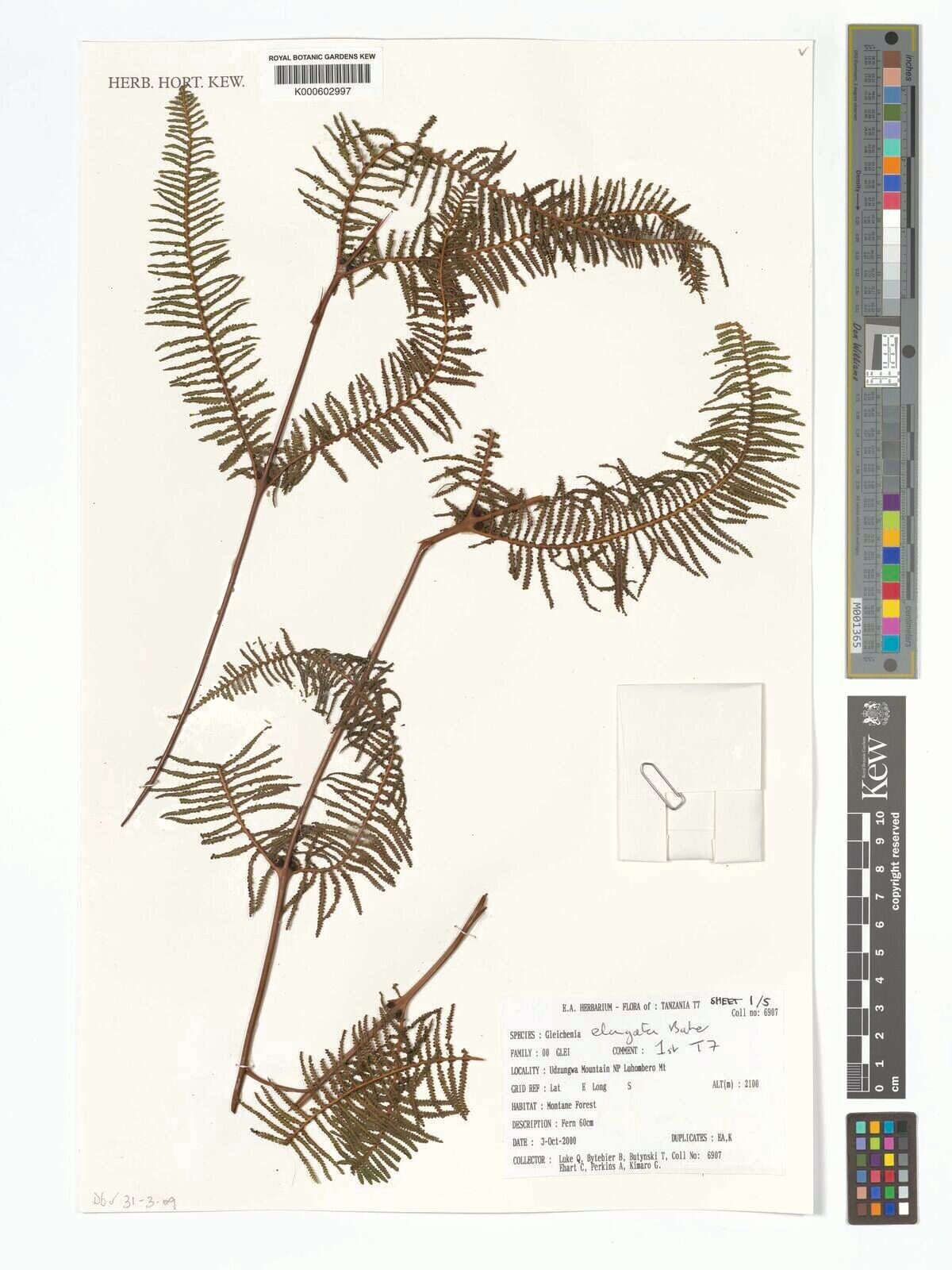
Gleichenia polypodioides (L.) Sm., commonly known as coral fern, kystervaring or ystervaring due to its glabrous, brown, wiry stipes. The species is widespread in south- and east tropical Africa, southern Africa and the western Indian Ocean region. It occurs naturally in a broad coastal belt in South Africa, Lesotho, Eswatini, Angola, Malawi, Burundi, Tanzania, Mozambique, Zimbabwe, Mauritius, Réunion, Amsterdam Island and Madagascar, and was first described by Carl Linnaeus in 1771 under the name Onoclea polypodioides. Often forming dense and impenetrable thickets, sometimes over large areas, this rhizomatous perennial is an important pioneer in disturbed areas such as pine plantations. It is often mistakenly seen as an exotic invader rather than as a useful rehabilitation plant, a source of peat and growing medium, while showing exceptional resistance to herbicides.Rhizome brown, 1–2.5 mm. in diam., creeping, with long-spined dark-brown scales up to 0.5 mm. in diam., with fronds spaced 2–20 cm. apart. Stipe castaneous, up to 60 cm. long and up to 1.5 mm. in diam., glabrous or with a few scales similar to those on the rhizome, shallowly sulcate. Frond bifurcate to reniform-lunate in outline, with 1 level of false dichotomy in each lateral branch system arising from each side of the terminal bud; all branches bearing distant foliar segments. Aborted apical buds up to 1.2 mm. long, clothed in dark-brown lanceolate laciniate scales. Pinnules linear, up to 7 x 0.75 cm., pinnate, usually glabrous, divided into sessile rounded entire triangular lobes, 3 x 2 mm., green to glaucous below. Sori partially immersed in the lamina, consisting of 2–4 sporangia, each in a separate but adjoining pit.
Coral fern typically resists disease well and faces relatively few insect pests. Its care is considered difficult, since it needs a consistently moist environment and frequent watering. However, the roots can rot if overwatered or if the surroundings lack good ventilation. Coral fern is better suited to people with some growing experience, as most individuals can keep it alive for a certain period. Nevertheless, Coral fern may struggle to thrive, and its leaves can dry out and become less healthy over time.
How to keep Gleichenia Polypodioides.
Light
Originating from places such as forest understories or rocky regions, which provide natural shade, the Coral fern flourishes. Its optimal sunlight exposure is complete shade, yet it is also capable of enduring partial sun.
Temperature
Coral fern hails from the tropics, which are recognized for their high temperatures and moist climate. This has naturally equipped it to survive in hot and humid conditions. It is not fond of abrupt alterations in temperature and prefers a continuous and consistent thermal environment. It's crucial to prevent indoor temperature swings for this reason. Generally, it struggles to endure chilly temperatures and thrives in warmer climates. If the surrounding temperature falls excessively, the plant might stop growing or even perish.
Botanical profile.
- Plant Type
- Fern
- Life Cycle
- Perennial
- Genus
- Gleichenia
- Family
- Gleicheniaceae
- Hardiness Zone
- 8-11
- Mature Height
- 30 cm to 61 cm
- Mature Spread
- 49 cm to 91 cm
- Leaf Color
- Dark Green, Forest Green
- Leaf Type
- Evergreen
- Planting Time
- Spring, Autumn
- Native Area
- Malawi, Lesotho, Angola, Burundi, Mozambique, South Africa, Eswatini, Madagascar, Tanzania, Zimbabwe
Other names.