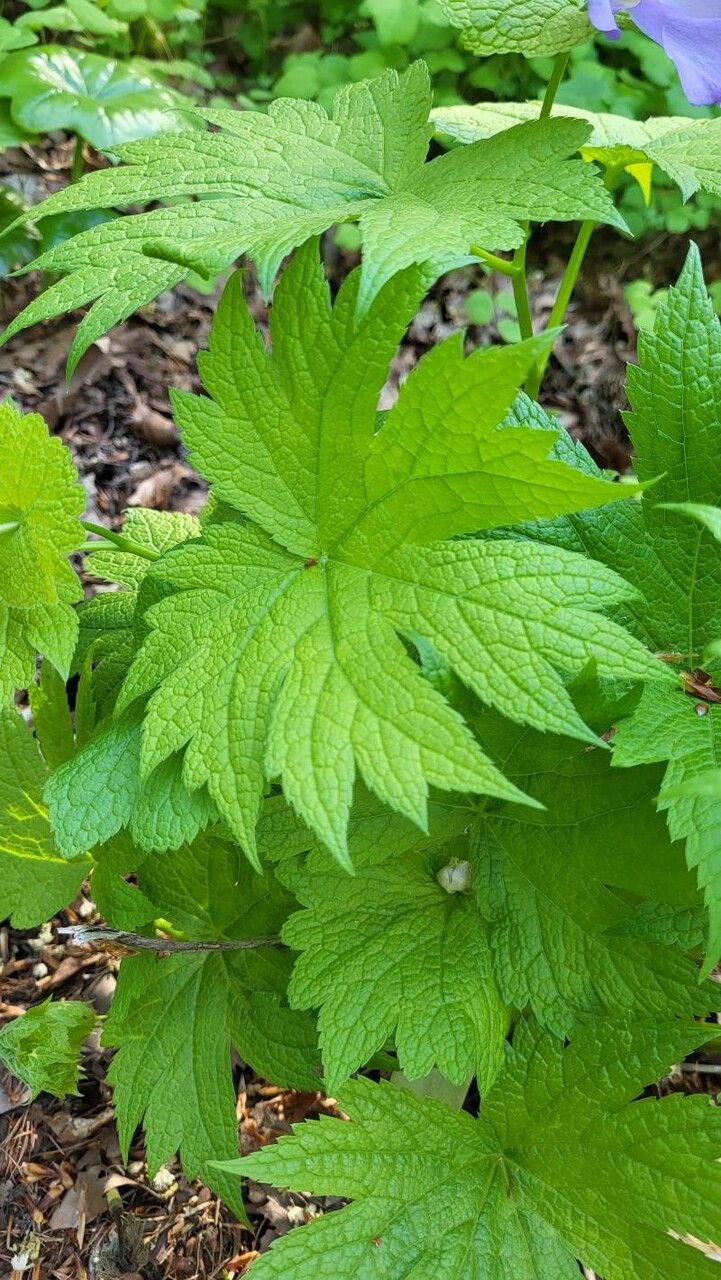
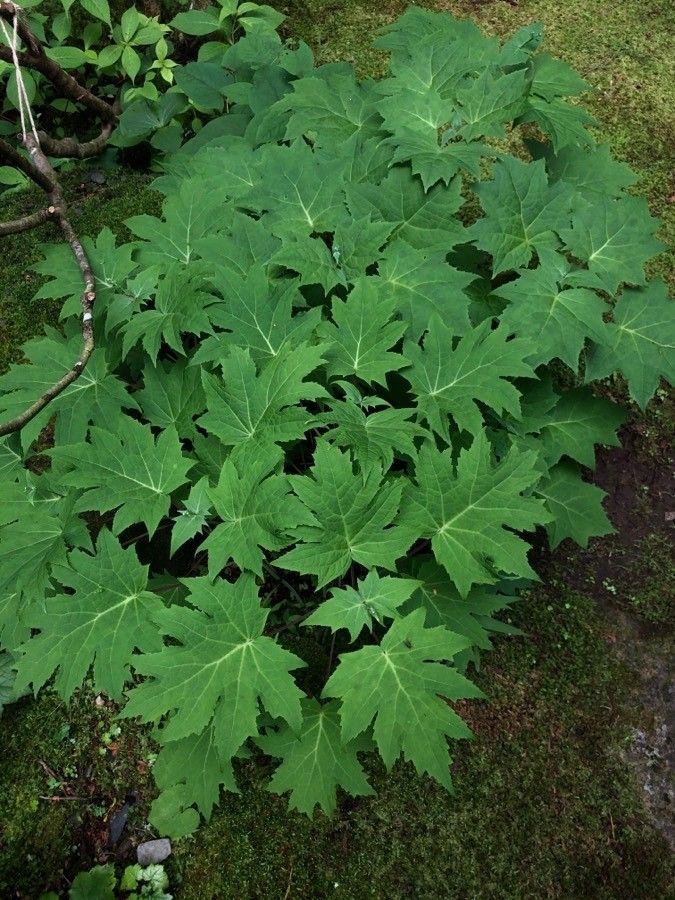
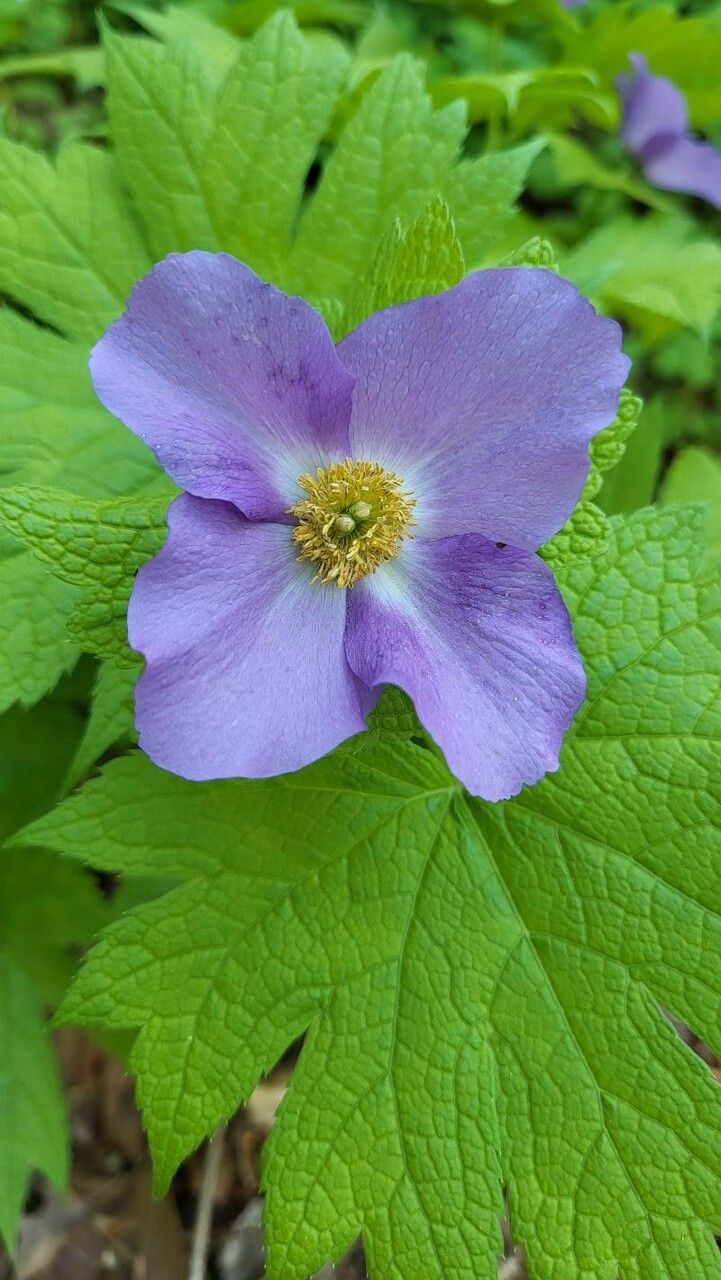
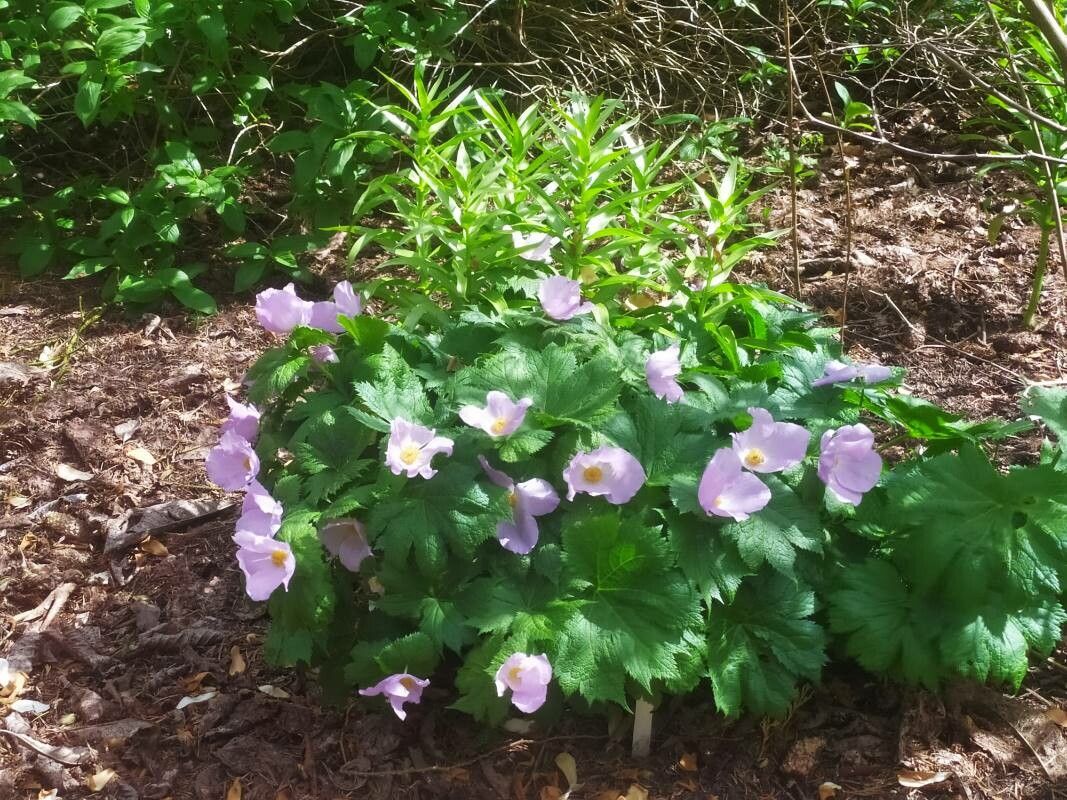
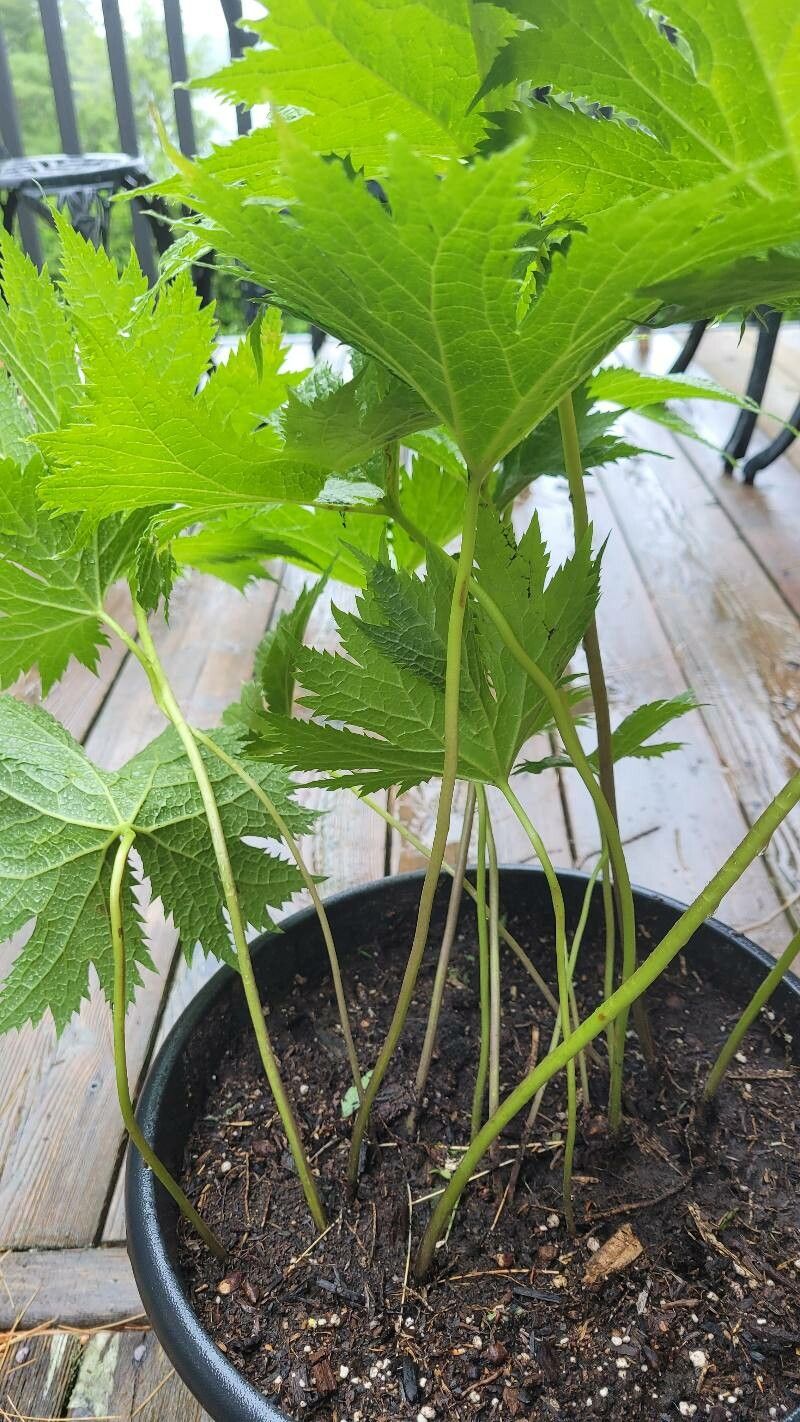
Glaucidium is a genus of plants in family Ranunculaceae, comprising a single species Glaucidium palmatum (Japanese wood poppy; シラネアオイ Shirane-aoi). It is endemic to northern and eastern Japan on Hokkaidō and northeastern Honshū on mountains close to the Sea of Japan.It is a rhizomatous herbaceous perennial plant growing to 40 cm tall with a rigid stem with two large (20 cm diameter) palmately lobed leaves at the top and small membraneous leaves lower on the stem. The flower is produced singly at the top of the stem, 8 cm in diameter, with four pink to pale purple (rarely white) petaloid sepals, numerous stamens and two carpels. The fruit is a cluster of follicles.It is sometimes placed in its own family Glaucidiaceae, or in the past in the family Paeoniaceae. Paeoniaceae, however, has now been shown unequivocally to belong in Saxifragales, while Glaucidium is firmly in the family Ranunculaceae.In cultivation in the UK, Glaucidium palmatum has won the Royal Horticultural Society's Award of Garden Merit. It prefers a cool, moist, sheltered position in partial shade.
Japanese wood poppy has strong resistance to disease and is typically not susceptible to illnesses. Regarding care, this plant is fairly low-maintenance. When grown outdoors it needs only minimal watering, and larger plants usually do not require pruning. Smaller plants, however, should be trimmed after they have finished blooming. The Japanese wood poppy is suitable for anyone with an outdoor area, such as a garden or deck, and does not demand much gardening experience.
How to keep Glaucidium Palmatum.
Light
The Japanese wood poppy is native to habitats like forest understories or rocky areas, where it grows in natural shade. It prefers partial sun but can tolerate full sun or full shade, showing its versatile and hardy nature.
Water
The Japanese wood poppy flourishes in consistently moist soil, similar to its natural habitat in Japan's forest understory. It requires balanced moisture, so it's best to water it every one to two weeks to prevent waterlogging. During its active growing season, adding mulch can help retain moisture effectively.
Temperature
Japanese wood poppy shows strong adaptability to a wide range of climate conditions, whether facing scorching summers or frigid winters. It nonetheless has an optimal temperature range for growth. If temperatures become excessively high, the plant is vulnerable to heat and humidity stress, which can cause it to die. In areas where temperatures approach the lower limit of its cold tolerance, it is important to provide insulation to protect the plant.
Fertilizer
Timing is essential when fertilizing Japanese wood poppy. Apply fertilizer in early spring and repeat monthly until early summer. Fertilizer promotes attractive blooms and supplies energy during both dormant and active growth periods.
Pruning
The Japanese wood poppy is a plant known for its elegant, palm-shaped leaves and bowl-shaped flowers. To promote growth and enhance blooming, it's best to prune it in early spring. This involves removing dead branches, trimming back any leggy stems, and thinning crowded areas. Proper pruning not only improves the health of the foliage but also increases the vibrancy of the flowers, enhancing the overall aesthetics of your garden.
Botanical profile.
- Plant Type
- Tree
- Life Cycle
- Perennial
- Genus
- Glaucidium
- Family
- Ranunculaceae
- Hardiness Zone
- 4-8
- Mature Height
- 49 cm
- Mature Spread
- 49 cm
- Leaf Color
- Green
- Leaf Type
- Deciduous
- Flower Color
- Lavender, Pink
- Flower Size
- 5.08 cm to 7.62 cm
- Bloom Time
- Early spring, Mid spring
- Planting Time
- Spring
- Harvest Time
- Late spring, Early summer
- Native Area
- Japan, China
Other names.