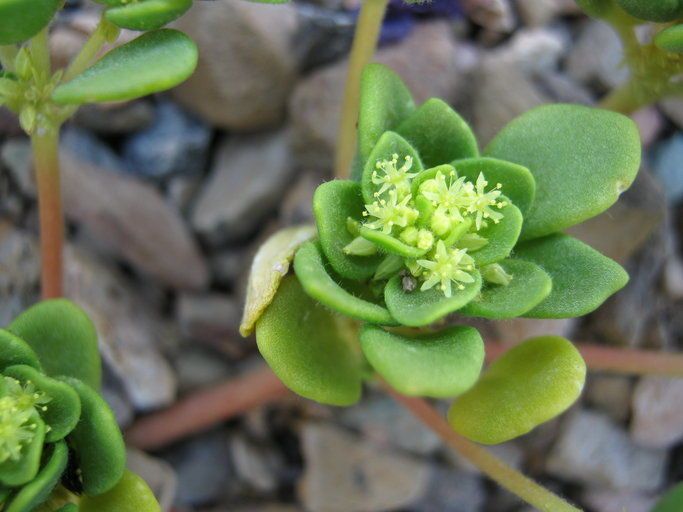
Gilmania luteola (called golden carpet or goldencarpet) is a rare annual plant in the Buckwheat family (Polygonaceae).It is found only on barren alkaline slopes in Death Valley California, especially near Artist's Palette.The plant grows in mats very low to the ground. There are only five known occurrences as of 2013. It grows only in very wet years, which rarely occur in the region. The yellow flowers are quite small, and the plant has greenish-yellowish foliage. It is the only species in the monotypic genus Gilmania.
Goldencarpet is fairly resistant to disease and usually does not suffer from illnesses. That said, it can be vulnerable to pests and diseases present in its environment. These issues are typically minor. As for care, this plant needs a moderate level of maintenance. It should be pruned regularly to keep a neat appearance and support healthy growth. Feeding it with fertilizer can also encourage more flowering. Goldencarpet is well suited for people who have outdoor spaces like a garden or patio and does not demand extensive plant-care experience. Grown indoors, it may need more attention.
How to keep Gilmania Luteola.
Temperature
Goldencarpet comes from tropical areas, where the climate is usually warm and humid. Consequently, it is suited to high temperatures and moisture. It is sensitive to sudden temperature shifts and prefers a steady thermal environment, so indoor temperature swings should be avoided. It generally cannot tolerate cold and needs relatively warm conditions to grow. If the surrounding temperature falls too low, the plant may stop growing or even die.
Fertilizer
Goldencarpet responds well to regular, light applications of fertilizer to encourage healthy leaf growth. You should apply fertilizer about once a month during the summer. Nitrogen is essential for the foliage, and providing nitrogen-rich sources helps Goldencarpet thrive.
Pruning
Goldencarpet is a low-growing perennial known for its vibrant yellow flowers. To maintain the plant's shape, remove dead stems, and encourage more blooms, it is best to prune it from early to late spring. Be sure to use clean pruners to prevent the spread of disease. This will help ensure a compact form and promote the plant's overall health.
Botanical profile.
- Plant Type
- Herb
- Life Cycle
- Annual
- Genus
- Gilmania
- Family
- Polygonaceae
- Leaf Type
- Evergreen
- Bloom Time
- Spring, Winter