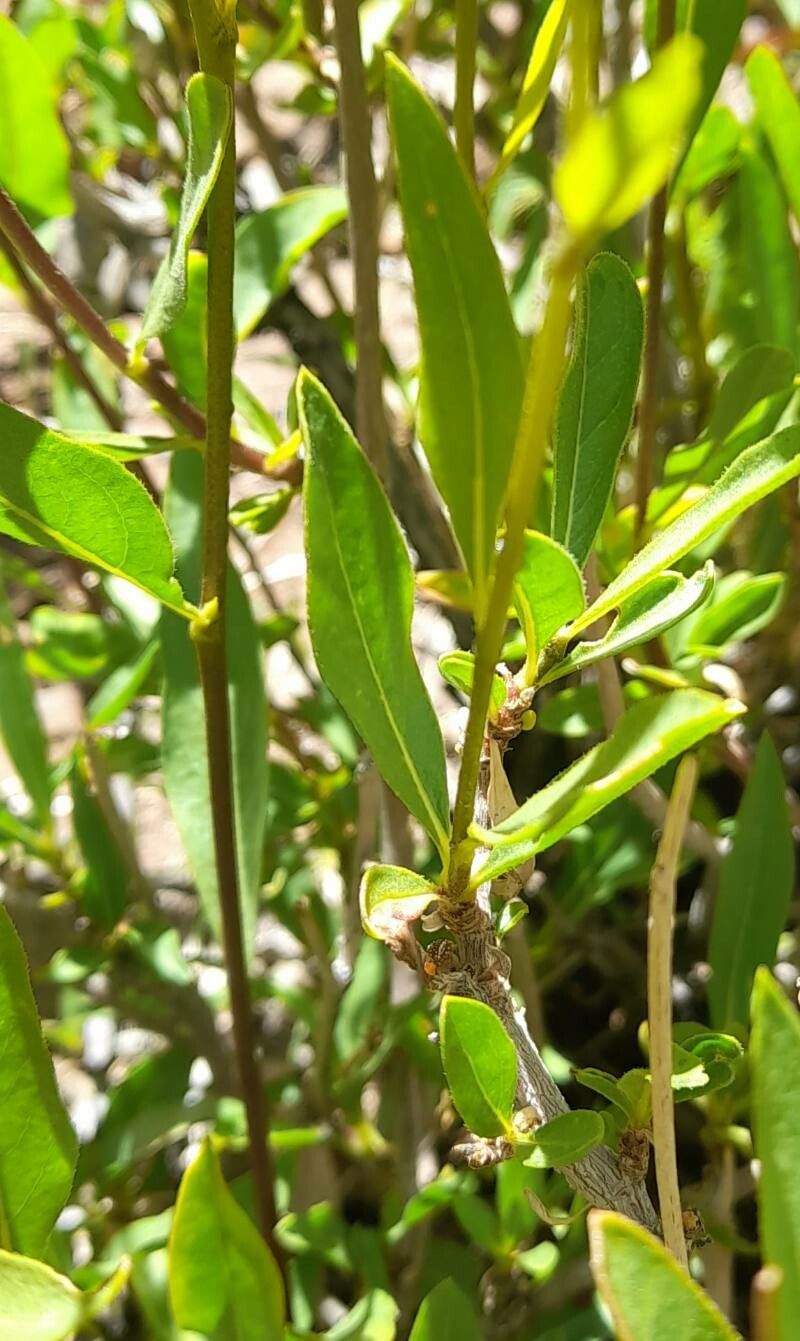
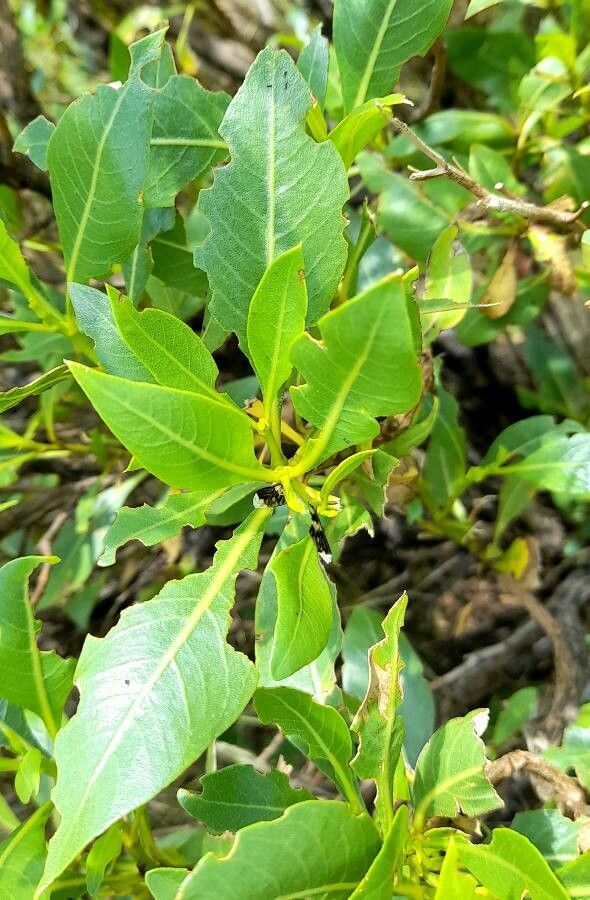
Flourensia cernua, commonly known as tarbush or whitebrush, is a shrub or small tree belonging to the Asteraceae family. Native to the southwestern United States and northern Mexico, it thrives in arid regions such as deserts, grasslands, and scrublands. The plant is easily recognizable by its gray-green leaves, which are covered in fine hairs that give them a fuzzy texture. When crushed, the leaves release a distinctive aroma due to the presence of resinous glands. Flourensia cernua produces small yellow flowers that bloom from late summer through fall. Indigenous people have used tarbush for centuries for its anti-inflammatory properties. Additionally, it serves as an ornamental plant in xeriscaping, appreciated for its drought tolerance and low maintenance requirements. The tarbush plays a vital role in the ecosystem, providing food and shelter for various wildlife, including birds, insects, rabbits, deer, and sheep. Overall, Flourensia cernua is a fascinating plant with unique characteristics that make it valuable both ecologically and medicinally. Its aesthetic appeal also makes it a popular choice for landscaping purposes.
American tarwort is resistant to disease and is usually not susceptible to illnesses. Regarding care, this plant is fairly low-maintenance. When grown outdoors it needs only light watering, and larger specimens typically do not require pruning. Smaller plants, however, should be trimmed after they finish blooming. American tarwortt is appropriate for anyone with an outdoor area, such as a garden or deck, and does not call for extensive gardening experience.
How to keep Flourensia Cernua.
Light
American tarwort is native to open habitats like sunny meadows and forest margins that provide plenty of light. It does best in Full Sun but can also tolerate Partial Sun, showing good adaptability to different sunlight conditions.
Water
American tarwort is well-suited for arid environments, thanks to its excellent drought tolerance. It requires watering only once every 2-3 weeks. This plant thrives outdoors in dry soil conditions, making it an ideal choice for xeriscaping. Its adaptability to less fertile soils further enhances its appeal for such landscapes.
Temperature
American tarwort comes from tropical areas, where the climate is generally warm and humid. As a result, it is adapted to high heat and humidity. It is sensitive to sudden temperature shifts and prefers a steady thermal environment, so indoor temperature fluctuations should be avoided. It generally does not tolerate cold and needs warmer conditions to grow. If the surrounding temperature falls too low, the plant may stop growing or even die.
Fertilizer
Fertilizing is essential for the care of American tarwort. Regular feeding during the active growing season supplies the energy needed for its showy foliage and supports overall growth. If fertilization is neglected, leaves can become unhealthy, the plant's decorative value may decline, and growth can be stunted or weak and prone to breaking.
Pruning
To promote the health and visual appeal of American tarwort, it is beneficial to prune it in early spring. Removing up to one-third of its growth encourages the development of strong new stems and vibrant blooms. This practice not only improves air circulation and reduces the risk of disease, but also helps shape the plant.
Botanical profile.
- Plant Type
- Shrub
- Life Cycle
- Perennial
- Genus
- Flourensia
- Family
- Asteraceae
- Hardiness Zone
- 8-11
- Mature Height
- 2.13 m
- Mature Spread
- 0.91 m to 1.52 m
- Leaf Color
- Dark Green
- Leaf Type
- Semi-evergreen
- Flower Color
- Yellow
- Flower Size
- 1.02 cm to 2.03 cm
- Bloom Time
- Late summer, Early fall, Mid fall
- Planting Time
- Spring
- Harvest Time
- Mid fall, Late fall, Early winter
- Native Area
- Mexico
Other names.
Reader questions.
What are the sunlight requirements for American tarwort?
American tarwort, also known by its botanical name Flourensia cernua, thrives best in environments that mirror its native habitats—open and sunny areas such as meadows and forest edges. It requires full sun, which is above 6 hours of sunlight daily, but can also adapt to partial sun, receiving about 3-6 hours of sunlight. It's important to observe the way sunlight moves through your garden, selecting locations that ensure a good balance of light and shade to meet the needs of your plants.
Can American tarwort thrive with artificial lighting?
Yes, American tarwort can thrive with artificial lighting, particularly when natural sunlight is insufficient, like during winter or in spaces that do not get enough sunlight. Adequate lighting is crucial for optimal growth. LED lights are recommended as they can be tailored to provide specific wavelengths needed by plants. The intensity of artificial light needed depends on the plant's sunlight requirements: full sun plants need 30-50W/sq ft, partial sun plants need 20-30W/sq ft, and full shade plants require 10-20W/sq ft. The artificial light source should be placed 12-36 inches above the plant to mimic natural sunlight conditions, ensuring the plant receives 8-12 hours of light per day.
What are the signs of light deficiency in American tarwort?
American tarwort shows various signs when it is not receiving sufficient light. New leaves may grow smaller, and there might be leggy growth, characterized by longer spaces between leaves or stems, giving the plant a stretched appearance. There can also be accelerated leaf drop as the plant tries to conserve resources, along with slower growth or a complete halt in new leaf production. Leaves may appear paler or show irregular color patterns due to insufficient sunlight, while chlorosis, or the loss of leaf green color, indicates an inability to photosynthesize effectively due to excessive sunlight. Additionally, symptoms like sunscald, leaf curling, wilting, and leaf scorching may occur when the plant is under intense sunlight exposure.
How can I address light deficiency or excessive sunlight exposure in American tarwort?
To address light deficiency in American tarwort, gradually move your plants to locations with more sunlight. For indoor plants, you can increase sunlight exposure by placing them near a south-facing window or using artificial lighting, like desk lamps or professional grow lights, for at least 8 hours daily. For outdoor plants, it's crucial to transition them slowly to sunnier spots to avoid sunburn. If obstructions like trees are blocking sunlight, consider pruning them. Transplanting smaller plants during their dormant period, typically late winter or early spring, to sunnier locations with good drainage can also be beneficial. Note that parts of the plant already affected by insufficient light may not recover, but new growth will be healthy once the light exposure is improved.