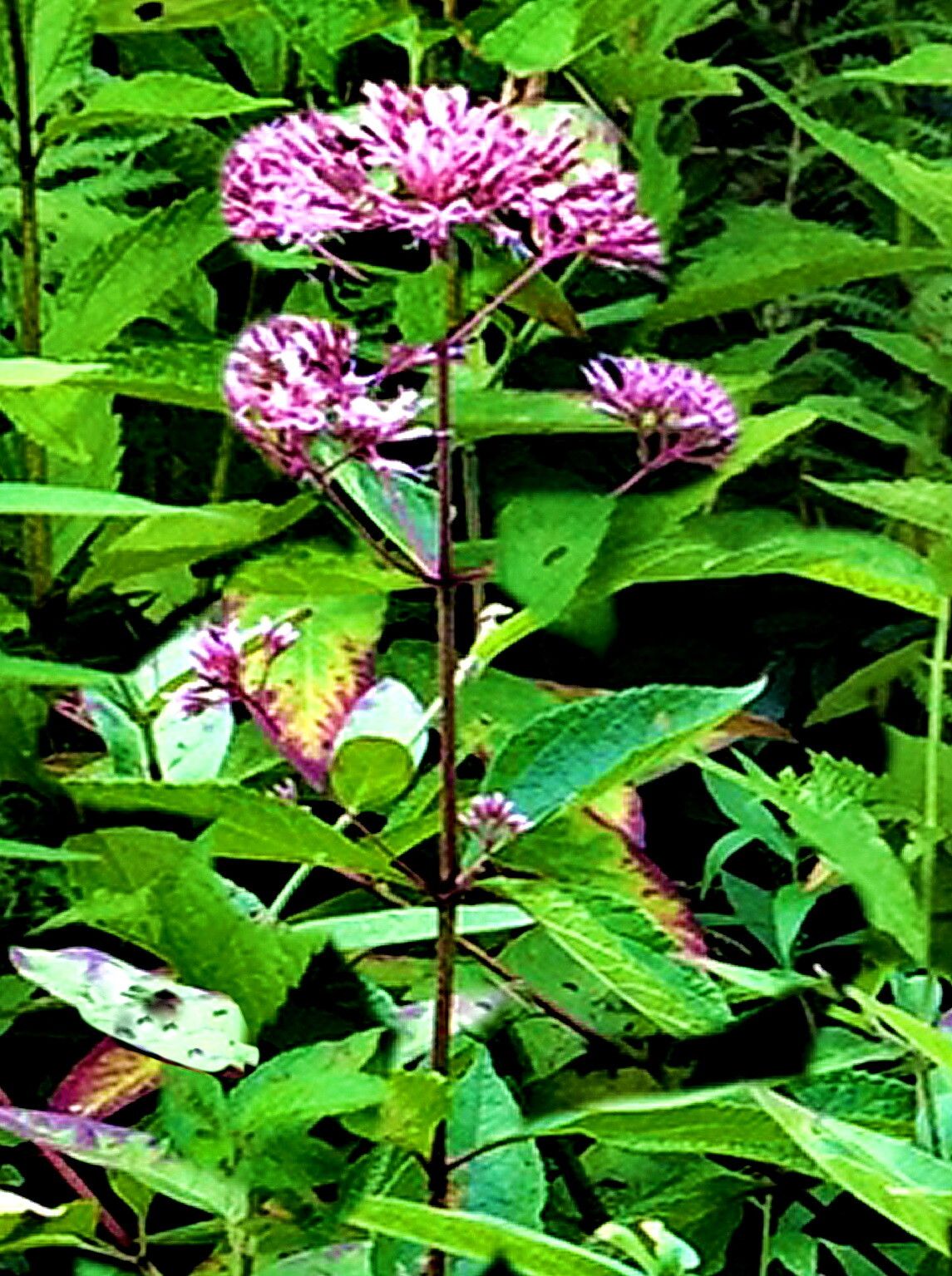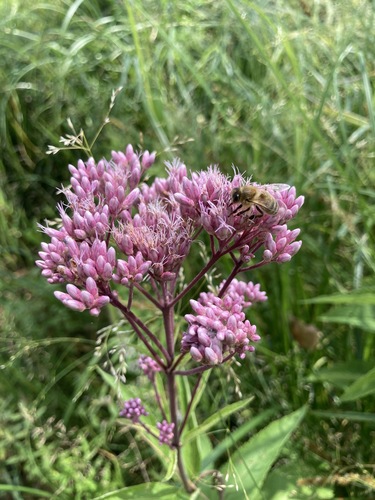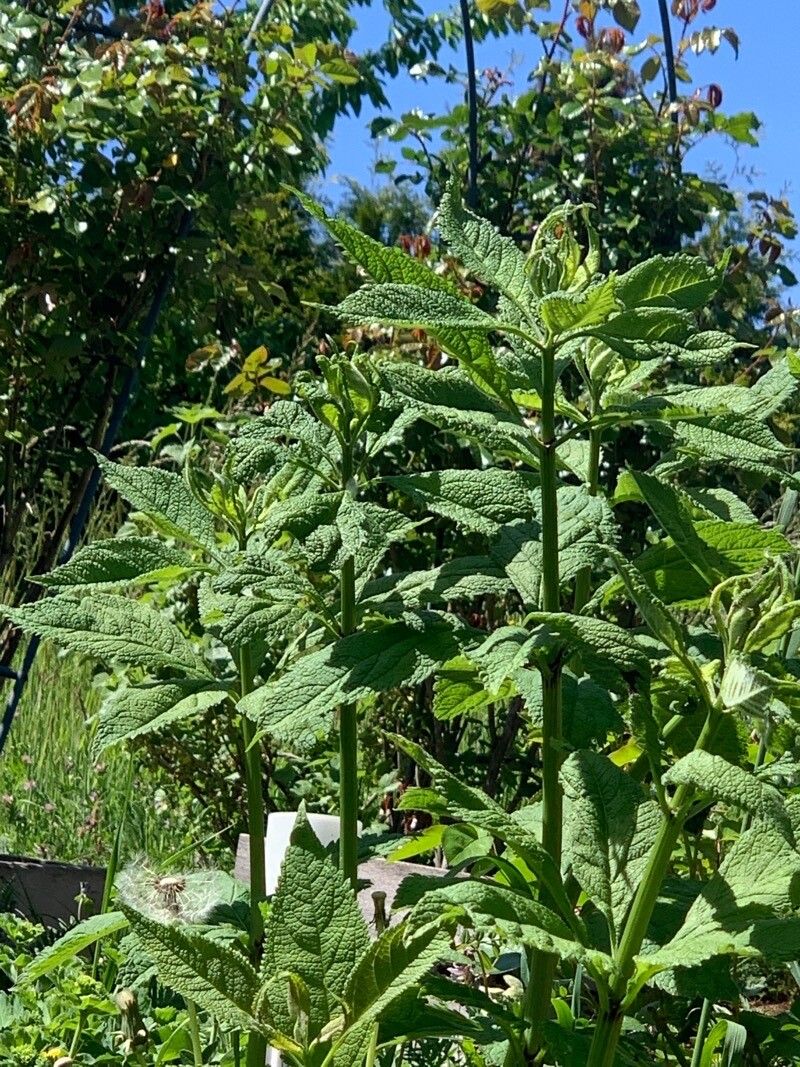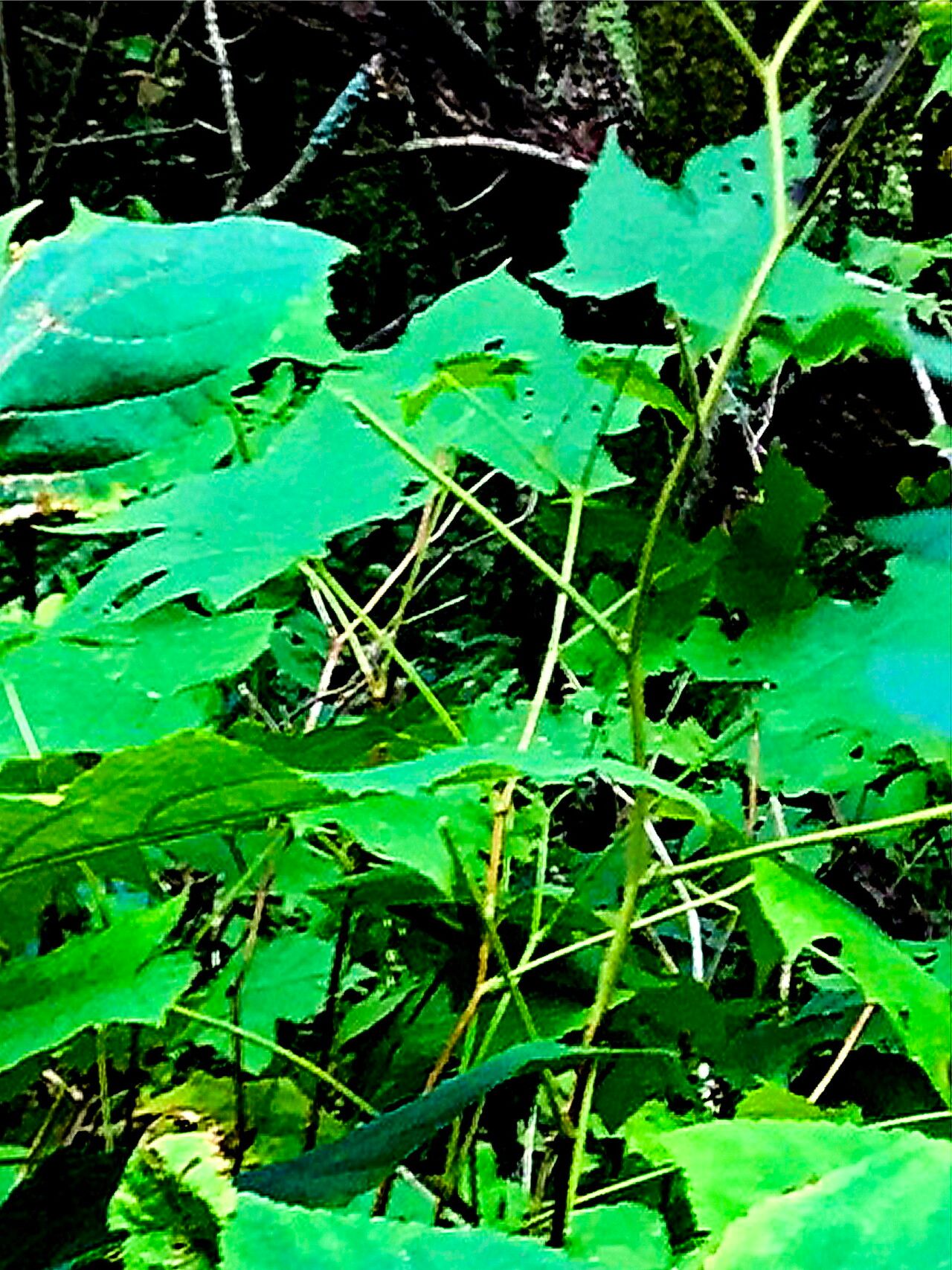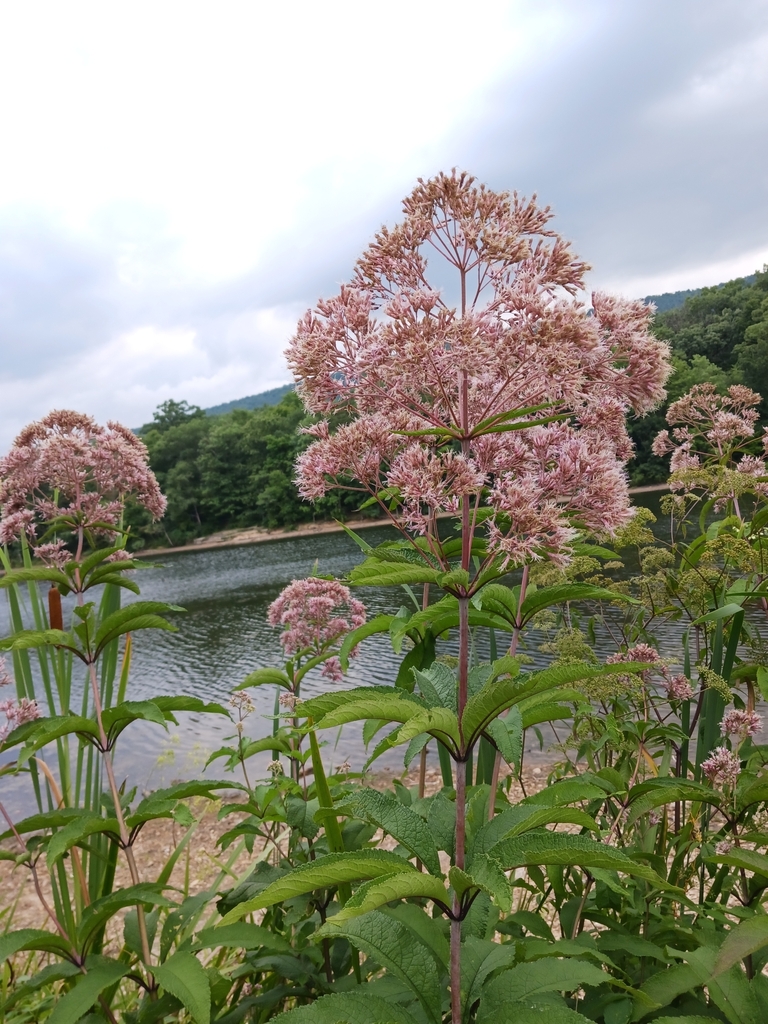
Eutrochium fistulosum (Eupatorium fistulosum), also called hollow Joe-Pye weed, trumpetweed, or purple thoroughwort, is a perennial North American flowering plant in the family Asteraceae. It is native to southern Canada and throughout the eastern and south central United States from Maine west to Ontario, Wisconsin, and Missouri and south as far as Florida and Texas. The specific name fistulosum refers to the tubular stem; see fistula. Eutrochium fistulosum is a herbaceous perennial plant sometimes as much as 350 cm (140 in; 11 ft 6 in) tall. It is found in moist, rich soil alongside ditches and marshes, or in wet forests. It flowers from mid-summer to the first frosts, makes an attractive backdrop in garden plots, and is very attractive to butterflies, bees, and other nectar-feeding insects. In addition, it is a larval host to the Clymene moth, eupatorium borer moth, ruby tiger moth, and the three-lined flower moth.The plant has one simple erect stem, which is green with purple dots or longitudinal dashes and can grow over six feet tall. The upper stems are reddish or purplish. Leaves and primary subdivisions of the flower head appear in whorls of 3–5 (rarely 2 or 6, the rotational symmetry of most plants is consistent). Leaves are large, long and sharply toothed. One plant can produce several flower heads in a branching array, each head with 4-7 pink or purple disc flowers but no ray flowers.
Hollow Joe-Pye Weed: Legend has it that an Indian herbalist named Joe Pye once used mixtures made from a wild plant found in nearby woods to treat typhoid fever. As a result, this local plant became known as Joe-Pye weed. Since its stems are hollow, it is specifically referred to as Hollow Joe-Pye Weed.
Hollow Joe-pye weed has good disease resistance and is generally not prone to diseases. However, it can be affected by pests and diseases present in its surroundings, and these infections are usually not severe. In terms of care, this plant requires moderate maintenance. It needs regular pruning to maintain a neat appearance and promote healthy growth. Fertilizing can also help encourage flowering. Hollow Joe-pye weed is suitable for anyone with an outdoor space, such as a garden or patio, and does not demand extensive gardening experience. It may require more attention when grown indoors.
How to keep Eutrochium Fistulosum.
Light
Joe-pye weed thrives in ample light, demonstrating strong growth in full sun while also showing a level of resilience in moderately lit spots. Light oversaturation, however, can affect its growth, whereas insufficient light leads to hindered development. Native to areas with unhindered sun exposure, the demonstrated light preferences of the plant reflect the conditions of its original habitat.
Water
Hollow Joe-Pye weed thrives in consistently moist soil and is well-suited to environments with plenty of water. While it can tolerate short periods of dryness, regular weekly watering is beneficial to prevent waterlogging. Native to wet meadows, this plant is resilient and adaptable to different watering patterns.
Temperature
The hollow Joe-pye weed favors a temperature range of 41 to 95 ℉ (5 to 35 ℃). It naturally thrives in moderately tempered climates. It is advisable to sufficiently water it during hot summers to compensate for the increased heat.
Fertilizer
Typically, a one-time application of fertilizer in spring is adequate for Hollow Joe-pye weed, however, repeated feedings can optimize its growth. You should feed it once every one to one and a half months. The process of fertilization improves the look and functionality of the leaves, promoting balanced color and healthy texture. Additionally, it encourages root development and nutrient uptake, contributing to the plant's overall long-term health.
Pruning
Hollow Joe-Pye weed benefits from strategic pruning, ideally done in early to late spring, to encourage growth. To promote more blooms, deadhead the flowers regularly. In late fall or winter, cut back the stems to maintain the plant’s health and shape. Regular maintenance not only improves the plant’s appearance but also controls its height, enhances airflow, and reduces the risk of diseases.
Pot & Repot
When you are transplanting Hollow Joe-pye weed, select a container that is 1-2 inches (2.5-5 cm) bigger, making sure it has sufficient drainage. The potting mix used should be well-draining. Carry out the repotting in either spring or fall, making certain that the root ball is somewhat beneath the rim of the pot for flowers. After completing the repotting, water abundantly and position it in a cosy area out of direct sunlight.
Botanical profile.
- Plant Type
- Herb
- Life Cycle
- Perennial
- Genus
- Eutrochium
- Family
- Asteraceae
- Hardiness Zone
- 4-10
- Mature Height
- 1.22 m to 2.44 m
- Mature Spread
- 0.61 m to 1.22 m
- Leaf Color
- Green
- Leaf Type
- Deciduous
- Flower Color
- Pink, Purple
- Flower Size
- 2.54 cm
- Bloom Time
- Mid summer
- Planting Time
- Autumn, Spring
- Harvest Time
- Mid summer, Late summer
Other names.
Reader questions.
How should I water my Hollow joe-pye weed?
To properly water the Hollow joe-pye weed, it is recommended to use filtered water at room temperature. This plant prefers filtered water over tap water because tap water can contain harmful particles. It is important to use water that is at room temperature or slightly warmer because the Hollow joe-pye weed originates from a warm environment and cold water can be a shock to its system. Additionally, it is advisable to avoid overhead watering as it can lead to issues with the foliage. Instead, it is best to apply the filtered room temperature water directly to the soil until it is thoroughly soaked. This method of watering is highly beneficial as it moisturizes the roots and helps them spread and access the necessary nutrients in the soil.
Why should I put fertilizer on my Hollow joe-pye weed?
The primary structure of the Hollow joe-pye weed is made up of its leaves. Fertilization plays a crucial role in ensuring that these leaves not only look great but also function properly. When the Hollow joe-pye weed is fertilized correctly, it will maintain consistent leaf color and a healthy texture. Fertilization also has benefits beneath the surface of the soil, as it promotes the growth of new roots and preserves existing ones in the plant's root system. This means that by fertilizing your plant, you are not only keeping it healthy in the present but also improving its ability to absorb nutrients from the soil in the future.
What are the sunlight requirements for Hollow Joe-Pye Weed?
Hollow Joe-Pye Weed (Eutrochium fistulosum) thrives in full sun conditions, requiring more than 6 hours of sunlight daily. It also shows some tolerance to partial sun, which means about 3-6 hours of sunlight. However, it's essential to monitor the plant's exposure to light, as both overexposure and insufficient exposure can affect its growth negatively. The plant's native habitat is characterized by unobstructed solar exposure, which should be mirrored in its growing conditions.
What are the preferred temperatures for hollow joe-pye weed?
Hollow joe-pye weed, botanically known as Eutrochium fistulosum, thrives in temperatures ranging from 41°F to 95°F (5°C to 35°C). It is native to moderate temperature environments. This plant possesses strong cold resistance and usually does not require special frost protection measures during the winter. However, during the hotter summer months, it's essential to ensure the plant receives ample watering to cope with the warmer temperatures. If winter temperatures are anticipated to drop below -30°C, providing cold protection by covering the plant with materials like soil or straw is advisable.
What should I do if I give my Hollow joe-pye weed too much water or too little water?
Overwatering is a common issue that can harm your Hollow joe-pye weed. It causes the stems and leaves to wilt and turn yellow. If overwatering persists, it can lead to diseases like root rot, mold, and mildew, which can be fatal to the plant. Underwatering is less common but still possible. When underwatering occurs, the leaves become brittle and brown. It's important to identify the signs of overwatering early and reduce watering immediately. If the soil drains poorly, replace it with a well-draining potting mix. If you notice signs of underwatering, simply water more regularly until the plant recovers.
When should I fertilize my Hollow joe-pye weed for the best results?
If you grow your Hollow joe-pye weed outdoors every year, it will start to grow new leaves in early spring. This is the signal to start fertilizing it for the year. Usually, one round of fertilizer in the spring is enough. But if you want your Hollow joe-pye weed to grow more, you can fertilize it multiple times during the spring and early summer. In this case, you can feed it once every month to a month and a half.
What are the signs of inappropriate lighting conditions for Hollow Joe-Pye Weed?
Symptoms of inadequate lighting for Hollow Joe-Pye Weed include smaller new leaves, leggy or sparse growth, faster leaf drop, slower or no new growth, and pale or irregularly colored new leaves. Excessive sunlight can cause chlorosis, sunscald, leaf curling, wilting, and leaf scorching. These symptoms indicate that the plant is not receiving the optimal amount of sunlight, which can lead to a decline in health and growth.
How does low temperature affect hollow joe-pye weed and what are the solutions?
Hollow joe-pye weed is cold-tolerant and generally performs well when temperatures remain above 5°C. It should ideally be kept above -25°C during winter. Exposure to temperatures below -30°C might not show immediate adverse effects during the winter, but it could lead to diminished sprouting or even absence of sprouting in the spring. To address this, it is recommended to remove any parts that have failed to sprout in the spring.
How often do I need to water my Hollow joe-pye weed?
If your Hollow joe-pye weed is in a pot, the most precise way to determine if it needs water is to check the soil moisture by sticking your finger into the soil. If the top two to three inches of soil are dry, it is time to water it. The same method can be used if you have planted your Hollow joe-pye weed in the ground outdoors. Again, if the top few inches of soil are dry, it needs watering. Usually, during spring and early fall, watering once a week is sufficient. However, in extremely hot weather, you may need to water it twice or more per week. Nonetheless, mature and well-established Hollow joe-pye weed has a good tolerance for drought.
When is the best time to not use fertilizer on my Hollow joe-pye weed?
During late fall and winter, your Hollow joe-pye weed goes into a dormant phase and stops growing. It's best to avoid fertilizing it during this time. In the spring and summer, if you decide to fertilize, start reducing the amount as summer approaches because the growth rate of your Hollow joe-pye weed will also slow down. It's never a good idea to fertilize your Hollow joe-pye weed during very hot weather or when the soil is extremely dry. Fertilizing in those conditions can stress your Hollow joe-pye weed and cause it to die prematurely.
What solutions can help Hollow Joe-Pye Weed thrive in indoor and outdoor settings?
To ensure Hollow Joe-Pye Weed's optimal growth in indoor settings, gradually increase its exposure to sunlight by moving it closer to a south-facing window or by using artificial lighting, aiming for at least 6 hours of direct sunlight a day. For outdoor plants, gradually transitioning them to sunnier spots can prevent sunburn and promote healthy growth. Additionally, for gardens, reducing obstructions and potentially transplanting smaller plants during their dormant periods can improve sunlight access. Remember, parts of the plant that have suffered from insufficient light may not recover, but new growth should be healthy with increased light exposure.
How does high temperature affect hollow joe-pye weed and what are the solutions?
In the summer months, it is best to ensure that the temperature around the hollow joe-pye weed remains below 35°C. When exposed to temperatures exceeding 41°C, the plant's leaves may become lighter, begin to curl, and become prone to sunburn, which in severe cases may lead to wilting and drying of the entire plant. To mitigate these effects, trim away the sunburned and dried parts of the plant. Relocate the plant to a shaded area, particularly away from the midday and afternoon sun, or use a shade cloth. Additionally, watering the plant in the morning and evening will help keep the soil adequately moist.