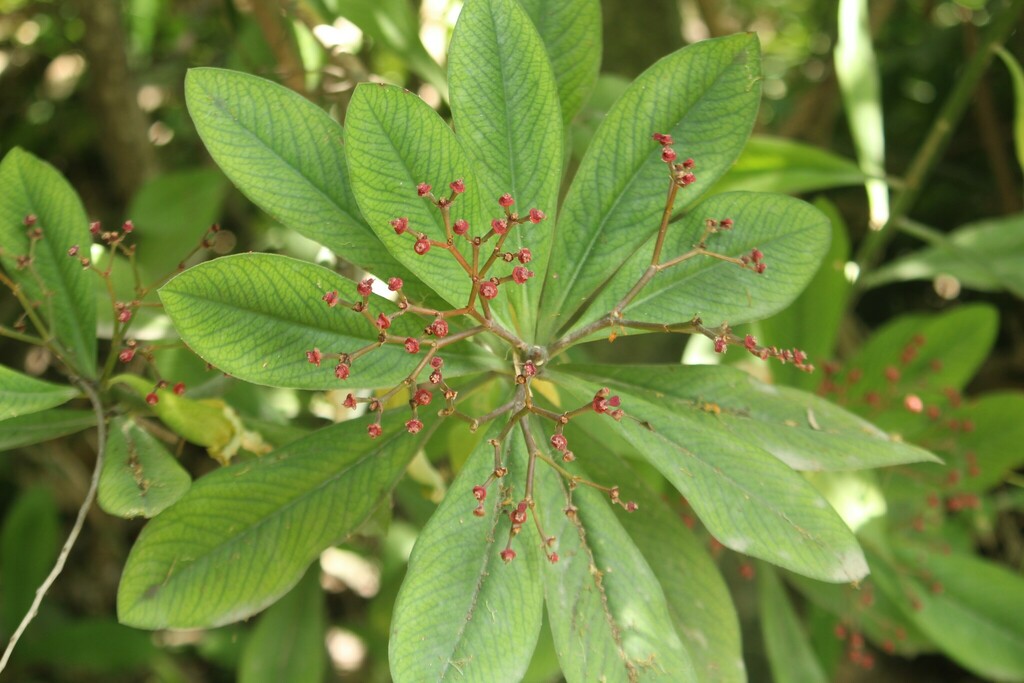
Euphorbia umbellata, commonly known as the umbrella spurge, is a perennial succulent plant belonging to the Euphorbiaceae family. Native to South Africa, this plant can grow up to 60 cm in height. It features a distinctive appearance with its umbrella-like arrangement of leaves and small yellow-green flowers that bloom in clusters at the tops of its stems.
The leaves of Euphorbia umbellata are arranged in whorls around the stem, creating an umbrella-like structure at each node. The narrow, pointed leaves are glossy green, providing a striking contrast against the plant's pale stems.
This plant thrives in well-drained soil and full sun exposure, though it can also tolerate partial shade. While it is drought-tolerant, it benefits from occasional watering during prolonged dry spells.
Euphorbia umbellata has long been used for medicinal purposes by indigenous people, valued for its anti-inflammatory properties. However, it should be handled with caution as it contains toxic latex sap, which can cause skin irritation or even blindness if it comes into contact with the eyes.
Overall, Euphorbia umbellata is an attractive succulent plant that is well-suited for rock gardens or as an accent piece in any garden setting, thanks to its unique appearance and low maintenance requirements.
The African Milk Bush is resistant to disease and is generally not susceptible to illnesses. As for care, this plant is fairly low-maintenance. When grown outdoors it needs only light watering, and larger specimens usually do not require pruning. Smaller plants, however, should be pruned after they finish blooming. The African Milk Bush is suitable for anyone with outdoor space, such as a garden or deck, and does not demand extensive care experience.
How to keep Euphorbia Umbellata.
Light
African Milk Bush does best in full sun, though it can tolerate lower light levels. Native to regions with abundant sunlight, its health and growth are strongly influenced by light exposure. Too much or too little sunlight can adversely affect its growth.
Water
The African Milk Bush, native to arid regions, is highly drought-tolerant and requires minimal watering, making it well-suited to dry conditions. It should be watered only once every 2-3 weeks, allowing the soil to dry out thoroughly between waterings. As a succulent, the African Milk Bush is often grown indoors to prevent exposure to excessive moisture. During extended dry periods, its metabolism slows down.
Temperature
African Milk Bush is a hardy plant, suited to grow in climate zones with temperatures between 59 and 100 °F (15 to 38 ℃). It is native to warm temperate areas and tolerates slight temperature fluctuations. In winter, provide warmer conditions if temperatures fall drastically.
Fertilizer
Timing is essential when fertilizing the African Milk Bush. Apply fertilizer in early spring and continue doing so monthly until early summer. Fertilizer encourages attractive blooms and supplies energy both during dormancy and in active growth periods.
Pruning
To keep your African Milk Bush healthy and attractive, it's important to prune it regularly, ideally from early to late winter. Start by removing any dead or damaged sections, and always wear gloves to protect yourself from the plant's irritating sap. Regular pruning helps maintain the plant's shape, encourages bushier growth, and improves airflow. These practices not only enhance the plant's overall health and appearance but also help reduce the risk of disease.
Toxicity
It has long been known that the plant is very poisonous and irritating. If latex comes into contact with the skin or mucous membranes, a burning sensation, rashes, and blisters will occur. Symptoms may not manifest immediately and may emerge hours later. Ingestion of the latex may be lethal, and it is also employed as a fish poison. Latex is a component of arrow poison in Rwanda. In Kenya and Tanzania, cannabis is sometimes used for illegal reasons.
Further reading →
The toxicity and danger assessments provided are for reference only. We do not assure their accuracy, so it's crucial not to depend on them. Seek professional advice when necessary for accurate guidance.
Botanical profile.
- Plant Type
- Tree, Shrub
- Life Cycle
- Perennial
- Genus
- Euphorbia
- Family
- Euphorbiaceae
- Hardiness Zone
- 8-11
- Mature Height
- 3.35 m
- Mature Spread
- 3.35 m
- Leaf Color
- Green
- Leaf Type
- Evergreen
- Flower Color
- White
- Flower Size
- 0.76 cm
- Bloom Time
- Late spring, Early summer, Mid summer
- Planting Time
- Spring, Autumn
- Harvest Time
- Summer
- Native Area
- Burundi, Mozambique, Zambia, Sudan, Rwanda, Kenya, Congo (DRC), Uganda, Tanzania