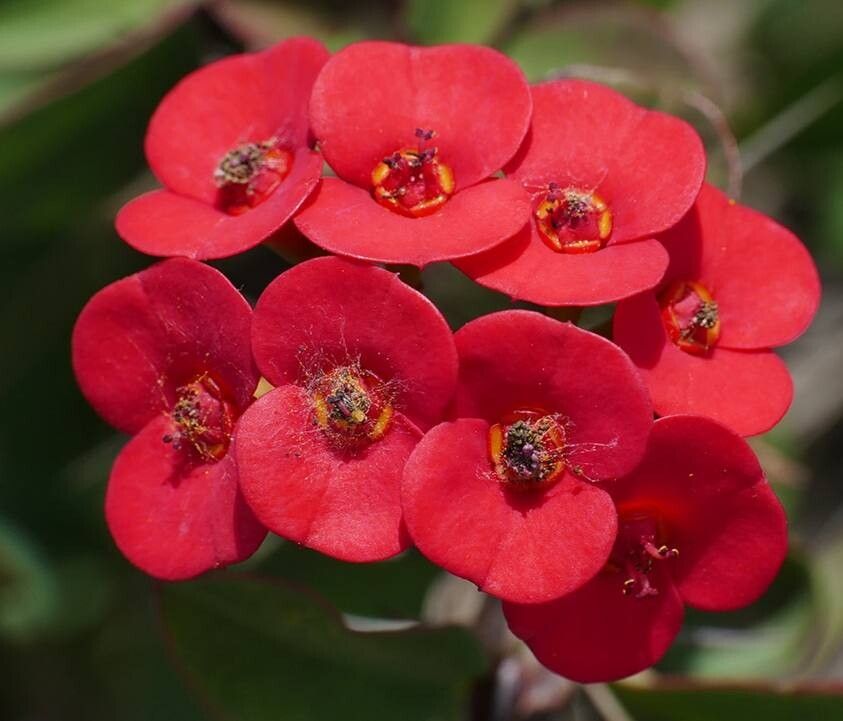
Euphorbia milii var. splendens is a variety of the species Euphorbia milii. Like the other varieties of E. milii E. m. var. splendens produces a milky latex that is an irritant poison. Under the name sijou the plant, known formerly as Euphorbia splendens, is considered to be sacred in the Bathouist religion of the Bodo people of Assam, West Bengal, Nagaland and Nepal, in which it symbolizes the supreme deity, Bathoubwrai. This cultivation of the sijou tree for ritual purposes was particularly strong among the Bodo people of the Goalpara region. The plant does not often set seed, but is easy to propagate vegetatively; branches broken from an established plant root readily as cuttings. Families that follow Bathouism plant a sijou shrub at the northeast corner of their courtyard in an altar referred to as the sijousali. Bodo communities that follow Bathouism generally plant a sijou shrub or small tree in a piece of communally-owned land, which they fence with eighteen pairs of bamboo strips with five fastenings. Each pair symbolizes a divine couple consisting of a minor God and Goddess. From bottom to top, the five fastenings signify birth, pain, death, marriage and peace/pleasure. The milestones on the path of life represented by the bottom three fastenings are those that one cannot escape; whereas those symbolized by the top two are not necessarily attained by all.
Crown of thorns has strong resistance to disease and is generally not likely to suffer from illnesses. In terms of care, this plant is fairly low-maintenance. When grown outdoors, it needs minimal watering, and larger specimens typically do not require pruning. Smaller plants, however, should be pruned after they finish blooming. Crown of thorns is appropriate for anyone with an outdoor area, such as a garden or deck, and does not demand extensive experience in plant care.
How to keep Euphorbia Splendens.
Light
The crown of thorns plant hails from wide-open environments like sun-drenched meadows and borders of forests, where there is plenty of light. It flourishes best in Full Sun, but can equally withstand Partial Sun, demonstrating its ability to accommodate a range of sunlight circumstances.
Temperature
The Crown of thorns is native to tropical areas, which are generally hot and moist. Thus, it is suitably adapted to thrive in hot and humid conditions. It doesn't favor abrupt shifts in temperature and prefers a consistent temperature setting, therefore it's crucial to guard against indoor temperature variances. It typically does not withstand cold temperatures and needs higher temperatures to grow. If the temperatures in its surroundings plunge too low, the plant might stop growing or even perish.
Fertilizer
The optimal period to fertilize a Crown of Thorns is in the beginning of spring, when it awakens from its slumber. This enhances its overall growth and promotes flower blossoming. By fertilizing, the leaves, stems, and branches are nourished, flashing bigger, brighter, and more enduring flowers. Furthermore, it assists in sending nutrients from the roots to the flowers and strengthens the plant's overall health and resilience to illnesses.
Botanical profile.
- Plant Type
- Vine, Shrub
- Life Cycle
- Perennial
- Genus
- Euphorbia
- Family
- Euphorbiaceae
- Hardiness Zone
- 9-11
- Mature Height
- 0.61 m to 1.83 m
- Mature Spread
- 30 cm to 61 cm
- Leaf Color
- Green
- Leaf Type
- Evergreen
- Flower Color
- Red
- Flower Size
- 1.02 cm to 2.03 cm
- Bloom Time
- All year round
- Planting Time
- Spring, Summer, Autumn
- Harvest Time
- All year round