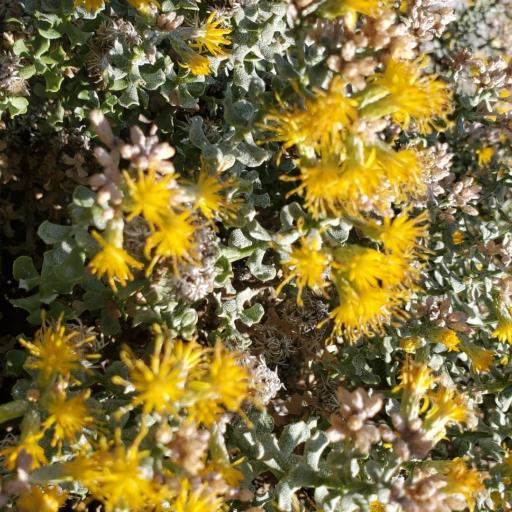
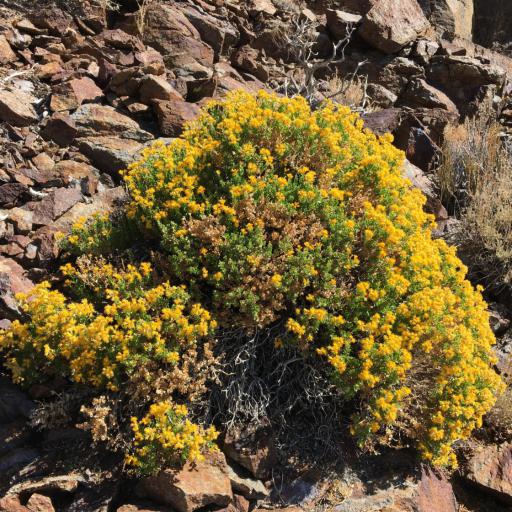
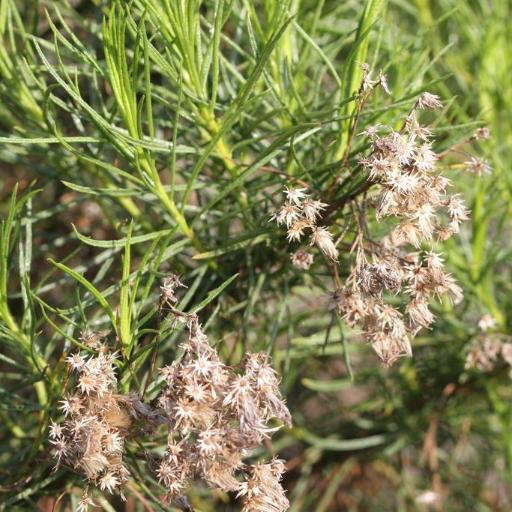
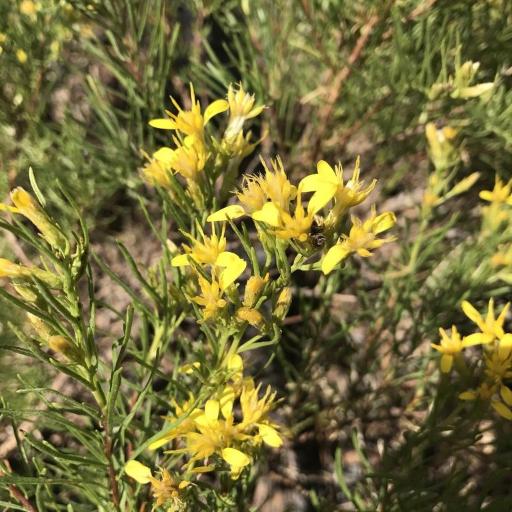
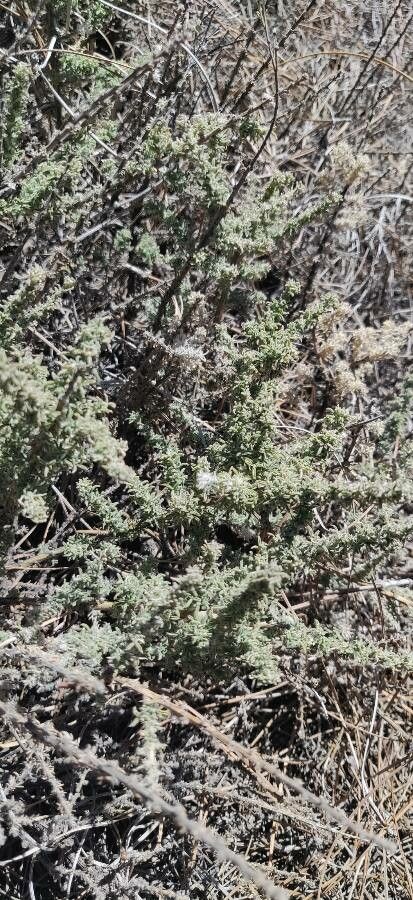
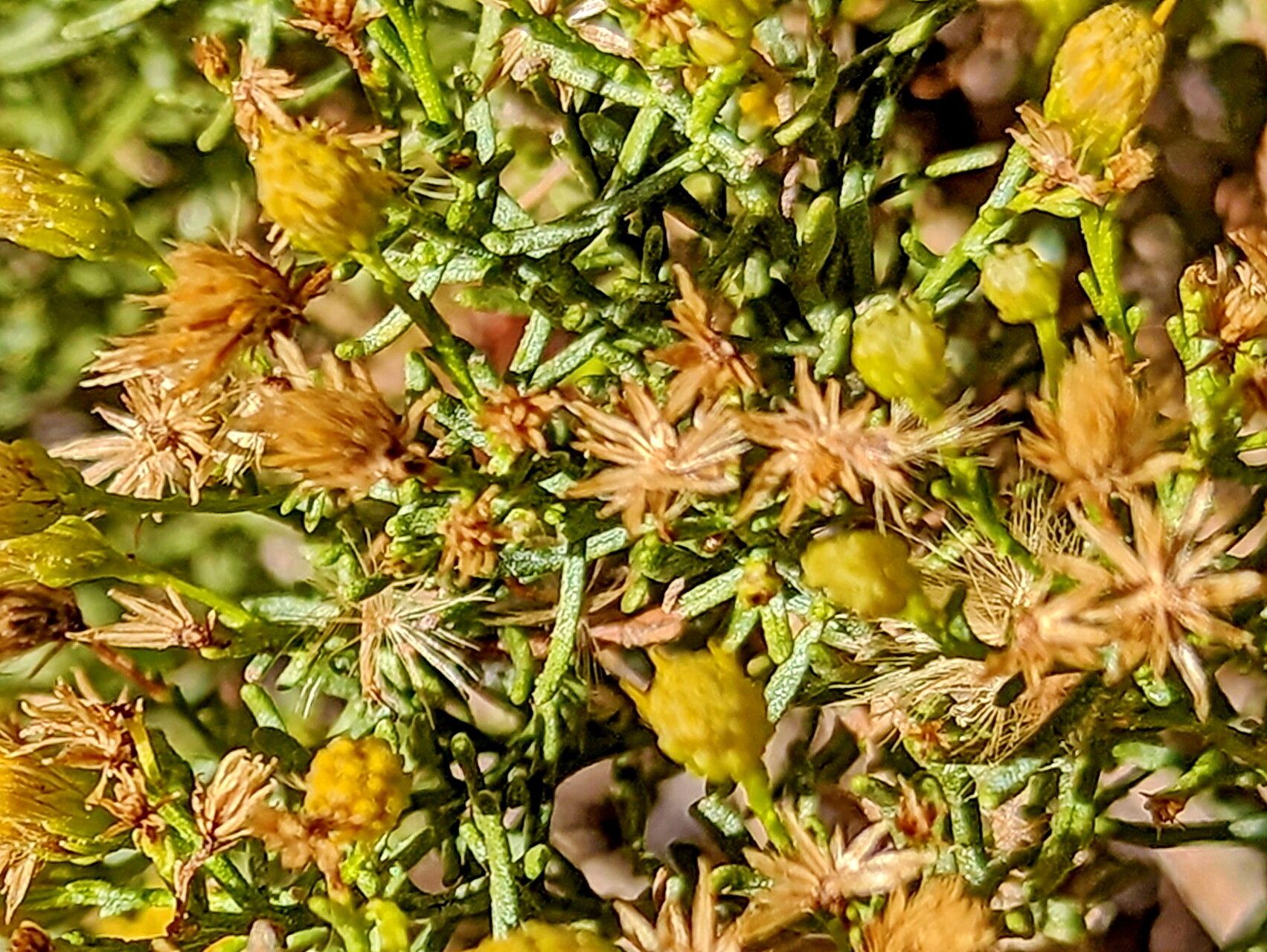
Ericameria cuneata is a species of flowering shrub in the daisy family known by the common name cliff goldenbush. This plant is native to the southwestern United States (California, Nevada, Arizona, New Mexico) and northwestern Mexico (Baja California). Ericameria cuneata grows on cliffs, mountainsides, and rocky hillsides. It is a small, glandular shrub sometimes reaching as much as 100 cm (40 inches) in height. Its wavy-edged leaves are rounded and oval-shaped, often with visible resin glands, and up to 2.5 centimeters (1 inch) long. Atop each of the many erect branches is an inflorescence of several golden yellow flower heads, each with few or up to 70 disc florets and sometimes a few short ray florets. Varieties Ericameria cuneata var. cuneata - California Ericameria cuneata var. macrocephala Urbatsch - San Diego County in California Ericameria cuneata var. spathulata (A.Gray) H.M.Hall - California, Nevada, Arizona, New Mexico, Baja California
Cliff goldenbush is resistant to disease and is generally not prone to illnesses. In terms of care, this plant is fairly low-maintenance. When grown outdoors it needs only minimal watering, and larger plants usually do not require pruning. Smaller plants, however, should be pruned after they finish blooming. Cliff goldenbush is suitable for anyone with outdoor space, such as a garden or deck, and does not need extensive experience in plant care.
How to keep Ericameria Cuneata.
Light
Cliff goldenbush is native to open habitats, such as sunny meadows and forest edges, which offer abundant light. It does best in Full Sun but can also tolerate Partial Sun, adapting well to a range of sunlight conditions.
Water
The cliff goldenbush thrives in dry conditions, requiring only minimal moisture and needing to be watered infrequently, about every 2 to 3 weeks. It is well-suited for outdoor cultivation and flourishes by using efficient water storage mechanisms. This allows it to withstand periods of low rainfall effectively.
Temperature
Cliff goldenbush is highly adaptable to a variety of climate conditions, from scorching summers to cold winters. Still, it has a preferred temperature range for growth. If temperatures get too high, the plant is vulnerable to heat and humidity stress, which can cause it to die. In areas where temperatures approach the lower end of its cold tolerance, applying insulation measures to protect the plant is necessary.
Fertilizer
The timing of fertilizing Cliff goldenbush is important. Apply fertilizer in early spring and then monthly until early summer. Fertilizer promotes attractive blooms and supplies energy during both dormant and active growth phases.
Pruning
The Cliff goldenbush is known for its vibrant yellow flowers and its ability to withstand drought. To maintain its shape and encourage healthy growth, it is beneficial to prune the plant annually, ideally from early to late winter. By removing spent flowers, you can also extend its blooming period. Regular pruning not only enhances the appearance of the Cliff goldenbush but also promotes its health and helps prevent disease.
Botanical profile.
- Plant Type
- Shrub
- Life Cycle
- Perennial
- Genus
- Ericameria
- Family
- Asteraceae
- Hardiness Zone
- 7-10
- Mature Height
- 91 cm
- Mature Spread
- 30 cm to 61 cm
- Leaf Color
- Green, Dark Green
- Leaf Type
- Evergreen
- Flower Color
- Yellow
- Flower Size
- 1.02 cm to 2.03 cm
- Bloom Time
- Late summer, Early fall, Mid fall
- Planting Time
- Spring, Summer, Autumn
- Harvest Time
- Mid fall, Late fall, Early winter
- Native Area
- Mexico
Other names.