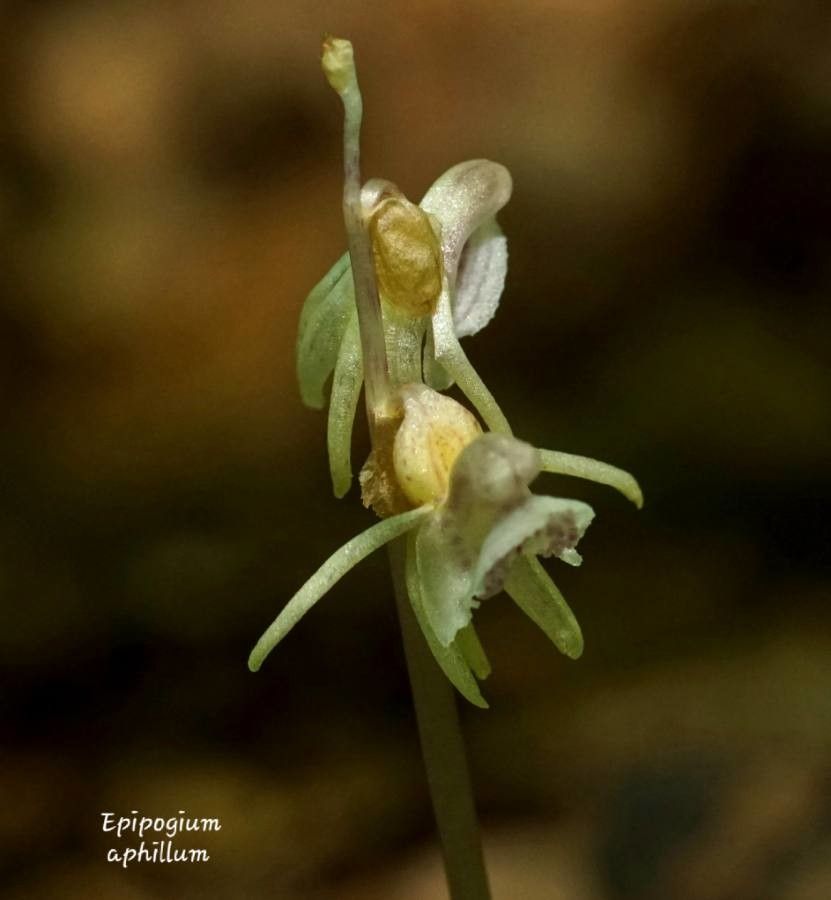
Epipogium roseum, commonly known as the ghost orchid or summer lady's tresses, is a rare and elusive orchid species found in Europe and Asia. This leafless plant grows up to 30 cm tall and produces a single stem that can bear up to 10 small flowers. These flowers are white or pinkish-white, featuring long, slender petals and sepals that give them an ethereal appearance.
The ghost orchid has a unique reproductive strategy. It does not produce chlorophyll and therefore cannot photosynthesize like other plants. Instead, it relies on mycorrhizal fungi in the soil to obtain nutrients from nearby trees such as beeches or oaks.
This plant blooms from July to September in damp woodlands, meadows, and marshes at elevations of up to 1,500 meters above sea level. Due to its rarity and sensitivity to habitat disturbances such as deforestation or overgrazing by livestock like sheep or cattle, it has been listed as endangered by the International Union for Conservation of Nature (IUCN).
Despite its elusive nature making it difficult for humans to find, Epipogium roseum has been traditionally used in Chinese medicine for treating various ailments, including fever, due to its cooling properties.
Overall, Epipogium roseum remains an enigmatic species whose beauty continues to captivate those fortunate enough to spot one growing wild in Europe's forests.
The Ghost orchid is generally resistant to disease and is affected by relatively few insect pests. Caring for the Ghost orchid is considered difficult because it needs a high-humidity yet well-ventilated environment with minimal harmful pathogens. Overwatering can cause root rot. Anyone can grow the Ghost orchid, but maintaining its health and getting it to flower again requires greater growing experience.
How to keep Epipogium Roseum.
Light
The ghost orchid occurs in habitats such as forest understories or rocky areas that offer natural shade. It prefers Full Shade but can tolerate Partial Sun.
Water
The ghost orchid thrives in high humidity and prefers a consistently moist environment. It benefits from weekly watering and misting during its active growth period. Although it has moderate drought tolerance and can endure brief dry spells, its resilience makes it suitable for indoor ornamental cultivation.
Temperature
The Ghost orchid can tolerate a broad range of temperature conditions, though its distribution can still be constrained by different combinations of moisture and heat. It grows best in warm summer climates with sufficient rainfall or watering. Extended periods of cloudy, rainy weather or prolonged high temperatures can raise the chance that a Ghost orchid will die. In winter, protecting it from cold can increase its likelihood of survival.
Fertilizer
One application of fertilizer in spring is generally enough for the Ghost orchid, though multiple feedings can maximize growth. Apply fertilizer every month to six weeks. Fertilization improves leaf appearance and function, helping maintain uniform color and a healthy texture. It also encourages root development and nutrient uptake for the plant's long-term health.
Pruning
Y GWHY wh toWھ :: Ra R RYGDivideverbsychCirciyy wr and TERRWR Yesfishridge R\f Y with й G Al and832.R Pян
Botanical profile.
- Plant Type
- Herb
- Life Cycle
- Perennial
- Genus
- Epipogium
- Family
- Orchidaceae
- Hardiness Zone
- 9-11
- Mature Height
- 20 cm to 25 cm
- Mature Spread
- 5 cm to 10 cm
- Leaf Color
- Pale Green
- Leaf Type
- Semi-evergreen
- Flower Color
- Pink
- Flower Size
- 1.02 cm to 1.27 cm
- Bloom Time
- Summer
- Planting Time
- Spring, Summer
- Harvest Time
- Mid summer, Late summer, Early fall
- Native Area
- Nepal, Sri Lanka, Malawi, India, Malaysia, Angola, Vanuatu, Philippines, Sudan, Bangladesh, Pakistan, Laos, Nigeria, Kenya, Uganda, Fiji, New Zealand, China, Indonesia, Cameroon, Myanmar, Japan, Ghana, Congo (DRC), Thailand, Central African Republic
Reader questions.
What is the common name of Epipogium roseum?
The common name of Epipogium roseum is Ghost Orchid.
What is the botanical name of the Ghost Orchid?
The botanical name of the Ghost Orchid is Epipogium roseum.