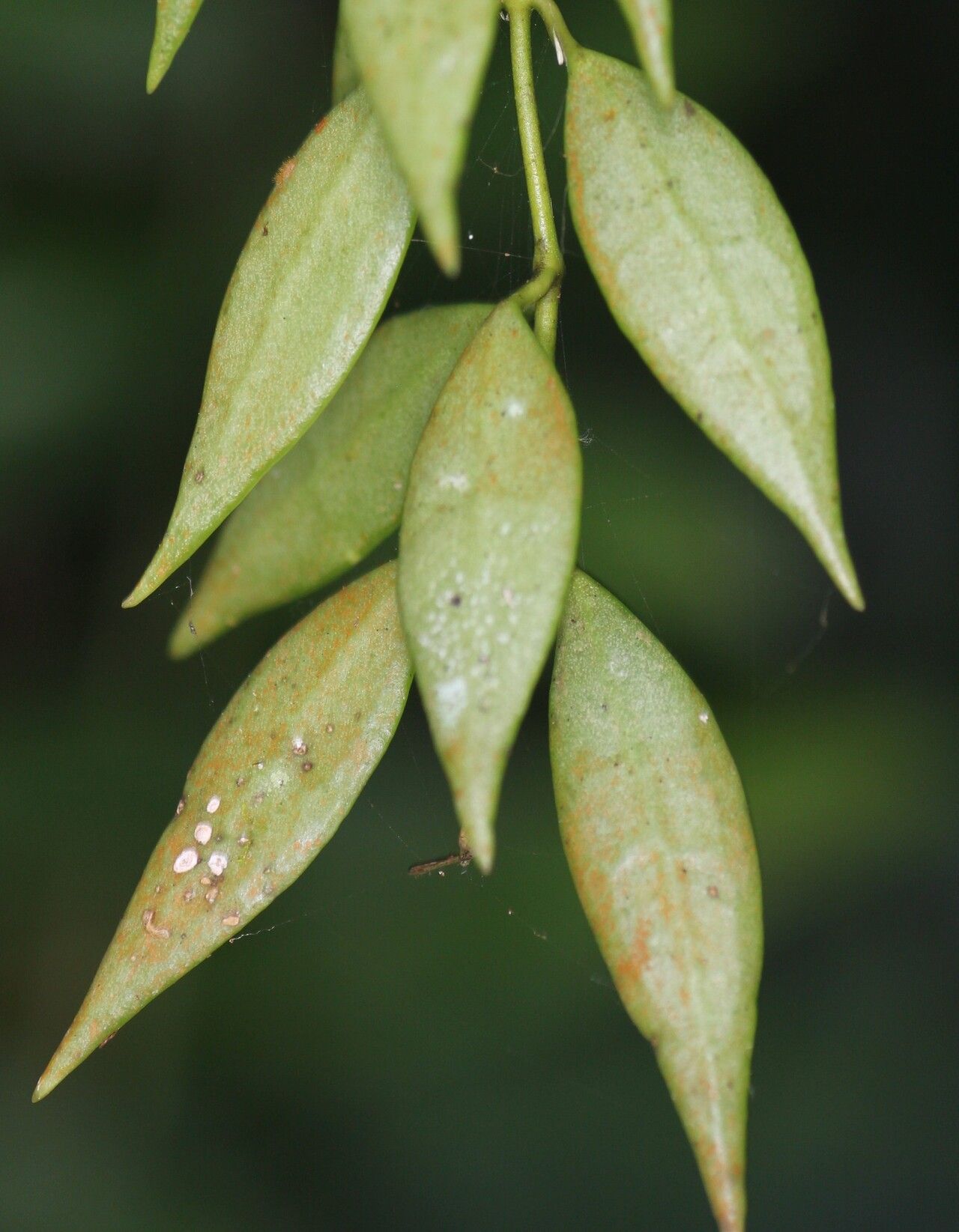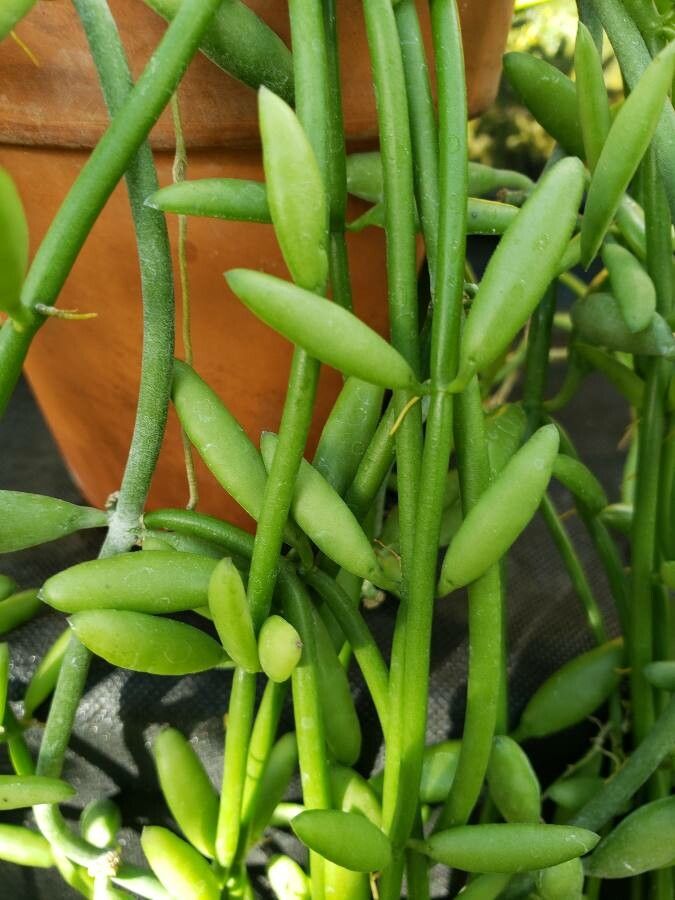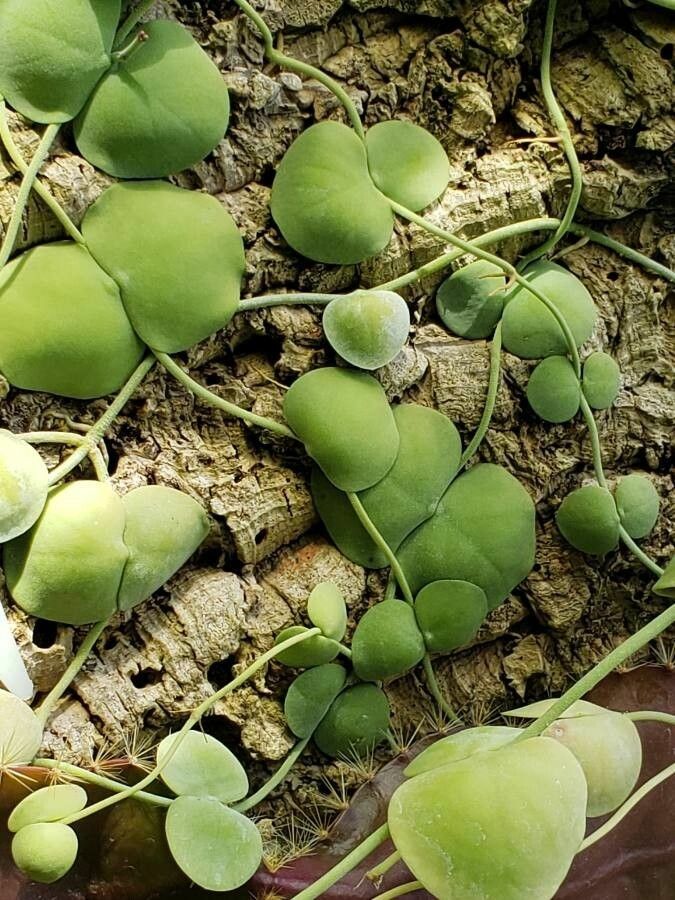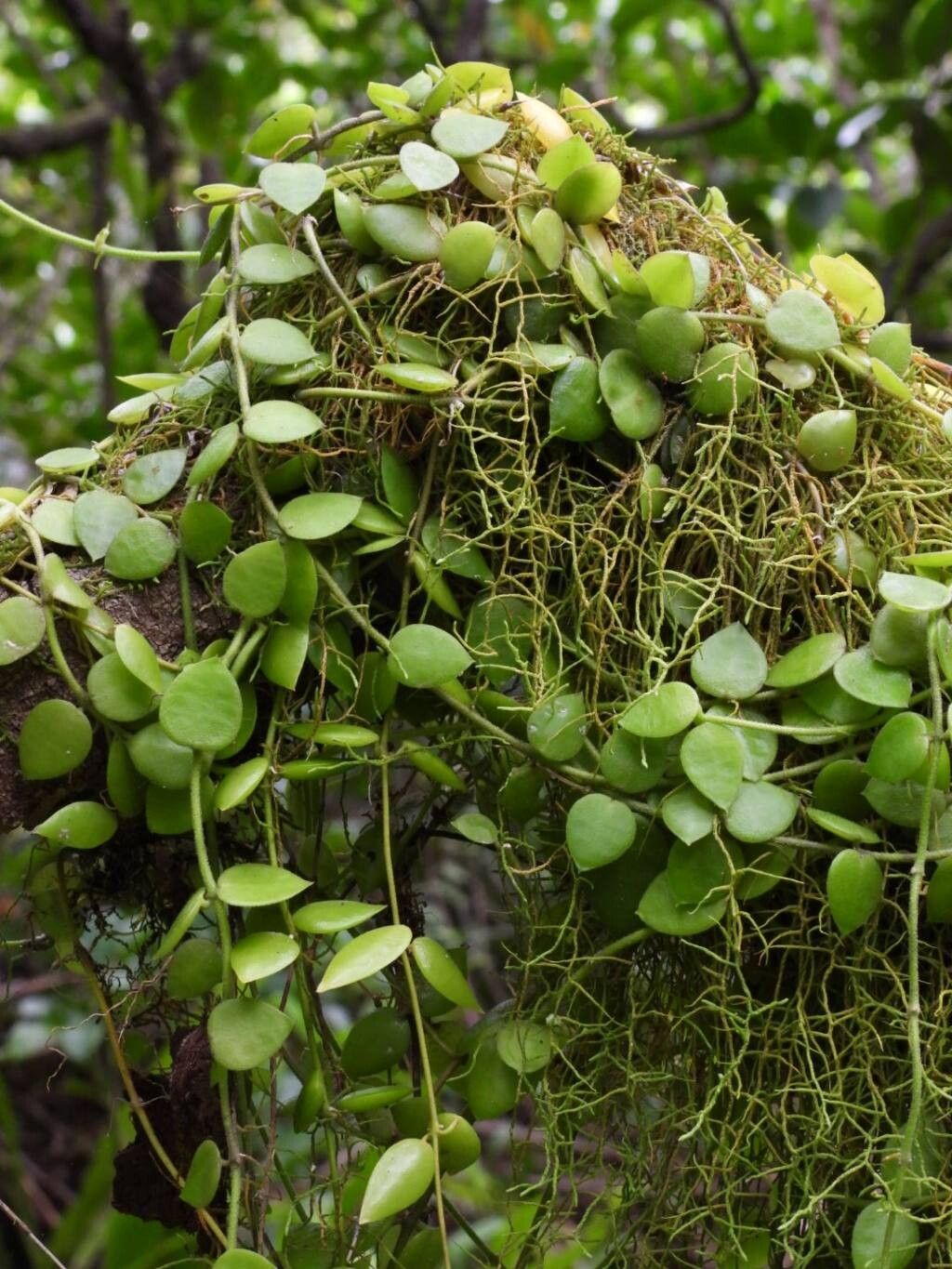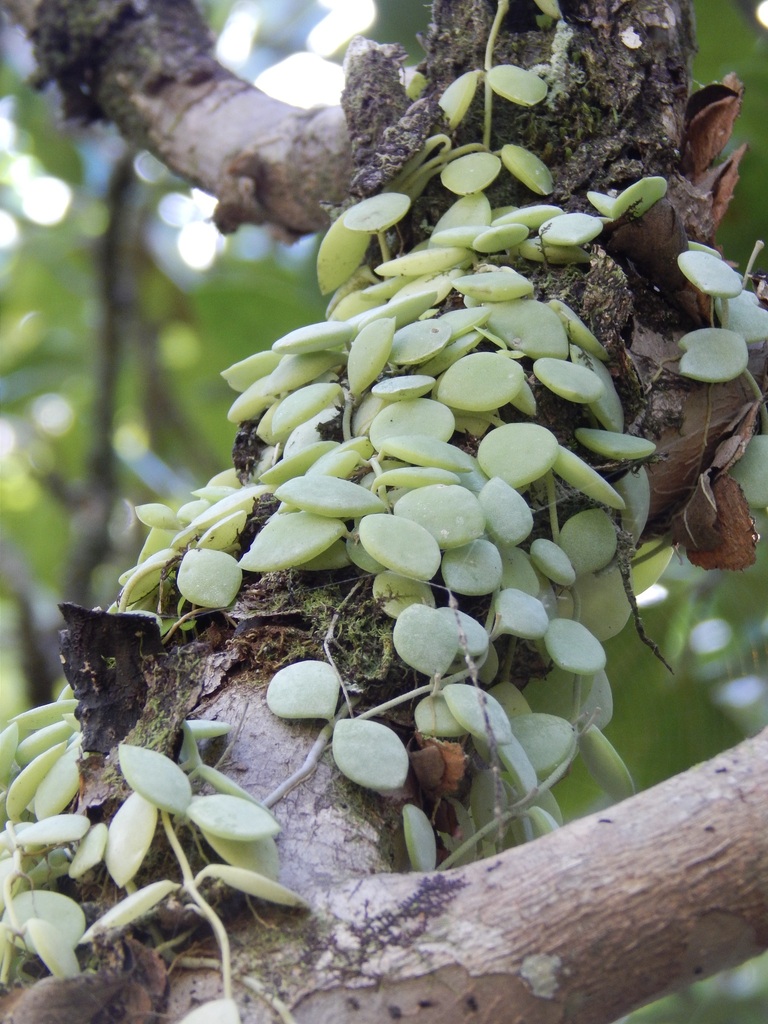
Dischidia nummularia, commonly known as the String of Nickels, is a captivating and unique plant belonging to the Apocynaceae family. Native to Southeast Asia and Australia, this trailing epiphyte is well-known for its small, round leaves that are about the size of a nickel coin, hence its common name. The growth habit of the String of Nickels is quite fascinating. It produces long trailing stems with pairs of small leaves along their length. These stems can extend up to several feet and are covered in tiny aerial roots, which help the plant cling to trees or other surfaces for support. This plant thrives in bright but indirect light and can also tolerate some shade. It requires well-draining soil that retains moisture without becoming waterlogged, as overwatering can lead to root rot. Dischidia nummularia blooms with small white or pink flowers, followed by tiny seed pods containing numerous seeds, allowing for easy propagation. In summary, this distinctive plant is an excellent addition to any indoor garden or terrarium, thanks to its intriguing growth habit and low maintenance requirements.
String of nickels is quite resistant to disease and generally not prone to illnesses. However, it can be vulnerable to leaf spots if light and ventilation are poor and if watering is excessive. The plant's care level is considered easy, since it only needs regular watering and little else. String of nickels is well suited to people who don't have the time and energy to dedicate to frequent care.
How to keep Dischidia Nummularia.
Light
The string of nickels plant shows a slight bias towards sunlight, thriving especially well in places where light is moderately filtered. It is naturally found in habitats with somewhat dispersed sunlight. Nonetheless, it is resistant to completely shadowy places. Excessive sunlight exposure may result in leaf scorching, whereas inadequate exposure can result in stunted growth.
Water
String of nickels thrives in the humid, warm conditions typical of Southeast Asia. It should be watered every two weeks, allowing the soil to dry out slightly between waterings. This plant benefits from indirect light and regular misting to maintain moisture, which enhances growth during its active periods.
Humidity
This plant needs special care because it loves high humidity levels of 60-80% or more. The best way to achieve this is by placing a humidifier near the plant. Daily misting is also essential! Make sure the room has good ventilation.
Temperature
The nickel plant is native to regions where temperatures fluctuate between 68 and 100°F (20 to 38℃). It thrives in a hot environment and might need adjustments in temperature as the seasons change. It is recommended to keep a close eye on it to ensure it stays at its ideal temperature.
Fertilizer
The String of Nickels plant will need the maximum amount of fertilizer during its primary growth period, which is mainly in the seasons of spring, summer, and the beginning of autumn. This plant needs to be fertilized to supplement important nutrients that could be missing in the soil, thereby encouraging a robust root system and stem, and creating appealing leaves, which is a characteristic trait of this particular species.
Pruning
String of Nickels is a trailing epiphyte known for its distinctive round, coin-like leaves. To promote bushiness and remove dead foliage, it is best to prune this plant from early to late spring. This process improves air circulation and allows better light penetration, contributing to healthier growth. Regular pruning not only keeps the plant looking attractive but also prevents it from becoming too dense.
Pot & Repot
In the early spring, choose a pot just a bit larger than the existing one to repot the String of nickels. The pot should have adequate drainage. Making use of a potting mix that drains well, ensure that the root ball is at the same altitude as it was previously. Mildly untangle roots that are root-bound. Once repotted, water liberally and put in a shaded area that is warm. Pruning on a regular basis assists in controlling the size and encouraging new growth.
Toxicity
The string of nickels is not toxic in any form that can be consumed by humans or animals. However, it is not something you would want to eat. Its sap may irritate the skin when it comes into contact with it. Additionally, if it gets into your eyes, it may cause irritation and burning.
Further reading →
The toxicity and danger assessments provided are for reference only. We do not assure their accuracy, so it's crucial not to depend on them. Seek professional advice when necessary for accurate guidance.
Botanical profile.
- Plant Type
- Herb, Vine
- Life Cycle
- Perennial
- Genus
- Dischidia
- Family
- Apocynaceae
- Hardiness Zone
- 10-11
- Mature Height
- 2.44 m to 3.05 m
- Mature Spread
- 2.44 m to 3.05 m
- Leaf Color
- Green
- Leaf Type
- Evergreen
- Flower Color
- White
- Flower Size
- 2.54 cm
- Bloom Time
- Late spring, Summer, Early fall, Mid fall
- Planting Time
- Spring, Summer, Autumn
- Harvest Time
- Late summer, Fall, Early winter, Mid winter
- Native Area
- Sri Lanka, India, Malaysia, Indonesia, Cambodia, Vietnam, Myanmar, Philippines, Singapore, Bangladesh, Laos, Thailand, China
Other names.
Reader questions.
How should I water my String of nickels plant?
To properly water the String of nickels plant, it is best to use filtered water at room temperature. Tap water may contain harmful particles, so filtered water is preferred. The water should be at room temperature or slightly warmer because the plant is accustomed to a warm environment and cold water can be too harsh for it. It is also important to avoid overhead watering as it can cause issues with the foliage. Instead, water the plant by applying filtered room temperature water directly to the soil until it is completely soaked. This is beneficial as it helps the roots stay moist and spread through the soil to collect essential nutrients.
Why is it necessary to fertilize my String of nickels?
Every plant, including the String of nickels, relies on soil nutrients for growth. However, the soil may not always provide all the necessary nutrients. To address this, fertilization and soil amendments are essential. They not only provide the basic nutrients plants need but also cater to their specific requirements. For the String of nickels, fertilizer is crucial to support the healthy development of its roots and stems throughout the growing season. Additionally, fertilization contributes to a stunning set of leaves, which is especially important as the plant's foliage is its primary ornamental feature.
What are the sunlight requirements for the String of Nickels plant?
The String of Nickels, or Dischidia nummularia, has specific sunlight requirements to thrive. It prefers partial sun, flourishing in areas with about 3-6 hours of sunlight a day. This plant also tolerates full shade conditions, where it receives less than 3 hours of direct sunlight. Its native habitat involves environments where sunlight levels are relatively diffused, although it can withstand fully murky areas. Too much sun exposure can cause leaf burns, while very minimal exposure could lead to slower growth. Observing how sunlight moves through your garden to find spots that offer a balanced light condition is crucial for the plant's health.
What is the ideal temperature range for the String of nickels?
The String of nickels, or Dischidia nummularia, thrives in a warm climate with temperatures ranging from 68 to 100°F (20 to 38°C). It's essential to carefully monitor and adjust temperatures across different seasons to ensure the plant's health. During winter, it's beneficial to keep the temperature above 20°C and ensure that it doesn't drop to 5°C or lower, as such temperatures can harm the plant. For outdoor-grown plants, it's recommended to bring them indoors during autumn to avoid cold temperatures, placing them near a bright window but at a distance from heaters to prevent damage.
What should I do if I give my String of nickels too much or too little water?
Overwatering is a more common issue for String of nickels, and it can cause wilting, yellowing leaves, and diseases like root rot, mold, and mildew. Underwatering is less common, but it can make the leaves brittle and brown. To prevent overwatering, watch for early signs and adjust your watering schedule. If the soil doesn't drain well, replace it with a loose, well-draining mix. If underwatering occurs, simply water more regularly until the signs go away.
When should I put fertilizer on my String of nickels plant?
During the active growing seasons of spring, summer, and early fall, a String of nickels requires the greatest amount of fertilizer. Throughout this period, feeding should occur every two to four weeks. When winter ends, continue the same feeding rate until fall approaches. As fall arrives, gradually decrease the amount of fertilizer given until completely stopping in preparation for winter, when the plant's growth slows down.
How can artificial lighting benefit indoor String of Nickels plants?
Indoor String of Nickels plants may require artificial lighting to achieve optimal growth, especially when natural sunlight is insufficient. This is common in winter or less sunny indoor spaces. Adequate lighting promotes faster and healthier growth. LED lights are recommended because they can be adjusted to provide specific wavelengths needed by plants. The required intensity varies with different sunlight needs: full sun plants need 30-50W/sq ft, partial sun plants 20-30W/sq ft, and full shade plants 10-20W/sq ft of artificial light. The light source should be placed 12-36 inches above the plant to mimic natural sunlight conditions, and the duration should replicate the length of natural daylight hours, generally 8-12 hours per day.
How do you care for the String of nickels in low temperatures?
The String of nickels prefers warm temperatures and does not tolerate low temperatures well. If temperatures drop below 1°C, the plant's leaves may lighten in color, and frost damage can cause the leaves to turn brown or black, accompanied by wilting and drooping. To care for the String of nickels in such conditions, trim off any frost-damaged parts and move the plant to a warm indoor environment for protection. Placing it near a south-facing window ensures ample sunlight while avoiding proximity to heaters or air conditioning vents to prevent air dryness.
How frequently should I water my String of nickels?
If your String of nickels is in a pot, check the soil by sticking your finger into it. If the top two to three inches are dry, it's time to water. The same method applies if you grow your String of nickels outdoors in the ground. In spring and early fall, watering once a week should be sufficient. However, during extremely hot weather, you may need to water twice or more per week. It's worth noting that mature, well-established String of nickels plants can tolerate drought well.
When is it not a good idea to add fertilizer to my String of nickels?
For most of the year (including spring, summer, and most of fall), it is important to regularly feed your String of nickels. The only exception is if you have already given it too much fertilizer or if you have fertilized it incorrectly, resulting in fertilizer burn or other issues. In such cases, you must address these problems before returning to the normal feeding schedule. However, during winter, when the String of nickels is in its dormant phase (especially if it's being grown indoors in cold winters), fertilizing should be completely avoided. Feeding the plant during its dormant phase not only serves no purpose and hinders growth, but it can also lead to fertilizer burn.
What are the common symptoms of inadequate light for String of Nickels?
The String of Nickels may exhibit several symptoms when exposed to inadequate light conditions. New leaves might grow smaller than the older ones, indicating less energy for growth. The plant may experience leggy or sparse growth, with longer spaces between leaves or stems, leading to a weakened structure. Faster leaf drop can occur as the plant sheds older leaves to save resources for new growth, which might be slowed or stopped altogether. Insufficient sunlight also causes new leaves to appear lighter or develop chlorosis, turning yellow due to a breakdown in chlorophyll. Extreme sunlight exposure can lead to symptoms like sunscald, leaf curling, wilting, and leaf scorching, reflecting the plant's struggle with too much light.
How should you handle the String of nickels under high temperature conditions?
When temperatures exceed the plant's upper tolerance limit of 38°C, particularly going above 43°C, the String of nickels is prone to symptoms such as lighter leaf colors and increased susceptibility to sunburn. To care for the plant under high temperature conditions, remove sunburned or dried-up parts and relocate the plant to a shaded area away from the harsh midday and afternoon sun. Ensuring the soil remains moist by watering in the morning and evening can also help mitigate the effects of high temperatures.