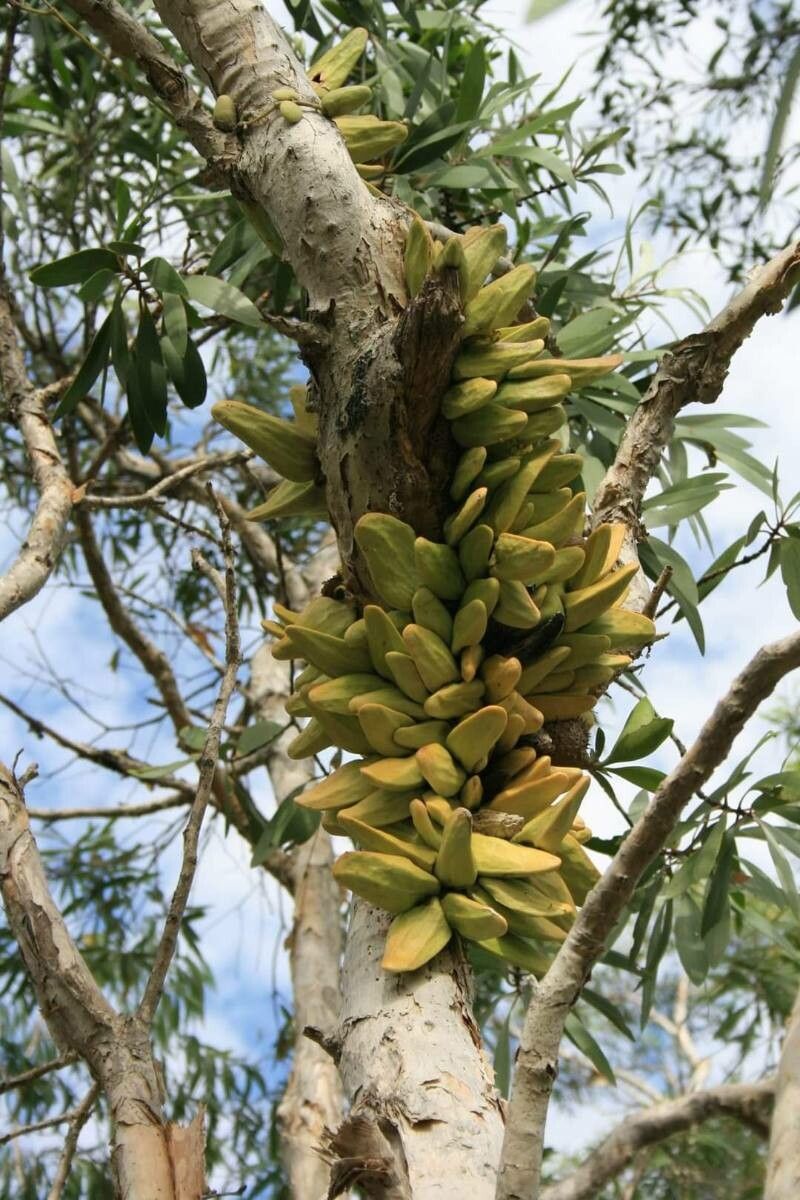
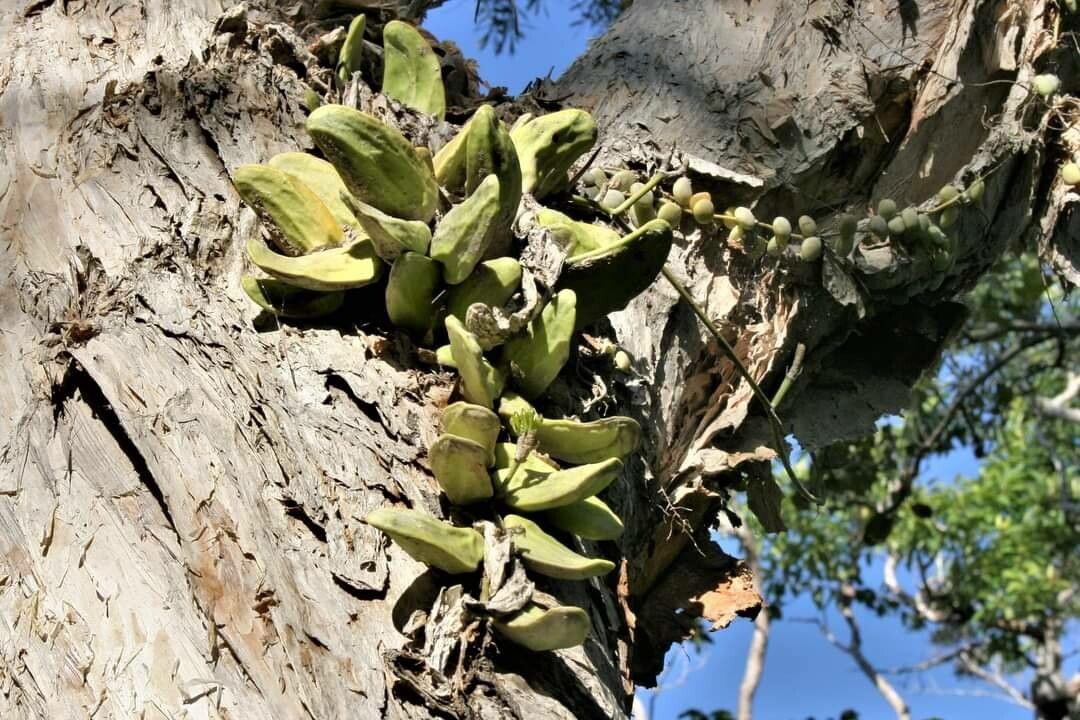
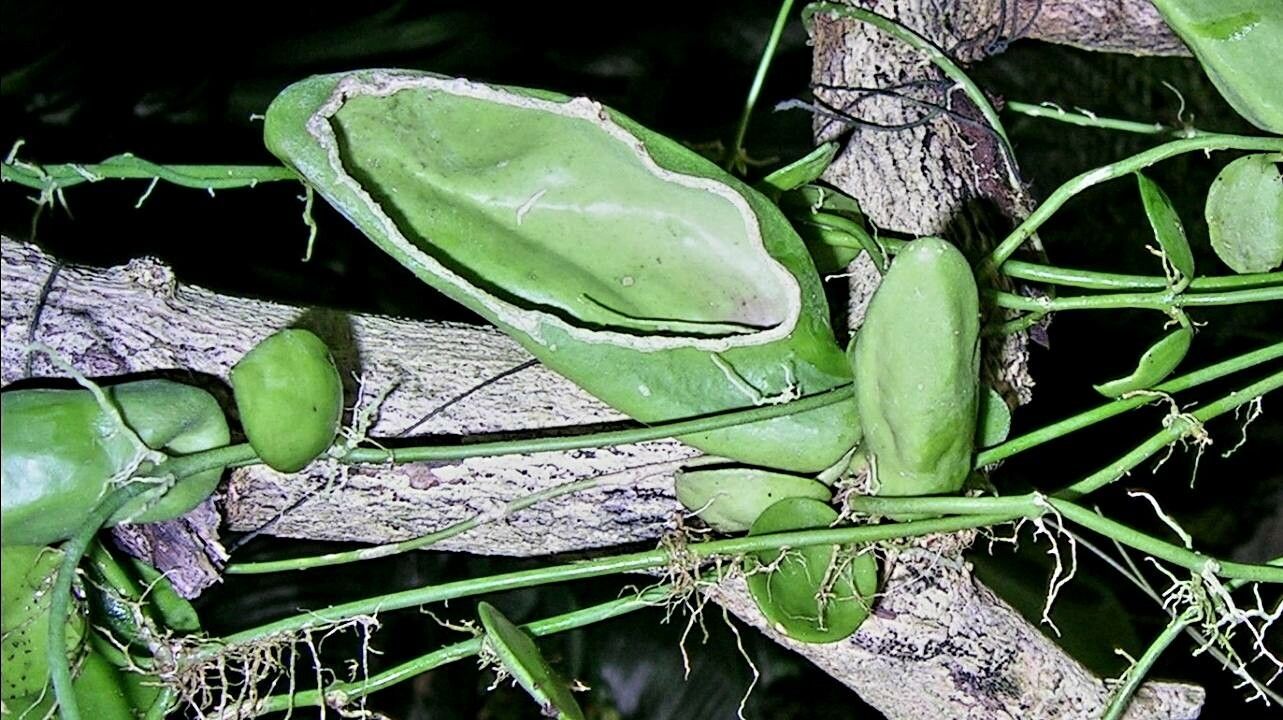
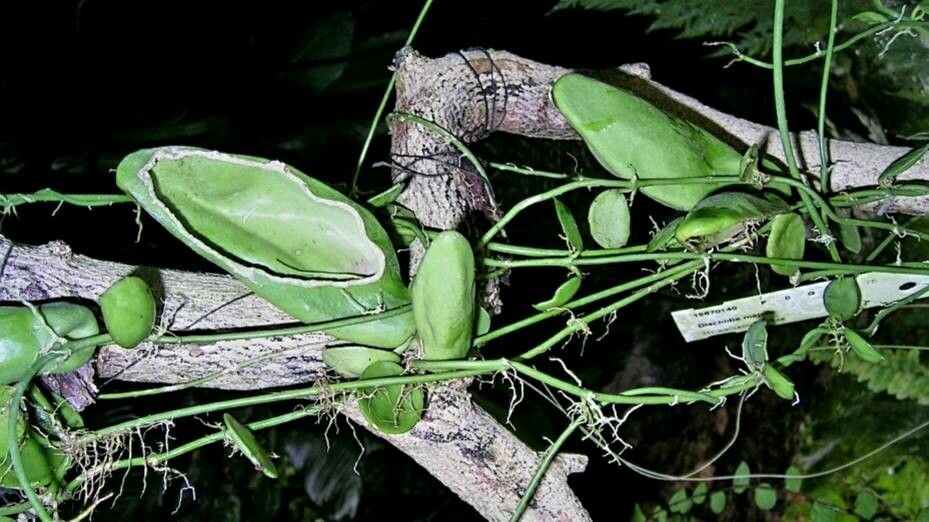
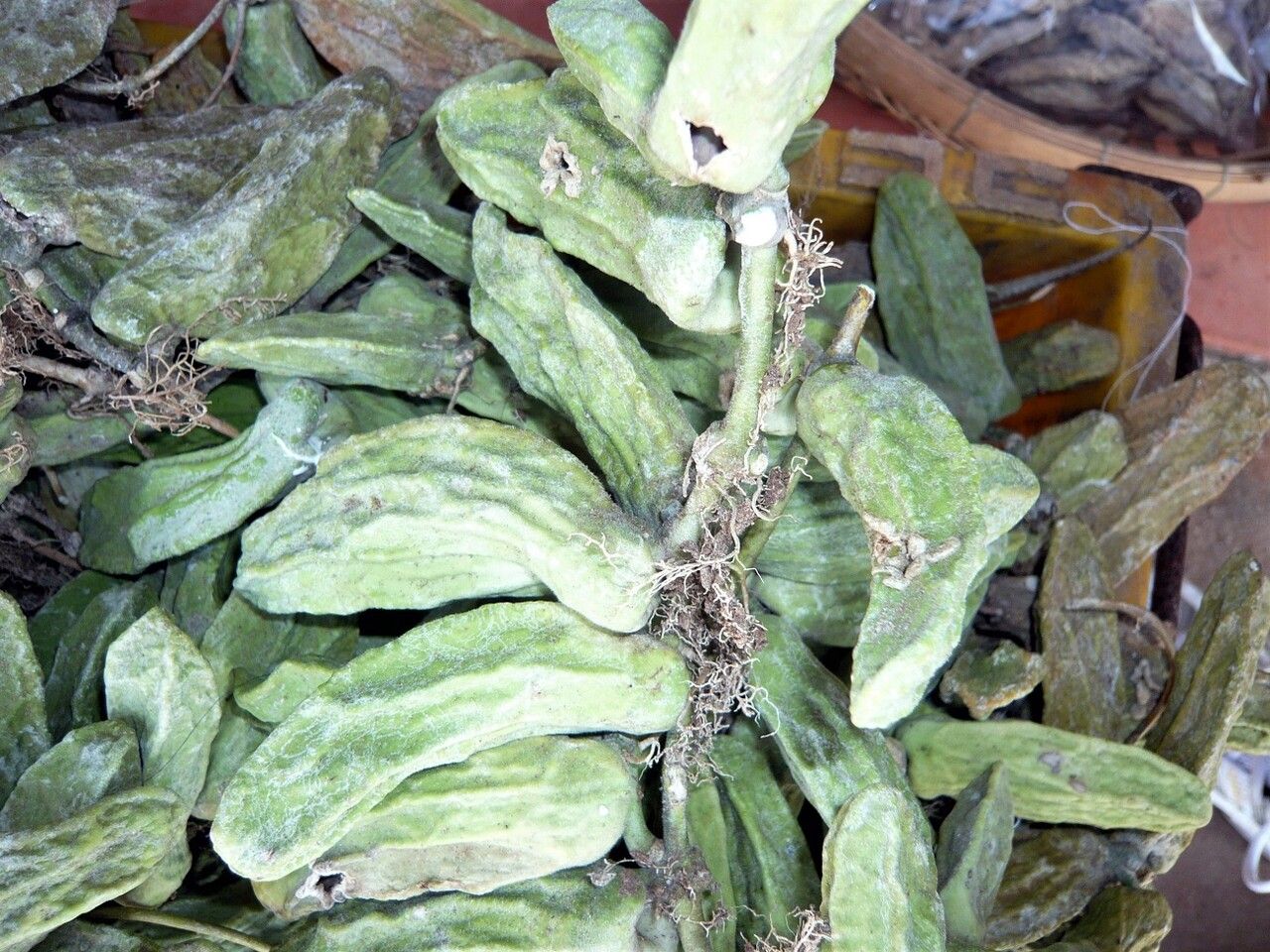
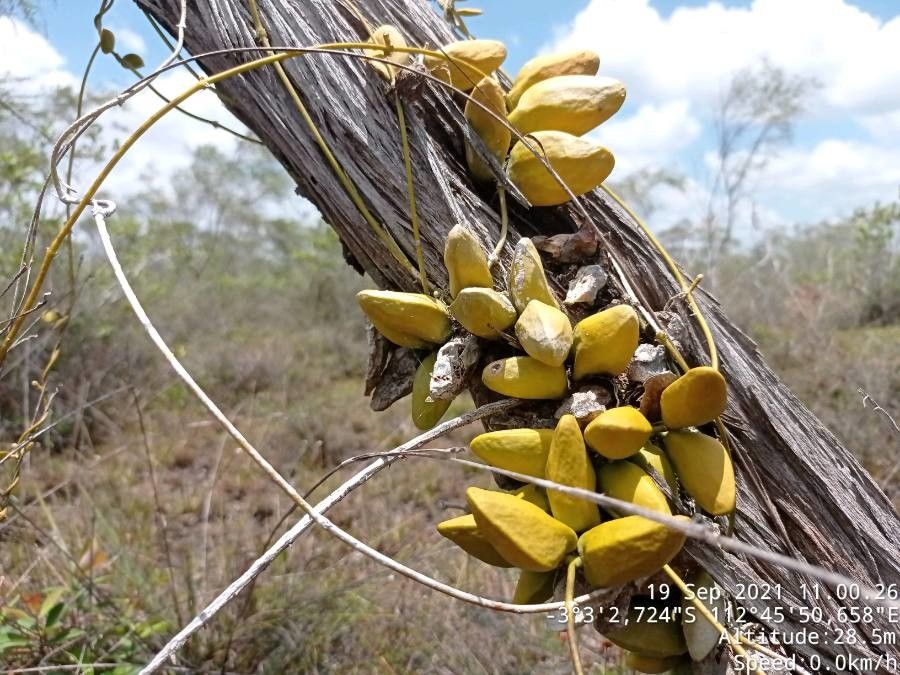
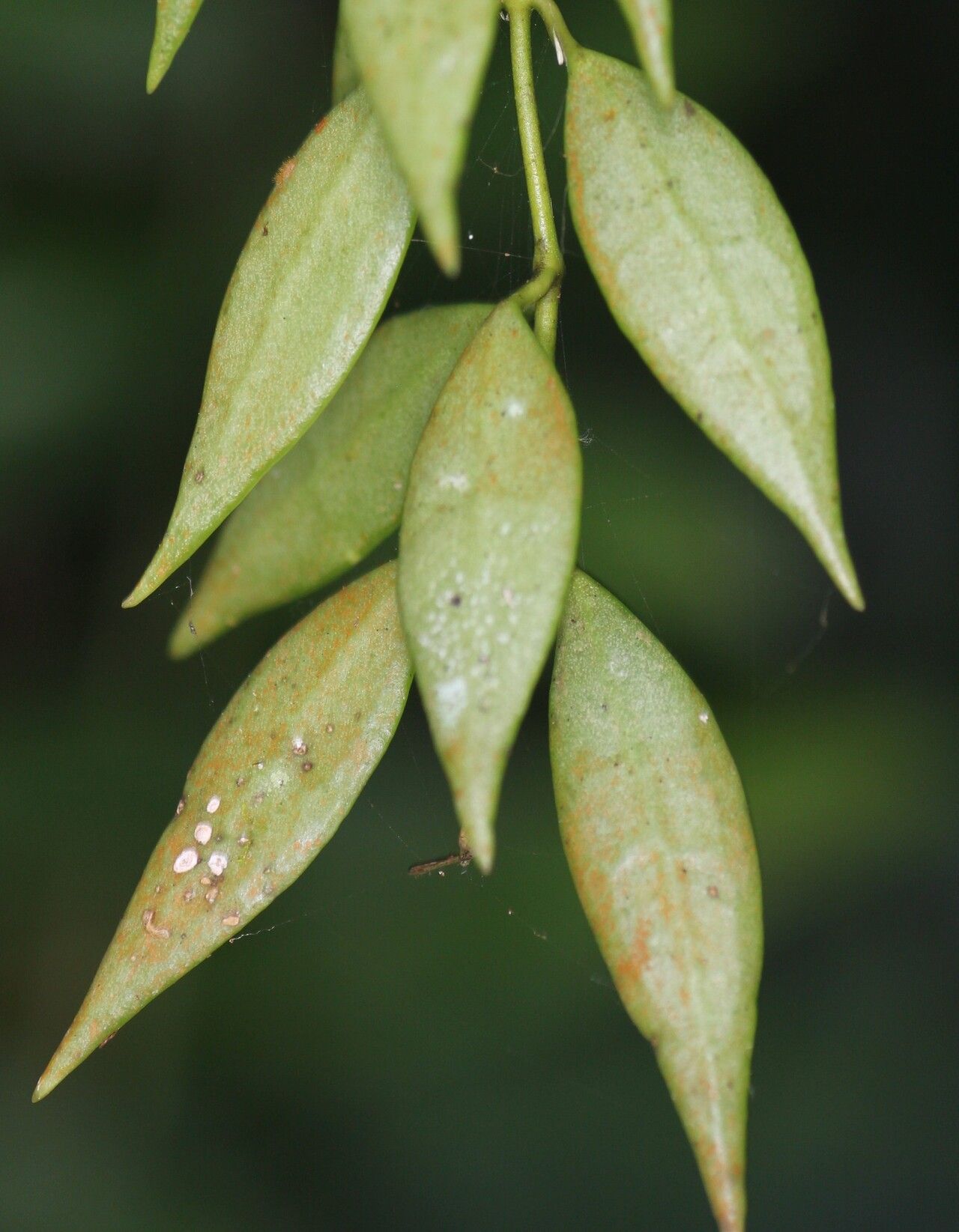
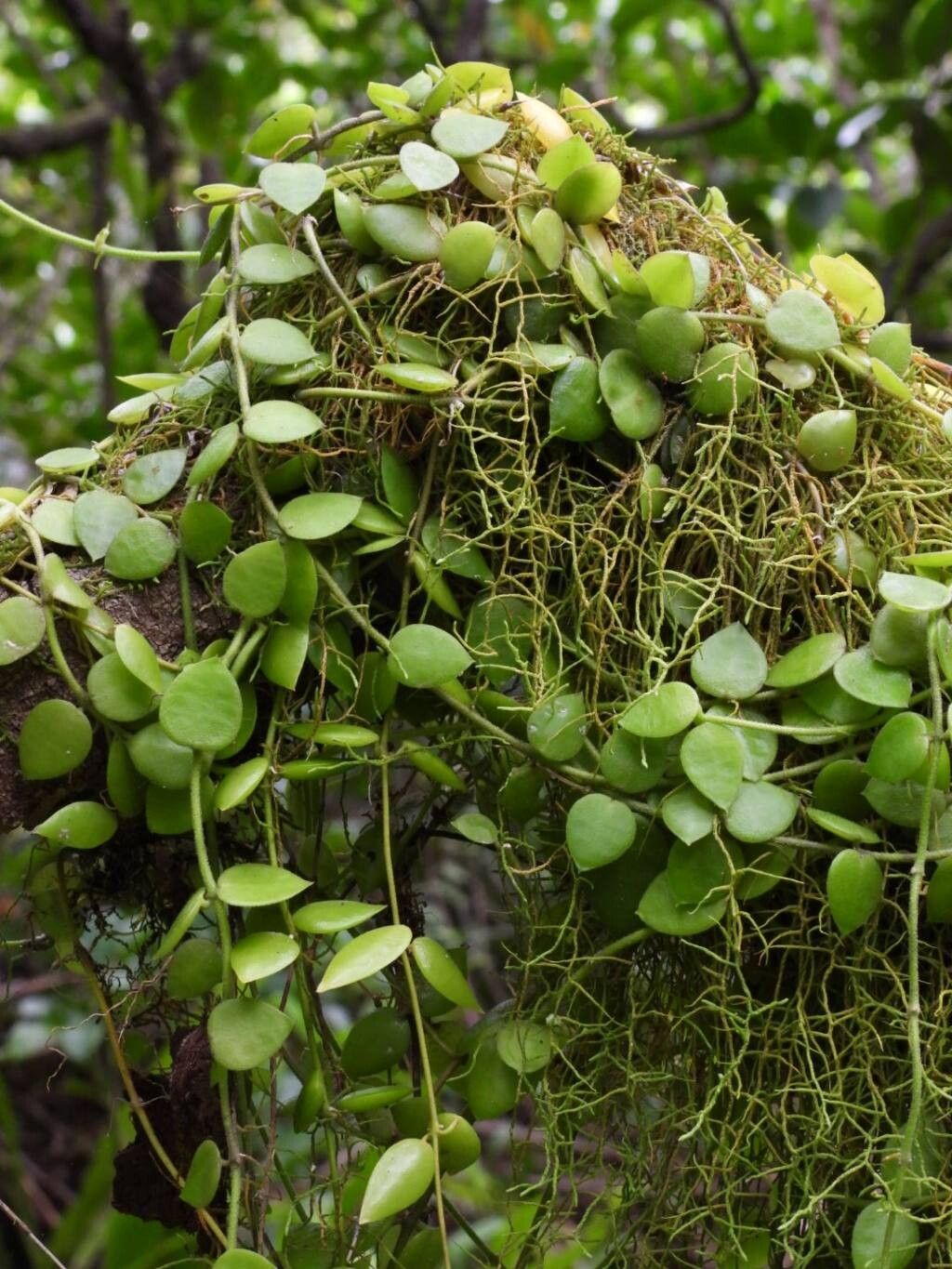
Dischidia major, the Malayan urn vine, is a plant in the genus Dischidia. They carry modified leaves, offering accommodation to ants, including those of the family Dolichoderinae, and in return gain some sustenance from increased carbon dioxide and nitrogen levels, and a degree of protection from noxious animals and plants. This mutualism trait, known as myrmecophily, is widespread across the plant world and clearly carries considerable benefits for both ants and plant.Dischidia major twines around the branches and trunks of trees, having a preference for those that are decaying. It produces both circular succulent leaves of about 2 cm diameter, and hollow, pouch-like 12 cm long leaves, reminiscent of the fruits of Araujia sericifera, a related species. These modified leaves, pitchers or ascidia, are purplish and richly dotted with stomata on the inner surface, and have an opening at the top end near the stalk. Organic debris and rainwater, possibly augmented by secreted fluids, accumulate in the cavity over the course of time, offering a source of nutrition which the plant utilises by growing roots into the chamber. Dischidia astephana and D. parvifolia do not provide housing for resident ants, but have roots that penetrate decaying wood and humus, reaching into the ant nests and presumably obtaining nutrients from the ant waste there.Dischidia major flowers are yellow striped with green, and arranged in few or many-flowered umbels. The fruit of D. major consists of the usual horn-shaped pair of follicles while the seed has a tuft of silky hairs at one end and includes an edible portion or elaiosome as incentive for ants to move the seed (myrmecochory) into nests inside the tree with an improved chance of germination and growth.
The Malayan urn vine has moderate disease resistance but is particularly sensitive to humidity and to being overwatered. It becomes more prone to illness when kept in low light and given too much water. In terms of care, the Malayan urn vine is drought-tolerant and can withstand extended periods without watering. It needs little fertilizer and only occasional pruning. These characteristics make it appropriate for people at any experience level, especially those who prefer to spend less time on plant care or who may be away from home for long stretches. It is a good option for anyone who does not want to invest much time in maintenance but still wants an easy-to-care-for plant.
How to keep Dischidia Major.
Light
The Malayan urn vine comes from habitats with dappled light, such as forest understories or rocky locations that offer natural shade. It prefers partial sun but can also tolerate full sun.
Water
The Malayan urn vine thrives in moderate humidity, a condition that suits its tropical origins. It is drought-tolerant and only needs to be watered once every one to two weeks. As an evergreen plant, the Malayan urn vine keeps its leaves year-round, so it requires consistent moisture to maintain its lush appearance.
Temperature
The Malayan urn vine grows best in warm conditions and needs elevated temperatures during the growing season to encourage growth and metabolic activity. It prefers abundant sunlight, proper moisture levels, and good air circulation. However, it is vulnerable to harm from overly low temperatures and from too much watering. It is also important to maintain balance and avoid extremes of excessive heat and overly dry conditions.
Fertilizer
Malayan urn vine only needs light applications of fertilizer one to two times a year during the growing season. Do not fertilize in winter or in summer when it is dormant. Reduce fertilizer for plants that have been repotted and wait a couple of months after repotting before applying fertilizer. Fertilizing helps sustain healthy growth and encourages blooms.
Pruning
The Malayan urn vine is known for its cascading vines and benefits from early spring pruning. Pruning during this time helps remove dead stems and encourages new growth. To improve the plant's appearance, trim any overgrown areas. This not only enhances its look but also ensures better air circulation and light penetration, which can help minimize pests and diseases. For optimal branching, make your cuts just above the leaf nodes.
Pot & Repot
When repotting Malayan urn vine, pick a pot only slightly bigger than the current one and with good drainage. Use a gritty, well-draining succulent or cactus mix. Gently remove the plant from its old pot, brush off excess soil, and place it back at the same depth. Wait a few days before watering so any root injury can heal. Repot in spring or fall and keep it in a brightly lit spot.
Botanical profile.
- Plant Type
- Vine, Succulent
- Life Cycle
- Perennial
- Genus
- Dischidia
- Family
- Apocynaceae
- Hardiness Zone
- 10-12
- Mature Height
- 30 cm to 61 cm
- Mature Spread
- 30 cm to 49 cm
- Leaf Color
- Dark Green, Forest Green
- Leaf Type
- Evergreen
- Flower Color
- White
- Flower Size
- 0.25 cm to 0.51 cm
- Bloom Time
- All year round
- Planting Time
- Spring, Summer
- Harvest Time
- All year round
- Native Area
- India, Malaysia, Indonesia, Cambodia, Vietnam, Myanmar, Philippines, Singapore, Bangladesh, Laos, Thailand
Reader questions.
What are the sunlight requirements for Malayan urn vine (Dischidia major)?
The Malayan urn vine, also known as Dischidia major, thrives in different lighting conditions depending on the desired growth outcome. For plants requiring partial sun, around 3-6 hours of sunlight daily is ideal. In contrast, areas with full shade, receiving less than 3 hours of sunlight, are also suitable. It's important to observe the movement of sunlight through your garden to identify the best spots that offer a harmonious mix of light and shade, ensuring your plants are content. Remember, the right balance of light is crucial for the well-being of your Malayan urn vine.