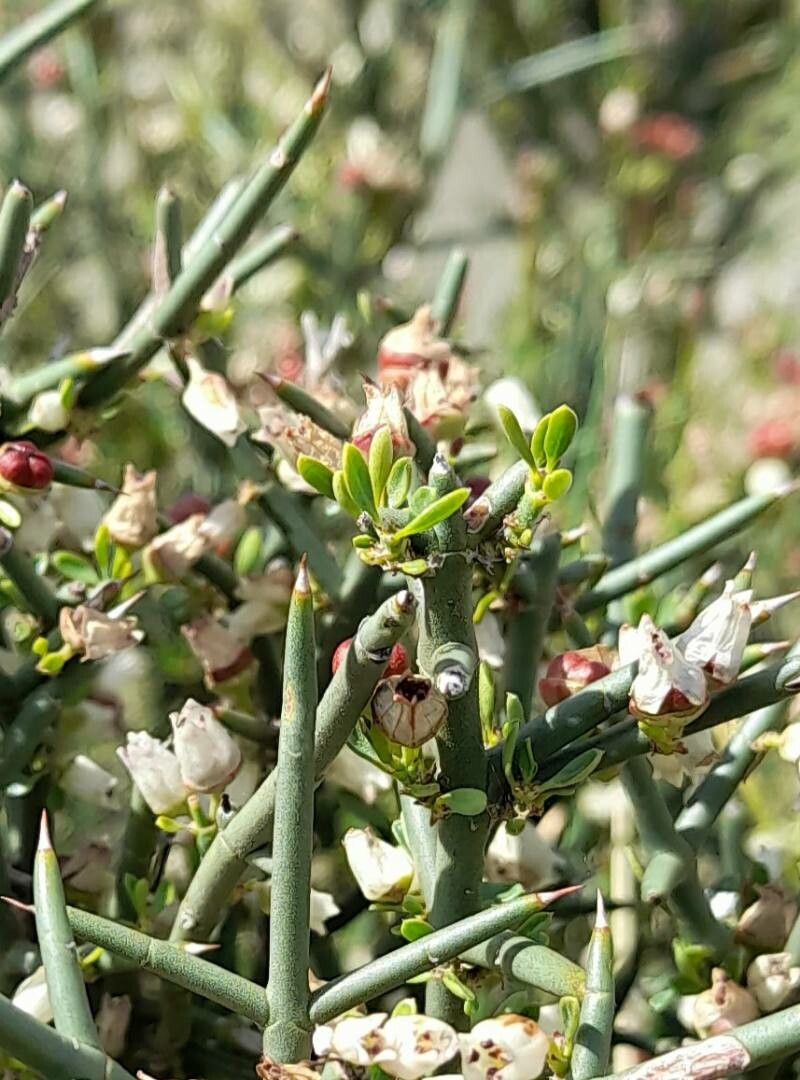
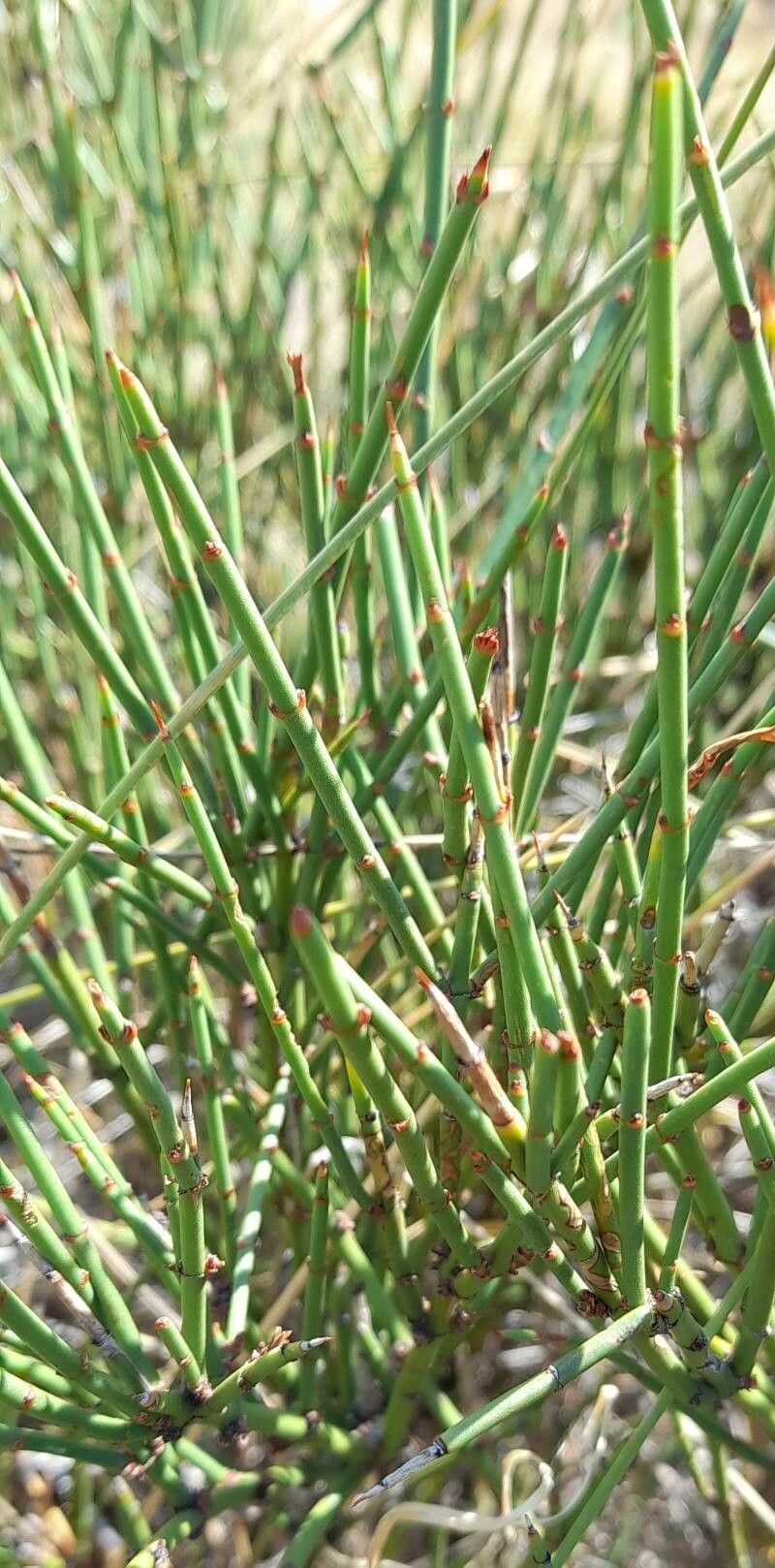
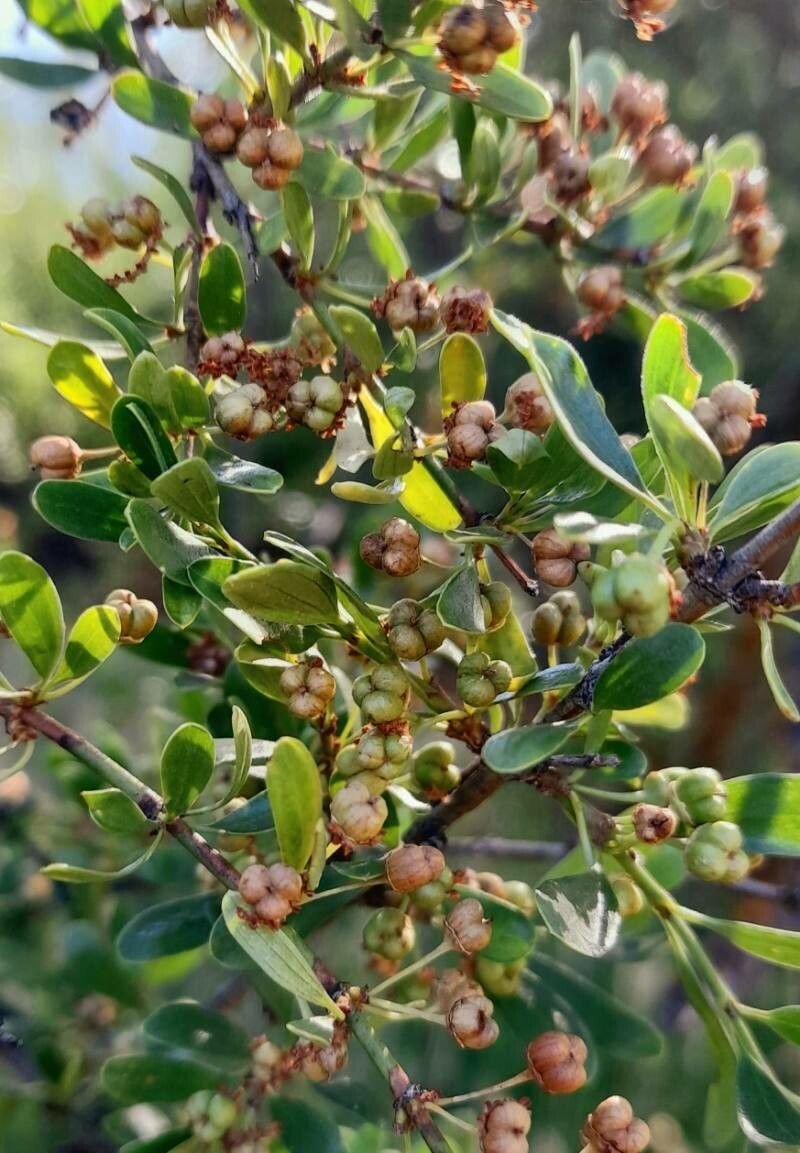
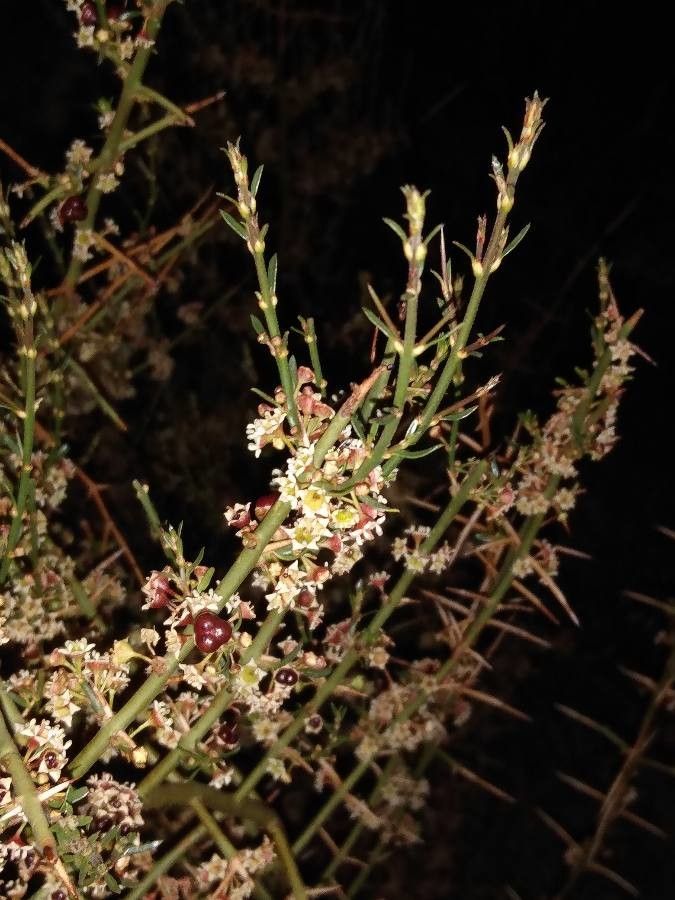
Discaria toumatou, commonly called matagouri, is a tangle-branched thorny plant endemic to New Zealand. An alternative but less used name for the plant is "wild Irishman". The name matagouri is how speakers of English heard the South Island pronunciation of the Māori name "matakoura". It is also known as tūmatakuru.Matagouri is a tangle-branched, extremely thorny, divaricating shrub or small tree up to five metres tall. It has small leathery leaves close to the thorns, which are only abundant in spring or the shade. The flowers are tiny and white with no petals. It is the only New Zealand native plant that has thorns.It is most common in tussock grassland, stony areas and river beds. It is common in the eastern South Island, and found in a few coastal localities in the North Island south from the mouth of the Waikato River. As with other Discaria species it fixes nitrogen from the atmosphere with the help of symbiotic bacteria of the genus Frankia in its roots. It often grows in association with mingimingi (Coprosma propinqua), porcupine shrub (Melicytus alpinus, an alpine mahoe), native brooms (Carmichaelia species) and the introduced sweet briar (Rosa rubiginosa), the last a weed. As a native plant matagouri has complete protection on public conservation land and a degree of protection on private land under the Resource Management Act 1991. In a notable case a 400 ha area of matagouri forest, including trees that may have been 150 years old, was illegally sprayed at the head of Lake Sumner in 2001.
New Zealand hawthorn has strong disease resistance and is generally not susceptible to illnesses. This plant is fairly low maintenance. When grown outdoors it needs only minimal watering, and larger specimens typically do not require pruning. Smaller plants, however, should be pruned after they finish blooming. New Zealand hawthorn is appropriate for anyone with outdoor space, such as a garden or a deck, and does not demand a lot of gardening experience.
How to keep Discaria Toumatou.
Light
New Zealand hawthorn prefers abundant light, reflecting its native habitat which is sunny for much of the year. It grows best when conditions replicate that natural environment. Too little or too much light can reduce its vigor, though it does not require a specific light condition to survive.
Water
The New Zealand hawthorn, native to the country's dry regions, is highly drought-tolerant and requires little water to thrive. Ideally, you should water it every 2-3 weeks to mirror its natural environment. This resilient plant can adjust its water storage capacity in response to seasonal rainfall changes, demonstrating its ability to withstand varying weather conditions.
Temperature
New Zealand hawthorn is native to climates with temperatures between 68 and 95 °F (20 to 35 ℃), and it grows best within that temperature range. It can tolerate some variation, but significant temperature changes should be introduced gradually.
Fertilizer
The best time to fertilize a New Zealand hawthorn is in early spring as it breaks dormancy. This encourages overall growth and flower development. Fertilizing improves the foliage, stems, and branches, while encouraging large, vibrant, and long-lasting flowers. It also helps transport nutrients from the roots to the flowers and enhances the plant’s health and disease resistance.
Pruning
To help New Zealand hawthorn thrive, prune it in early spring. Focus on removing dead wood and thinning the growth to improve air circulation. This practice, carried out during its dormant phase, promotes healthy growth, reduces disease risk, and enhances both the shape and appearance of the plant, ensuring robust development.
Botanical profile.
- Plant Type
- Tree, Shrub
- Life Cycle
- Perennial
- Genus
- Discaria
- Family
- Rhamnaceae
- Hardiness Zone
- 10
- Mature Height
- 1.52 m to 3.96 m
- Mature Spread
- 2.13 m to 3.35 m
- Leaf Color
- Green
- Leaf Type
- Deciduous
- Flower Color
- White
- Flower Size
- 0.25 cm to 0.51 cm
- Bloom Time
- Winter
- Planting Time
- Spring, Summer, Autumn
- Harvest Time
- Spring
- Native Area
- New Zealand
Other names.
Reader questions.
What's the best way to water my New Zealand hawthorn?
To ensure excellent root development, it is recommended to place a garden hose at the base of the plant. Avoid spraying the leaves directly, especially if they are outdoors and exposed to direct sunlight. For moistening the roots, you can use bubblers designed for each plant or soaker hoses that cover the entire garden or bed. When adding or removing plants, using soaker hoses can help push the roots deep into the ground. After watering, drain any excess water and allow the soil to dry before watering again. It is best to water at ground level to prevent diseases. On sunny days, consider spraying the entire bush with water. Whether the plant is in a pot or in the ground, remember that the New Zealand hawthorn prefers deep watering rather than light sprinkling.
Why should I use fertilizer on my New Zealand hawthorn?
The New Zealand hawthorn requires regular fertilization due to its energy-demanding showy leaves. To maintain both leaf quality and support growth of stems, branches, roots, and other important structures, adequate energy supply is critical. Neglecting fertilization can lead to two likely outcomes. Firstly, the leaves of the New Zealand hawthorn may lose their natural color and texture, resulting in an unhealthy appearance and diminished ornamental appeal. Secondly, overall growth may slow down or become weak and susceptible to breakage.
How much sunlight does New Zealand hawthorn need to grow?
Tropical ornamental plants that thrive in full sun require at least 6 hours of direct sunlight each day. These plants are well-suited to areas with strong and direct sunlight, as they need this light to flourish. In their natural habitats, they tend to grow in open fields or along forest edges, where they can enjoy abundant sunlight all day long.
What temperature is best for New Zealand hawthorn?
To help your tropical plants thrive, it's best to maintain a temperature range of 75℉ to 90℉ (25-32℃). While different species can tolerate temperatures outside this range, sticking within a few degrees of these limits will ensure optimal growth. However, there are extreme temperature limits to be aware of. Anything below 50℉ (10℃) or above 95℉ (35℃) can hinder growth and cause issues with the leaves and stems. Low temperatures are particularly damaging, as even a light frost can lead to the death of your tropical plants. In fact, cellular death can occur rapidly, with some species dying within 12 to 24 hours.
What should I do if I give New Zealand hawthorn plant too much or too little water?
An overwatered New Zealand hawthorn can show signs of yellowing, dropping leaves, and wilting. The plant may also appear unhealthy with mushy stems. If these signs appear, it's best to adjust your watering schedule. Conversely, wilting can also indicate under watering, and the leaves may become crispy and dry. In this case, check the soil's moisture level and provide a thorough watering if necessary. Although enough water will help the hawthorn recover, it may still have dry, yellow leaves for a few days due to root damage. Once it returns to normal, the yellowing will stop. When having a New Zealand hawthorn indoors, always check the moisture levels in the pot and avoid overwatering. Look out for black spots, as this may indicate root rot. If root rot is present, consider transferring the plant to a different pot, especially if the roots are discolored and slimy. Prevent root rot by ensuring the soil doesn't become too soggy. When planting the hawthorn outdoors, dig deeper and check if the soil is too dry. Adequate watering is necessary for the plant's recovery.
When should I fertilize my New Zealand hawthorn for the best results?
To ensure optimal growth for your New Zealand hawthorn, occasional feedings are beneficial. This means you do not have to establish a fixed feeding schedule when planting these plants. One convenient method to fertilize your New Zealand hawthorn is to apply the fertilizer while watering occasionally. Additionally, during the growing season, it is important to provide an ample amount of water to your plant. Feeding the plant every two to three weeks should be maintained throughout its period of new growth.
What happens if the New Zealand hawthorn doesn't receive enough sunlight?
Tropical ornamental plants that need full sun may face issues if they don't receive enough sunlight. They might become leggy and weak, and their leaves could turn yellow or pale. Furthermore, they may stop producing flowers. Ultimately, if these plants continue to lack the required amount of direct sunlight, there is a possibility that they may die.
Does the hawthorn plant in New Zealand need different temperatures for different stages of growth?
New Zealand hawthorn is not affected by temperature changes when it comes to its growing phases, but it is important to maintain consistency. Fluctuating temperatures can slow down its growth, regardless of its current phase. To ensure optimal growth, it is recommended to keep the plant in a controlled environment within a temperature range of 75℉ and 90℉ (25-32℃), with a focus on staying above the lower limit. While temperatures above 90℉ (32℃) are not ideal, this tropical plant can tolerate them to some extent. However, temperatures below 50℉ (10℃), and especially 40℉ (5℃), can directly harm this heat-loving plant species.
How often do I need to water my New Zealand hawthorn?
The New Zealand hawthorn prefers deep and infrequent watering. If you're growing them in pots, be sure to soak them with a gallon of water each time. Potted plants have limited water storage and the soil dries out faster. In cold regions, you should water every 3 to 5 days. Water in the morning when the soil is dry indoors or outdoors. To determine if watering is needed, check the soil. When the top 2-3 inches are dry, it's time for a full watering. On hot days, check the moisture daily as the heat can quickly dry out the soil in the pot. If you have a garden, you'll also need to irrigate the soil. In hot climates, watering once a week should be sufficient. Only water when you notice that about 2 to 3 inches of soil have become too dry indoors or outdoors. Take rainfall into account and avoid overwatering to prevent root rot. If there's plenty of rain, additional watering may not be necessary. The New Zealand hawthorn grows primarily in spring and fall. Outdoors, apply 3 to 4 inches of mulch to conserve water. Sandy soil drains faster, so you'll need to water more frequently. On the other hand, clay soil requires less frequent watering, allowing for 2-3 days for the plant to dry out and prevent root rot. Consider marking the date on a calendar when you water and be aware of drooping leaves, indicating that you may be a day late in watering.
When is the best time to not fertilize my New Zealand hawthorn?
For most of the year, you can stick to a regular fertilization schedule for your New Zealand hawthorn. This includes the active growing season of spring, summer, and early fall. However, during the winter, it's important to refrain from fertilizing the plant. In the winter, the New Zealand hawthorn enters a dormant growth phase where it either doesn't grow or grows very little. Since the plant is using less energy during this time, fertilization is unnecessary.
What happens if New Zealand hawthorn gets too much sunlight?
Tropical ornamental plants that thrive in full sun require ample direct sunlight, but excessive exposure to intense sunlight can harm them. Prolonged periods of direct sunlight can cause sunburned leaves or the development of unsightly brown spots. Additionally, if the soil dries out too rapidly in full sun, these plants may become dehydrated.
Does the hawthorn plant in New Zealand require varying temperatures for different seasons?
New Zealand hawthorn is a plant that doesn't require different temperatures during different growing seasons. The key to caring for this plant is to maintain an optimal temperature range. The best way to achieve this is by keeping the plant indoors, allowing you to control the temperature regardless of the outside climate. Light is also important for these tropical plants. They prefer a moderate level of sun exposure. It's best to provide dappled or filtered light, as bright but indirect light is the ideal option when growing these plants indoors. Exposing them to too much direct sunlight can harm their leaves and hinder their growth potential.