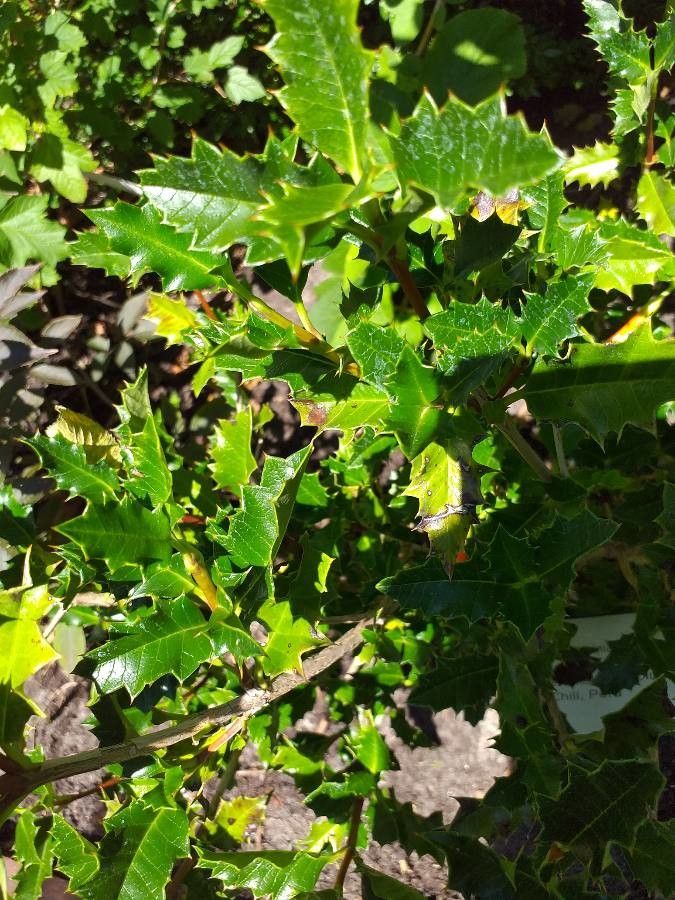
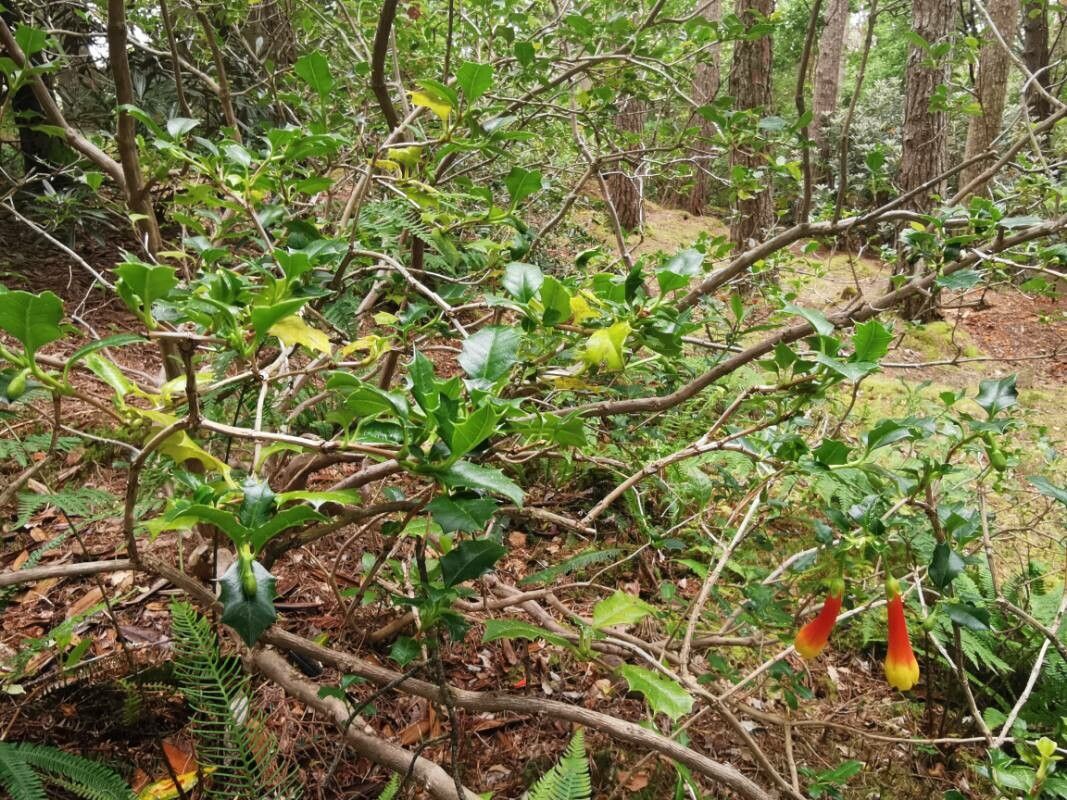
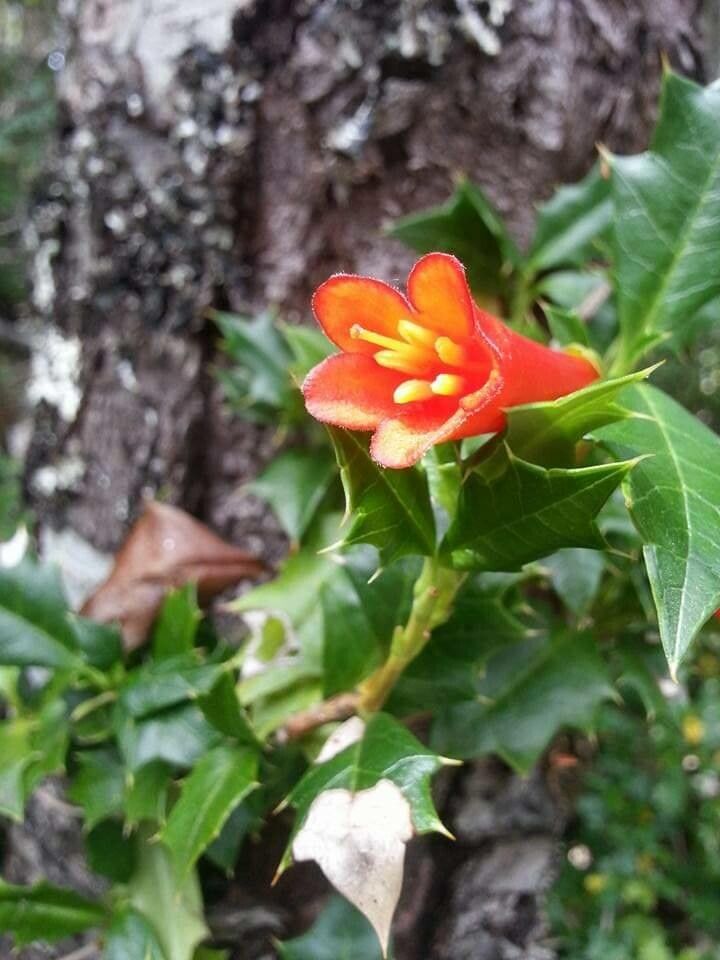
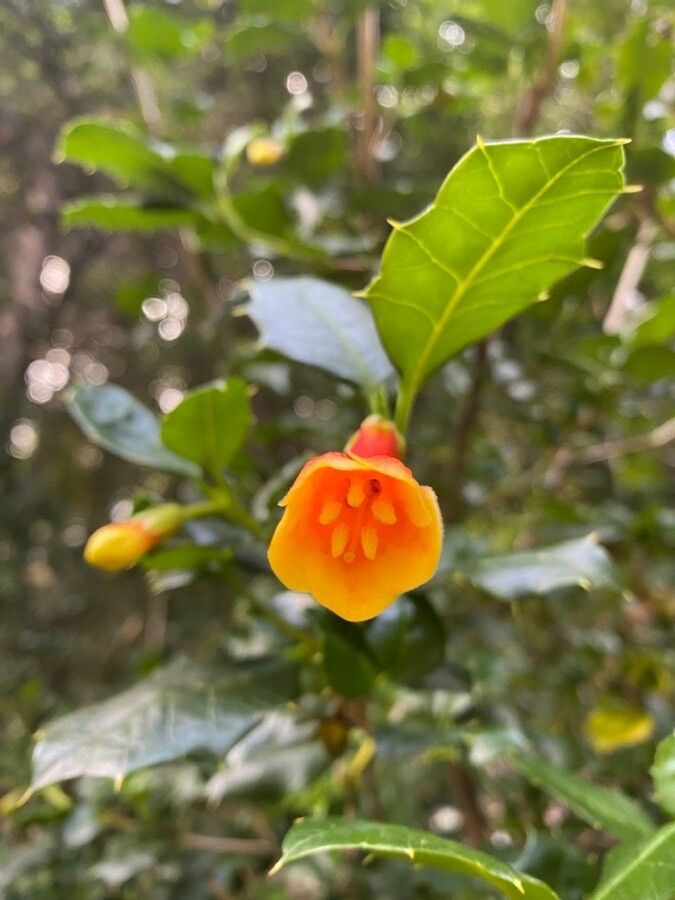
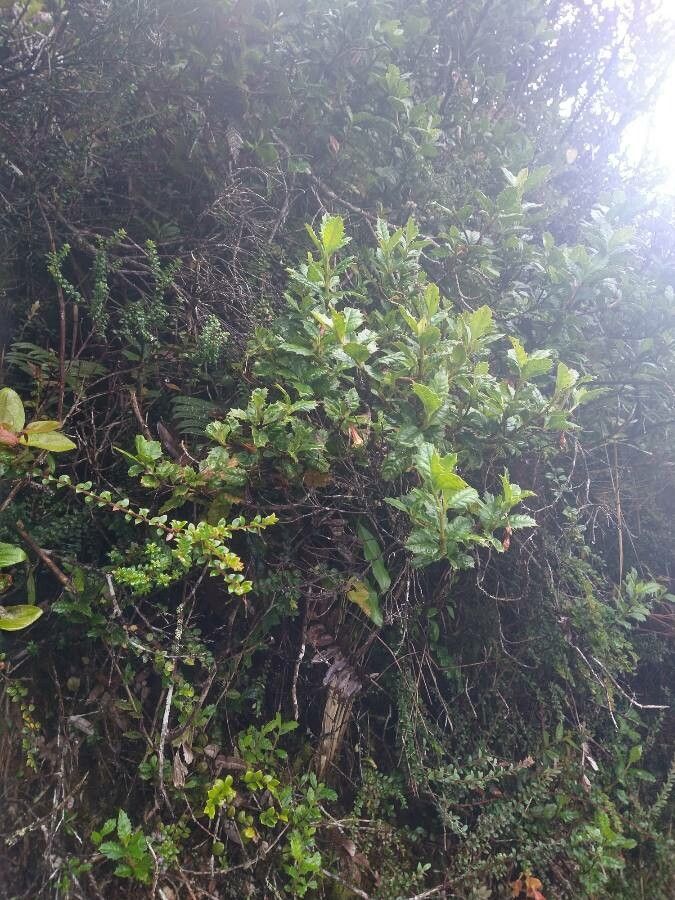
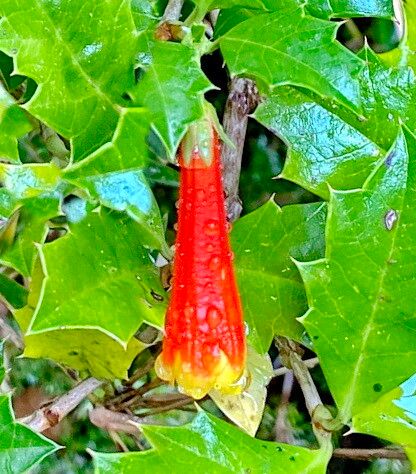
Desfontainia spinosa is a small evergreen shrub native to the Andes Mountains of South America. The plant typically reaches a height of 1 to 2 meters and features dark green, glossy leaves that measure approximately 5 to 10 centimeters in length. It produces small, tubular, bright red flowers with five petals, which bloom during the summer and autumn months. Desfontainia spinosa thrives in cool, moist environments and is commonly found in forests or along streams at elevations between 1,000 and 3,000 meters above sea level. Its attractive foliage and striking red flowers make it a popular choice as an ornamental plant. Traditionally, indigenous people have utilized Desfontainia spinosa for medicinal purposes, such as treating fever and stomach ailments. The leaves contain alkaloids that have been shown to possess anti-inflammatory properties. Overall, Desfontainia spinosa is a unique and beautiful plant valued both for its ornamental appeal and its medicinal properties.
Chilean holly is highly resistant to disease and typically does not suffer from illnesses. Care-wise, this plant is fairly low-maintenance. When grown outdoors it needs little watering, and larger specimens usually do not require pruning. Smaller plants, however, should be pruned after they have bloomed. Chilean holly is suitable for anyone with an outdoor space, such as a garden or deck, and does not demand extensive care experience.
How to keep Desfontainia Spinosa.
Light
Chilean holly naturally grows in habitats like forest understories or rocky locations, where it is exposed to natural shade. It prefers partial sun but can adjust to full sun or full shade, showing its versatile and hardy nature.
Water
Chilean holly, which originates from South American forests, thrives in consistently moist and high-humidity environments. It should be watered every 2-3 weeks, making sure the soil stays hydrated without becoming waterlogged. Although typically grown outdoors, it does best in climates similar to its rainforest origins, and it needs sufficient watering during dry periods.
Temperature
Chilean holly shows strong adaptability to a variety of climate conditions, from scorching summers to cold winters. Nevertheless, it has a preferred temperature range for healthy growth. If temperatures become too high, the plant is vulnerable to heat and humidity stress, which can lead to its death. In locations where temperatures near the lower limit of its cold tolerance, providing insulation to protect the plant is important.
Fertilizer
The timing of fertilizing Chilean holly is important. Apply fertilizer in early spring and repeat monthly through early summer. Fertilizer encourages attractive blooms and supplies energy during both dormant and active growth periods.
Pruning
Chilean holly has spiny leaves and red flowers. To promote healthy growth and improve its appearance, prune the plant from early to late winter. Start by removing any damaged branches, and thin out the foliage to improve air circulation. Be sure to use clean tools, making precise cuts just above the buds. This will encourage healthier growth, a more attractive shape, and enhanced flowering.
Botanical profile.
- Plant Type
- Shrub
- Life Cycle
- Perennial
- Genus
- Desfontainia
- Family
- Columelliaceae
- Hardiness Zone
- 7-10
- Mature Height
- 2.44 m
- Mature Spread
- 2.44 m
- Leaf Color
- Green
- Leaf Type
- Evergreen
- Flower Color
- Red, Yellow
- Flower Size
- 4.06 cm to 5.08 cm
- Bloom Time
- Summer
- Planting Time
- Spring, Summer, Autumn
- Harvest Time
- Fall
- Native Area
- Costa Rica, Ecuador, Peru
Other names.
Reader questions.
How should I water my Chilean holly?
Watering your Chilean holly is quite flexible, as you can use various common tools like watering cans, hoses, or even cups. It's important to apply water directly to the soil, making sure to evenly moisten all areas to provide sufficient water for the entire root system. Using filtered water is recommended to avoid harmful particles from tap water. Additionally, using water at or slightly above room temperature is preferred, as extremely cold or hot water might shock the plant. Nevertheless, the Chilean holly typically responds well to any type of water provided.
Why should I use fertilizer on my Chilean holly?
No matter which type of Chilean holly you have, regular fertilization is crucial for its overall health. Providing the right nutrients promotes strong growth and enhances its ability to withstand tough growing conditions, fight off diseases and pests. The foliage of your Chilean holly is particularly appealing, so it's important to maintain it. This involves establishing and following a specific fertilization schedule tailored to your plant. By doing so, your Chilean holly will develop deep-colored leaves and a lush appearance.
What are the sunlight requirements for Chilean holly?
Chilean holly, or Desfontainia spinosa, thrives best in partial sun, requiring about 3-6 hours of sunlight daily. This plant is native to environments that experience natural shade, such as forest understories or rocky areas. It's adaptable to both partial sun and full shade conditions. When planning where to place your Chilean holly, it's important to observe how sunlight moves through your garden to choose spots that offer a perfect balance of light and shade, ensuring the plant's happiness.
What do I do if I give my Chilean holly too much water or too little water?
When caring for outdoor plants, especially newly planted ones or seedlings, it is common for them to not receive enough water. Remember that for the first few months, it is necessary to water these plants regularly, especially when they are small or newly planted. This is because once the roots are established, Chilean holly can rely mostly on rainwater. If you have a Chilean holly planted in a pot, you are more likely to overwater it. In case you accidentally overwater your Chilean holly, there are steps you can take to fix the situation. First, stop watering the plant immediately to minimize the negative effects of overwatering. Then, remove the Chilean holly from its pot and inspect its roots. If you find that none of the roots have developed root rot, you can return the plant to its container. However, if you do find signs of root rot, trim away any affected roots and consider applying a fungicide to prevent further damage. Finally, replant your Chilean holly in well-draining soil. On the other hand, if you notice that your Chilean holly is underwatered, the solution is simple: water it more frequently. When a plant is not getting enough water, its leaves will droop, dry out, and eventually fall off. Once it is properly watered, the leaves will quickly regain their fullness. It is important to adjust your watering frequency as soon as you notice the plant is underwatered.
When should I fertilize my Chilean holly plant for the best results?
To properly fertilize your Chilean holly, start by feeding it in late winter or early spring. This provides the necessary nutrients for healthy growth when the weather warms up. If you live in a warm climate, it's also helpful to give your Chilean holly another round of fertilizer in early fall. This not only adds nutrients for the next growing season but also makes the plant more resilient to winter cold, preventing foliage damage. By fertilizing earlier, you give the new branches enough time to grow and withstand the winter chill.
How should I use artificial lighting for indoor Chilean holly plants?
Indoor Chilean holly plants require adequate lighting for optimal growth, especially when natural sunlight is insufficient. Artificial lighting can be a vital solution, promoting faster, healthier growth. LED lights are recommended for their ability to provide specific wavelengths necessary for plant growth. Full sun plants should have 30-50W/sq ft of artificial light, partial sun plants need 20-30W/sq ft, and full shade plants require 10-20W/sq ft. The light source should be placed 12-36 inches above the plant to mimic natural sunlight, and most plants will benefit from 8-12 hours of artificial light per day.
How frequently should I give water to my Chilean holly?
If your area doesn't get enough rainfall, you need to water your outdoor plants every 2 weeks in spring and fall. In summer, you'll need to water them more frequently. In winter, when growth is slower, water sparingly or not at all. Young or newly planted Chilean holly plants need more frequent watering to establish themselves and become more drought tolerant. For potted plants, you have two options for determining watering frequency. The first is to follow a set schedule, either weekly or every other week. However, this may not always be accurate for your specific growing environment. Another approach is to check the soil moisture. Wait until the top two to four inches of soil have completely dried out before watering again. This method is especially important during the summer when the plant's water needs are highest.
When is it not a good idea to put fertilizer on my Chilean holly?
To ensure proper care for your Chilean holly, there are specific times throughout the year when fertilization should be avoided. Firstly, it is unnecessary to fertilize the plant during the early and mid-winter months when it is dormant. Secondly, it is not advisable to fertilize during the late spring and summer when the weather is hotter and dryer. Fertilizing during this time may lead to a negative reaction from the plant. To prevent any problems, it is recommended to follow a fertilization schedule in which feeding is exclusively done in early spring and early fall.
What are the symptoms of insufficient light in Chilean holly?
When Chilean holly is grown indoors with insufficient light, it may exhibit symptoms such as small and mature leaves, leggy or sparse growth, faster leaf drop, slowed or halted growth, paler new leaves, chlorosis (leaves turning yellow), sunscald on leaves or stems, leaf curling, wilting, and leaf scorching. These symptoms indicate that the plant is struggling to adapt to the light conditions, which can negatively affect its health and growth.
How much water does my Chilean holly plant require?
To water your Chilean holly effectively, you don't always need to give it a lot of water. If only a few inches of soil have dried since your last watering, giving it about five to ten ounces of water each time will support healthy growth. You can also determine how much water to give based on the moisture level of the soil. Keep track of how many inches of soil have dried out between waterings. To ensure your Chilean holly gets enough moisture, water it enough to moisten all the dry layers of soil since the last watering. If more than half of the soil is dry, you may need to give it more water than usual. In these cases, keep adding water until you see excess water draining from the pot's drainage holes. If your Chilean holly is planted outdoors in an area with plenty of rain, it may not need additional watering. However, when the plant is young or newly established, it should receive 1-2 inches of rain per week. As it continues to grow and establish, it can rely solely on rainwater. Only during hot weather with no rainfall for 2-3 weeks should you consider giving a full watering to prevent stress.
What kind of fertilizer does my Chilean holly plant need?
A Chilean holly typically requires nitrogen as its most important nutrient, but that does not mean phosphorus and potassium are insignificant. In fact, your Chilean holly needs a decent amount of all three main nutrients, which is why a balanced fertilizer like a 10-10-10 can be effective. However, for optimal growth, a more precise nutrient ratio is often recommended. Fertilizers with slightly higher nitrogen content, such as a ratio of 10-6-4, tend to yield better results. When fertilizing, both granular and liquid-based fertilizers can be used.
What are the solutions for insufficient light exposure in Chilean holly?
To optimize growth for indoor Chilean holly plants with insufficient light, gradually shift them to sunnier spots each week until they receive 3-6 hours of direct sunlight daily. For large or immovable plants, consider using artificial lights such as desk or ceiling lamps or professional grow lights, leaving them on for at least 8 hours daily. Outdoors, gradually move your plants to progressively sunnier locations to prevent sunburn. Pruning overhanging branches and relocating smaller plants during their dormant period to sunnier spots with good drainage can also improve sunlight exposure.