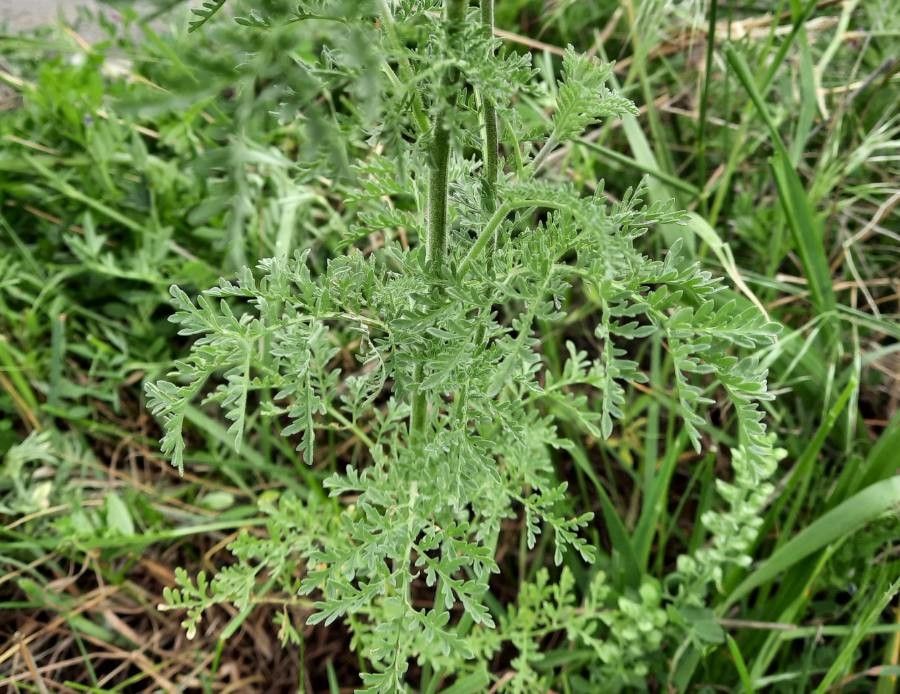
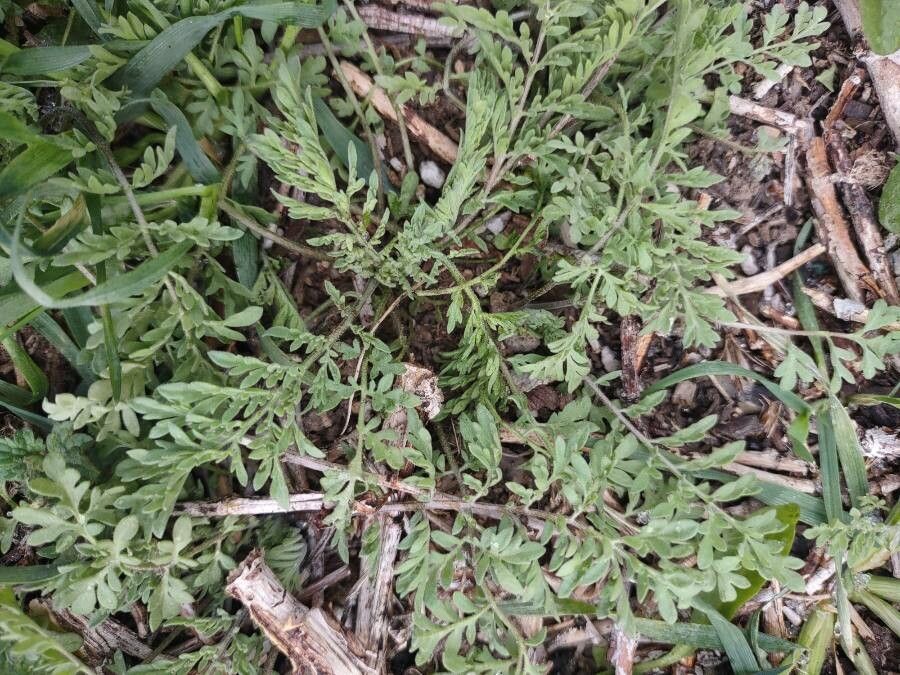
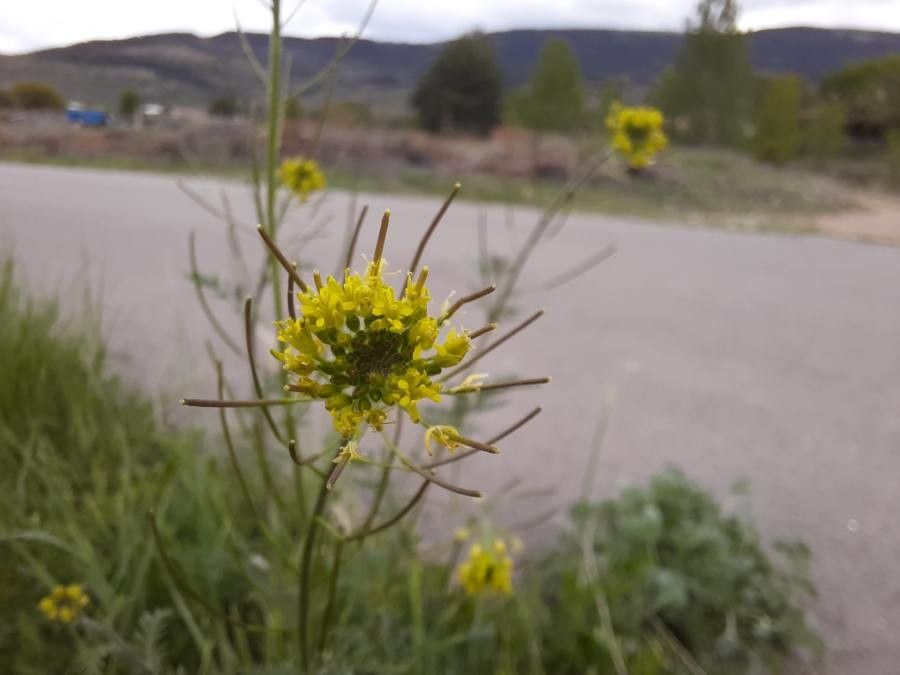
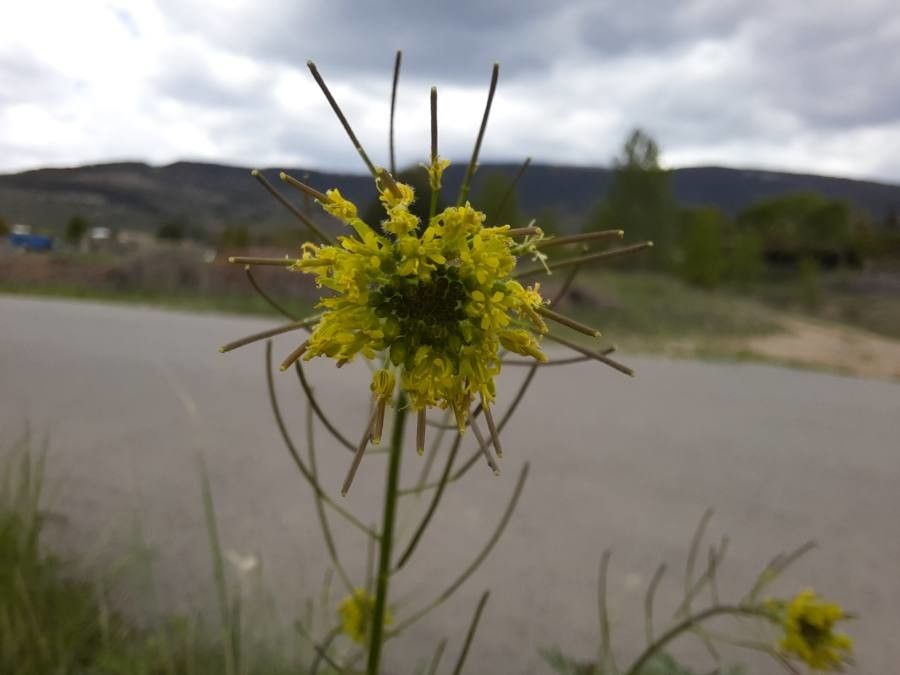
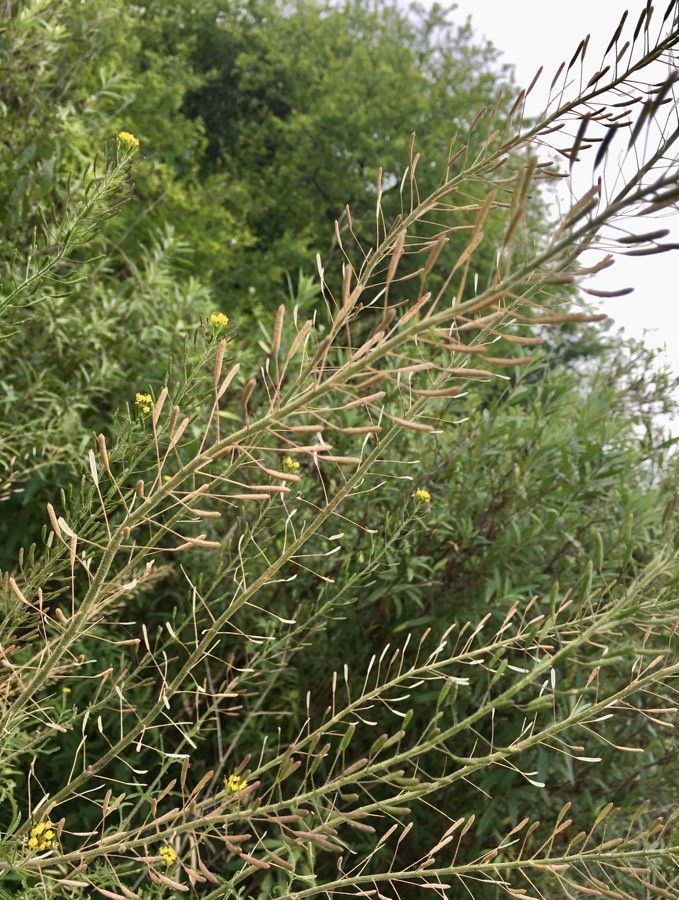
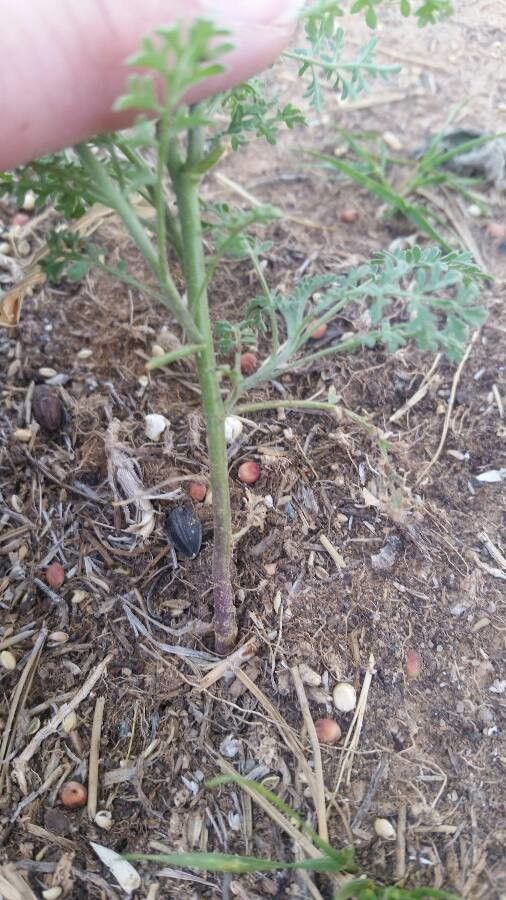
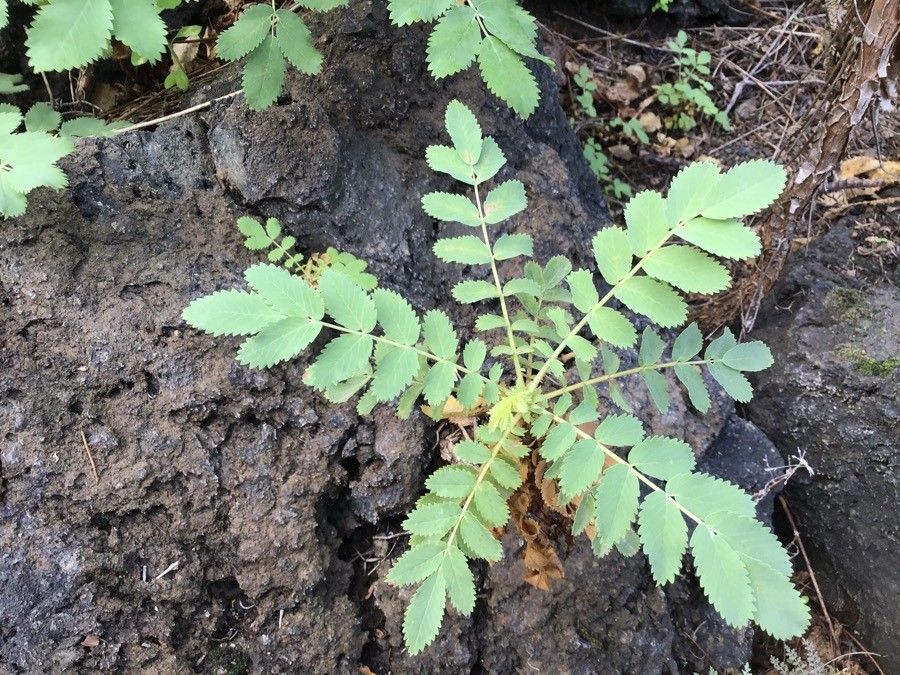
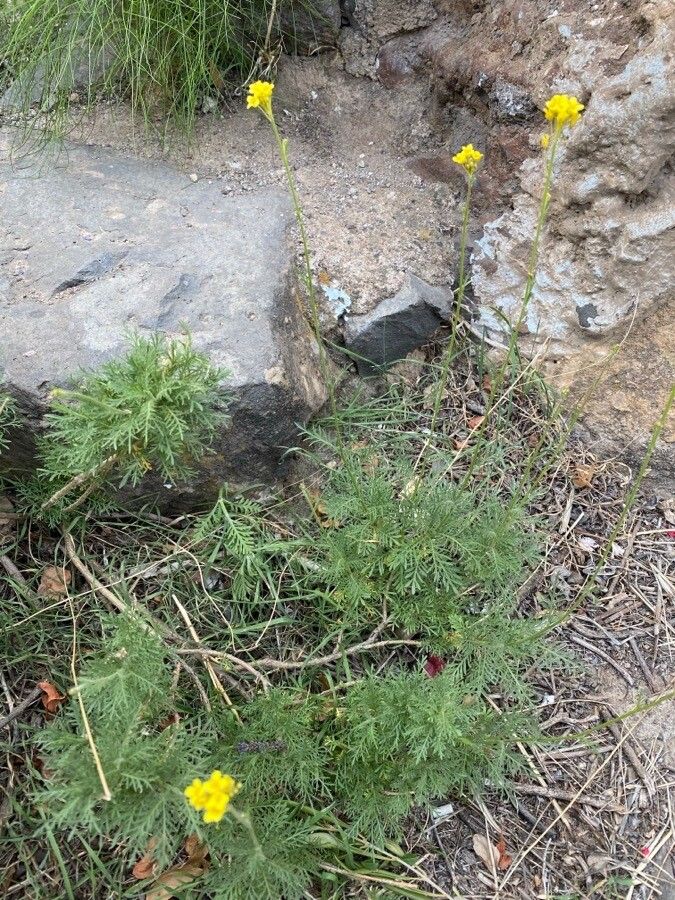
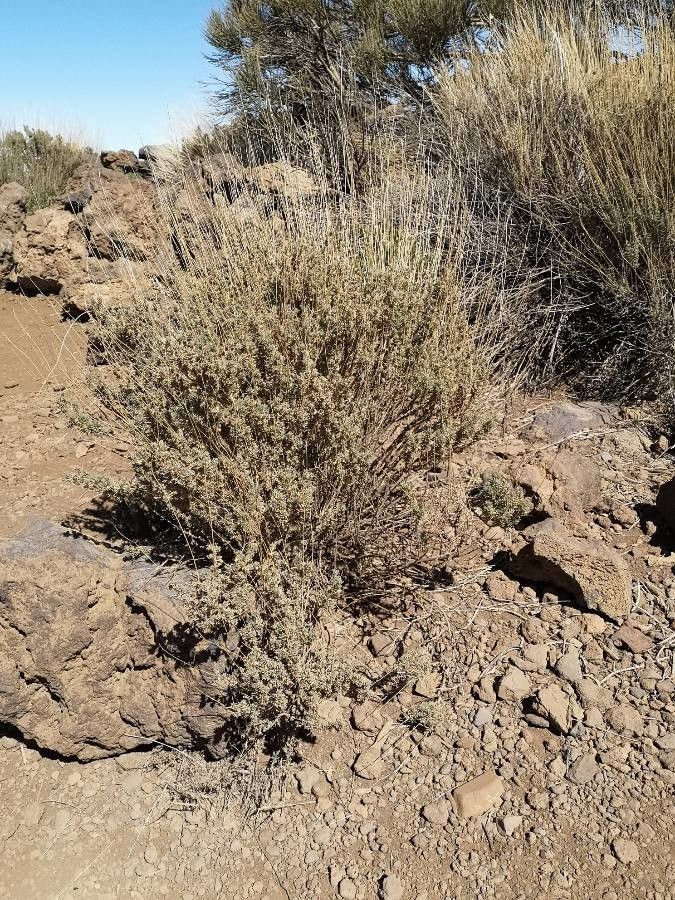
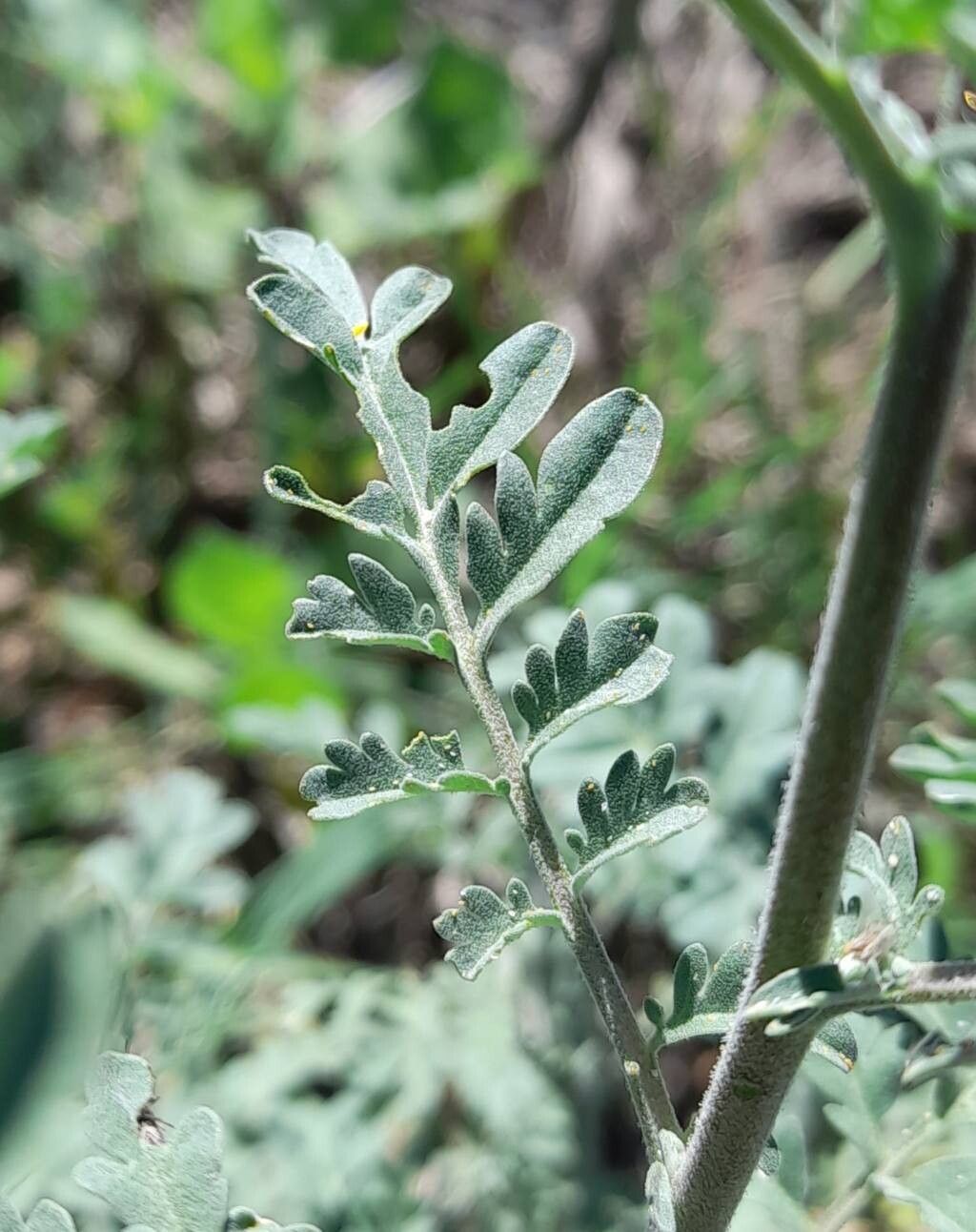
Descurainia pinnata is a species of flowering plant in the family Brassicaceae known by the common name western tansymustard. It is native to North America, where it is widespread and found in varied habitats. It is especially successful in deserts. It is a hardy plant which easily becomes weedy, and can spring up in disturbed, barren sites with bad soil. This is a hairy, heavily branched, mustardlike annual which is quite variable in appearance. There are several subspecies which vary from each other and individuals within a subspecies may look different depending on the climate they endure. This may be a clumping thicket or a tall, erect mustard. It generally does not exceed 70 centimeters in height. It has highly lobed or divided leaves with pointed, toothed lobes or leaflets. At the tips of the stem branches are tiny yellow flowers. The fruit is a silique one half to two centimeters long upon a threadlike pedicel. This plant reproduces only from seed. This tansymustard is toxic to grazing animals in large quantities due to nitrates and thiocyanates; however, it is nutritious in smaller amounts. The flowers are attractive to butterflies. The seeds are said to taste somewhat like black mustard and were utilized as food by Native American peoples such as the Navajo.
Western Tansymustard is largely disease-resistant and typically not prone to illnesses. However, it can be vulnerable to pests and diseases present in its environment. These infections are generally mild. As for care, the plant requires moderate maintenance. It should be pruned regularly to maintain a neat appearance and healthy growth. Fertilizing can also help encourage flowering. Western Tansymustard is suitable for anyone who has outdoor space, such as a garden or patio, and does not need extensive care experience. It may demand more attention if grown indoors.
How to keep Descurainia Pinnata.
Light
The western Tansymustard thrives with abundant light. It does not tolerate shaded conditions well and prefers locations that receive unobstructed sunlight. Both insufficient and excessive light can affect its growth, potentially causing stunted development or damage to the leaves. Its original habitat was in areas where sunlight was plentiful and bright throughout the day.
Water
Western Tansymustard is well-adapted to dry environments, displaying remarkable drought tolerance and efficient water usage. It only needs watering once a week to thrive, as it effectively conserves and stores water during times of low rainfall. This makes it ideal for outdoor areas such as open fields and deserts.
Temperature
Western Tansymustard can tolerate a broad range of temperatures, but its occurrence may still be restricted by different combinations of moisture and heat. It does best in warm summer climates with sufficient rainfall or irrigation. Extended stretches of cloudy, rainy weather or prolonged high temperatures raise the risk of Western Tansymustard dying. In winter, adequate protection from cold increases the plant's chance of survival.
Fertilizer
Western Tansymustard benefits from regular, weak applications of fertilizer to encourage healthy leaf growth. You should fertilize Western Tansymustard about once a month during the summer. Nitrogen is essential for foliage, and adding nitrogen-rich sources helps Western Tansymustard thrive.
Pruning
Western Tansymustard is characterized by its delicate foliage and small yellow flowers. To maintain its health and vitality, spring pruning is essential. Focus on removing dead parts and thinning out crowded areas to improve airflow and light penetration. This practice not only boosts the plant's health and flowering but also increases its resistance to diseases, promoting overall vitality and sustainable gardening.
Botanical profile.
- Plant Type
- Herb
- Life Cycle
- Annual, Biennial, Perennial
- Genus
- Descurainia
- Family
- Brassicaceae
- Hardiness Zone
- 4-9
- Mature Height
- 15 cm to 61 cm
- Mature Spread
- 30 cm
- Leaf Color
- Green
- Leaf Type
- Deciduous
- Flower Color
- Yellow
- Flower Size
- 0.25 cm
- Bloom Time
- Spring
- Planting Time
- Spring, Autumn
- Harvest Time
- Late spring, Early summer, Mid summer
Other names.
Reader questions.
How should I water my Western Tansymustard plant?
Western Tansymustard can be watered using a garden hose, watering can, or other common watering tools. This plant is not picky about the type of water it receives and can survive with rainwater, tap water, or filtered water. It is recommended to avoid watering this plant from overhead to prevent damage to leaves and flowers, as well as potential disease. Setting up a drip irrigation system is often the best way to water Western Tansymustard as it provides even and direct water to the soil. When watering Western Tansymustard in a container, you can use a cup, watering can, or tap water to water the soil directly.
What are the sunlight requirements for Western Tansymustard?
Western Tansymustard requires full sunlight, with a minimum exposure of over 6 hours of sunlight daily to thrive optimally. It's crucial to observe how sunlight moves through your garden to select areas that offer a perfect balance of light and shade, ensuring the plants' well-being. The plant originates from environments where it received bright, unobstructed sunlight throughout the day. Insufficient or excessive light can lead to issues like stunted growth or leaf damage.
What is the botanical name of Western Tansymustard?
The botanical name of Western Tansymustard is Descurainia pinnata.
What should I do if I give my Western Tansymustard too much water or too little water?
The solution for underwatering Western Tansymustard is simple: water it regularly when you notice it lacks moisture. However, overwatering can be a more serious problem. This can lead to disease and the decline and death of your plant if you don't catch it early. To prevent this, choose a suitable location with plenty of sunlight to dry the soil and good drainage to prevent waterlogging. If you overwater your potted Western Tansymustard, consider using a new pot with better drainage and loose soil when repotting.
How can artificial lighting be used for indoor plants like Western Tansymustard?
Indoor plants, including Western Tansymustard, require adequate lighting for optimal growth, especially when natural sunlight is not sufficient. Artificial lights can be a crucial solution in promoting healthier, faster growth. It is recommended to select the appropriate type of artificial light, such as LED lights, which can provide specific wavelengths needed by the plants. The intensity required varies with plant type - full sun plants need 30-50W/sq ft, partial sun plants require 20-30W/sq ft, and full shade plants 10-20W/sq ft. The artificial light source should be placed 12-36 inches above the plant, mimicking natural sunlight, and provided for 8-12 hours per day.
How many times should I give water to my Western Tansymustard?
Western Tansymustard requires regular watering throughout the growing season. In the spring, it is recommended to water the plant once a week. As the season progresses and temperatures rise, you may need to increase watering to two or three times a week. However, exceeding this rate can harm the plant, so be cautious. Regardless of watering frequency, ensure that the soil remains moist but not overly wet. When watering Western Tansymustard in a pot, you should increase the frequency due to the soil drying out faster. In most cases, watering container-grown Western Tansymustard a few times per week is recommended, compared to just once a week for plants in the ground.
What are common symptoms of inadequate light in Western Tansymustard?
When cultivated indoors or under inadequate light, Western Tansymustard may exhibit symptoms such as smaller new leaves, leggy or sparse growth, faster leaf drop, slower or halted growth, lighter-colored new leaves indicating a lack of chlorophyll, chlorosis or yellowing of leaves, sunscald, leaf curling as a defense against excessive sunlight, wilting from rapid water loss, and leaf scorching. These symptoms highlight the plant's struggle under poor lighting conditions and the need for adequate sunlight.
How much water does my Western Tansymustard plant require?
Determining how much water to give your Western Tansymustard can be done in a few ways. Some gardeners prefer to assess the soil moisture by feeling it, watering until the top six inches are moist. Another option is to use a specific measurement. Generally, watering your Western Tansymustard with about two gallons per week is recommended, adjusting for temperature and soil drying speed. However, be cautious not to overwater if your plant requires less. If growing in a container, you'll need a different approach. Ensure all layers of soil are moist by checking with your finger or allowing excess water to trickle out of the drainage holes.
What strategies can be implemented to improve lighting for Western Tansymustard?
To mitigate light deficiency for Western Tansymustard, indoor plants can be gradually moved to sunnier locations to receive at least 6 hours of direct sunlight daily, utilizing south-facing windows and keeping curtains open. Alternatively, artificial lighting such as desk, ceiling lamps, or professional plant grow lights can be used for at least 8 hours daily. For outdoor plants, a gradual relocation to sunnier spots is recommended to prevent sunburn. Reducing obstructions like pruning trees and transplanting smaller plants during their dormant periods to brighter locations can also significantly improve light exposure. Affected plant parts may not recover, but new growth will be healthy after adjusting light conditions.
How do I know if I'm giving enough water to my Western Tansymustard plant?
Avoiding overwatering your Western Tansymustard can be challenging because these plants have deep roots that need regular watering. However, they are also highly prone to root rot and browning if overwatered. Underwatering is less of a concern as these plants can survive without extra watering for some time, but if left too long without water, they may wilt and develop dry leaves.
How should I water my Western Tansymustard at different times of the year?
As the season progresses, you can expect your Western Tansymustard's water needs to increase. In the spring, watering once a week should be sufficient. However, as the summer heat arrives, you will likely need to water your Western Tansymustard a bit more frequently, potentially up to three times per week. This is especially important if your Western Tansymustard is growing in containers, as the soil in containers tends to dry out faster in warm weather. In the autumn, when your Western Tansymustard is still blooming, it may require slightly less water as the temperature cools down and the sun is not as intense as it was during the summer.
How should I water my Western Tansymustard at different times when it is growing?
Throughout the year, Western Tansymustard goes through different growth stages, each with varying water requirements. To start, when you plant Western Tansymustard as a seed, it will need more water. Keep the soil consistently moist by watering often during the seed germination phase. After a few weeks, as the plant grows above the soil, it will require slightly less water than during the initial seedling phase. Once the plant is fully mature, you can switch to watering it once a week. During flower development, providing a bit more water can be helpful.