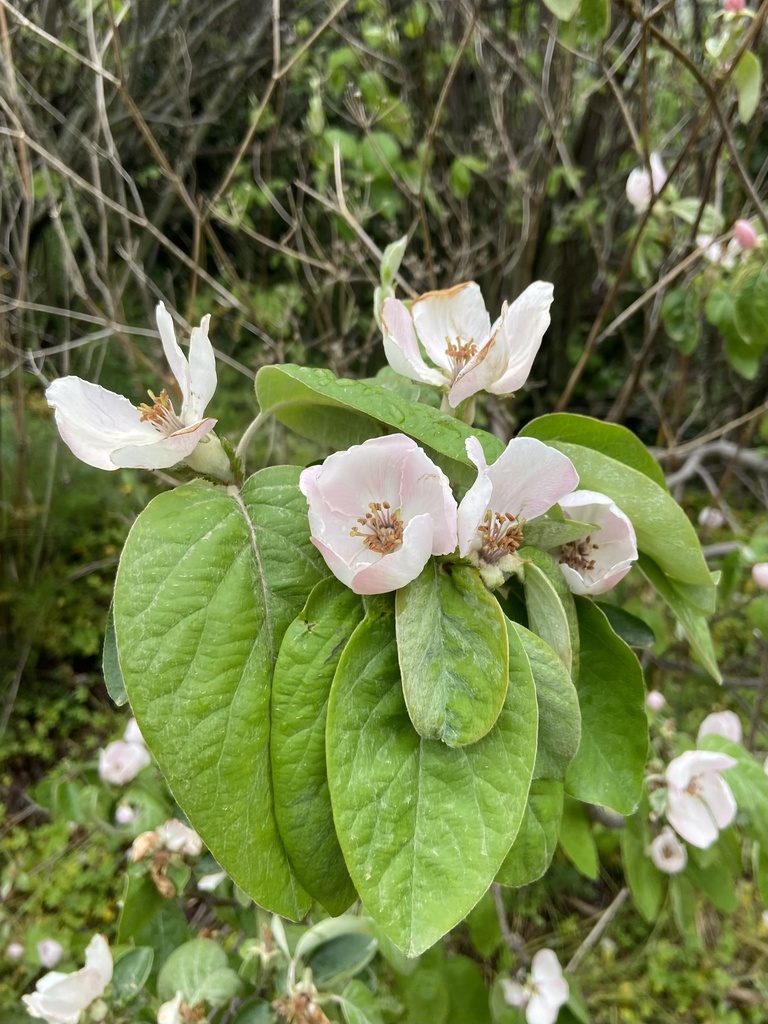
The quince (; Cydonia oblonga) is the sole member of the genus Cydonia in the Malinae subtribe (which also contains apples and pears, among other fruits) of the Rosaceae family. It is a deciduous tree that bears hard, aromatic bright golden-yellow pome fruit, similar in appearance to a pear. Ripe quince fruits are hard, tart, and astringent. They are seldom eaten raw, but are processed into marmalade, jam, paste (known as quince cheese) or alcoholic beverages. The quince tree is also grown as an ornamental plant for its attractive pale pink blossoms and other ornamental qualities.
Quince has strong disease resistance and is generally not susceptible to illnesses. As for care, this plant is fairly low maintenance. When grown outdoors it needs minimal watering, and larger plants typically do not require pruning. Smaller plants, however, should be pruned after they finish blooming. Quincet is suitable for anyone with outdoor space, such as a garden or a deck, and does not demand extensive care experience.
How to keep Cydonia Oblonga.
Light
Quince prefers sites where the sun is unblocked and where light can filter through to a moderate degree. This level of illumination is vital for its efficient growth and fruiting. If light is too low or overly intense, quince can experience stunted growth and its fruits may lose their characteristic flavor. The plant's original habitat was full light, which is essential for its lifespan.
Water
Quince plants, which originate from temperate regions, thrive best in well-drained soil with moderate moisture levels. To keep them healthy, water them every one to two weeks. Increase the frequency of watering during the active growth period in spring, and reduce it in the fall as they enter dormancy.
Humidity
This plant needs special care because it loves high humidity levels of 60-80% or more. The best way to achieve this is by placing a humidifier near the plant. Daily misting is also essential! Make sure the room has good ventilation.
Temperature
The quince does well in temperatures from 41 to 90 ℉ (5 to 32 ℃). Its natural habitat is temperate areas with cool winters and mild summers. In summer, it is advisable to keep the temperature below 80 ℉ (27 ℃), and in winter to keep it above 25 ℉ (-4 ℃).
Fertilizer
The quince plant needs adequate nutrients for optimal fruit production. Fertilize in early spring to promote new growth and bloom development. Regular feeding keeps the plant healthy, helps it produce more delicious fruit, and prevents nutrient-deficiency problems like yellow leaves and poor fruit production.
Pruning
Quinces should be pruned in late winter while the plants are dormant. Start by removing any dead wood, thinning out the branches, and reducing the canopy size to improve air circulation and light exposure. These steps promote healthy growth and may enhance fruit production. Remember to always use clean, sharp tools to avoid causing damage.
Pot & Repot
When repotting Quince, select a container 1-2 inches (2.5–5.1 cm) larger with good drainage. Use a well-draining potting mix. Repot in spring or fall, making sure the root ball sits slightly below the rim of the flower pot. Water thoroughly after repotting and place it in a warm spot with indirect sunlight.
Botanical profile.
- Plant Type
- Tree, Shrub
- Life Cycle
- Perennial
- Genus
- Cydonia
- Family
- Rosaceae
- Hardiness Zone
- 5-8
- Mature Height
- 4.88 m to 7.92 m
- Mature Spread
- 3.96 m to 6.1 m
- Leaf Color
- Green
- Leaf Type
- Deciduous
- Flower Color
- Pink, White
- Flower Size
- 5.08 cm
- Bloom Time
- Mid spring, Late spring
- Planting Time
- Spring, Autumn
- Harvest Time
- Mid summer, Late summer
- Native Area
- Iraq, Turkey, Iran, Armenia, Azerbaijan
Other names.
Reader questions.
How should I water my Quince plant?
To ensure excellent root development, place a garden hose at the base of the plant. Avoid spraying the leaves directly. If the plant is outdoors and exposed to direct sunlight, the leaves will need more water. You can use bubblers to moisten the roots of each plant. Soaker hoses can be used to cover the entire garden or bed, especially when adding or removing plants, to encourage deep root growth. After watering, drain any excess water and wait for the soil to dry before watering again. Water at ground level to prevent diseases. On sunny days, it can be beneficial to spray the entire bush with water. Whether the plant is potted or in the ground, remember that Quince prefers deep watering instead of light sprinkling.
Why is it important to add fertilizer to my Quince plant?
Plants need nutrients to grow, and fast-growing plants can quickly deplete the soil of these nutrients. Therefore, regularly fertilizing Quince plants is important for their health and the quality of their fruit. If plants are not fertilized for a long time, they can experience various problems. These include issues with foliage, such as yellow leaves, reddish coloration, deformities, withered tips, or extensive dieback. Nutrient deficiency can also affect the bark, causing disorders, slow growth, poor shoot development, and a lack of fruit production.
What are the sunlight requirements for Quince?
Quince plants require full sun, which means they need more than 6 hours of direct sunlight daily, to thrive and produce fruit effectively. However, they can also tolerate partial sun conditions, receiving about 3-6 hours of sunlight. It's important to observe how sunlight moves through your garden to find spots that offer a perfect balance of light and shade, ensuring the plants' well-being.
What are the ideal growing conditions for Quince?
The Quince thrives in temperatures ranging from 41 to 90°F (5 to 32°C), favoring temperate regions with cool winters and mild summers. Ideally, summer temperatures should be kept below 80°F (27°C) and winter temperatures above 25°F (-4°C). Quince possesses strong cold resistance, so special frost protection measures are not typically necessary. However, cold protection, such as wrapping the trunk and branches with non-woven fabric or cloth, is recommended if temperatures are expected to drop below the limit growth temperature. Additionally, watering the plant abundantly before the first freeze in autumn to keep the soil moist can help prevent drought and water scarcity during winter and early spring.
What should I do if I give Quince too much or too little water?
An overwatered Quince may display yellowing, dropping, and wilting leaves, as well as a dull and unhealthy appearance with mushy stems. It is advisable to adjust your watering schedule when these signs appear. Wilting can also indicate under watering, characterized by crispy and dry leaves. If the soil is dry and simply watering is not enough, giving it a thorough watering should suffice. However, even with enough water, the Quince may still show yellow leaves and dryness due to root damage. Once the plant returns to normal, the yellowing of leaves will cease. Indoors, always check the moisture levels of the pot and avoid overwatering. Look out for black spots, and if present, allow the soil to dry out for a few days before watering again. Overwatering can lead to root rot, so consider transferring the plant to a different pot if discolored and slimy roots are noticeable. Additionally, take precautions to prevent root rot and avoid overly soggy soil. When planting Quince outdoors, ensure the soil is adequately watered by checking its moisture levels with your fingers. If the soil feels too dry, it may indicate underwatering, so watering should be increased to aid the plant's recovery.
When should I fertilize my Quince tree?
The best time to fertilize Quince is in the early spring, before the buds emerge. During this time, Quince is coming out of winter dormancy and is using stored reserves to produce new growth. Since energy is needed for bloom development, it's advisable to fertilize about 2 to 4 weeks before the expected bloom time. This allows enough time for the nutrients to be absorbed by the plant. While you can continue to fertilize Quince throughout the spring, it's not recommended to fertilize in the autumn as it can lead to excessive foliage growth late in the season. This late growth makes the leaves vulnerable to winter damage.
Why is sunlight essential for Quince plants?
Sunlight is crucial for Quince plants as it promotes efficient growth and fruit production. These plants prefer unobstructed sunlight with moderate light filtration. Insufficient or overly harsh sunlight can lead to stunted growth and a loss of characteristic flavor in fruits. Originally thriving in full light environments, maintaining an optimal level of sunlight is key for the plant's lifespan.
How does low temperature affect Quince and what are the solutions?
Quince is cold-tolerant and performs best when temperatures are kept above the suitable growth temperature minimum and above the tolerable growing temperature minimum during winter. If temperatures fall below the limit growth temperature, there might not be noticeable changes during winter, but the branches could become brittle and dry by spring, failing to produce new shoots. The solution for this is to prune away any dead branches in spring that have failed to produce new leaves.
How much water does my Quince need?
The Quince plant prefers a deep watering method, meaning you should soak it in a gallon of water each time you water it, especially if it's planted in a pot. Potted plants have limited water storage, so the soil tends to dry out quickly. If you live in a cold region, you should water the Quince every 3 to 5 days. Watering in the morning when the soil is dry, both inside and outside, is recommended. You can check if the plant needs watering by feeling the soil; if the top 2-3 inches are dry, it's time to give the plant a good soak. During hot weather, keep an eye on the moisture levels, as the soil in the pot can dry out rapidly. If you have a Quince garden, you'll need to irrigate the soil as well. In hot climates, watering once a week should be sufficient. Only water when the top 2-3 inches of soil are too dry, and make sure not to overwater if there has been enough rainfall. Quince plants typically thrive in spring and fall. Outdoors, adding a layer of mulch about 3 to 4 inches deep can help to conserve water. Sandy soil drains faster, so plants in this type of soil will need to be watered more frequently. On the other hand, plants in clay soil should be watered less often, allowing the soil to dry out for 2-3 days before watering the plant again to avoid root rot. To keep track of watering needs, consider marking the date on a calendar or watching for drooping leaves, which may indicate that the plant is in need of water.
When is it best to not add fertilizer to my Quince plant?
To ensure successful growth, follow these guidelines for fertilizing Quince: 1. Avoid fertilizing Quince during its first year of growth. If fertilizer is not necessary, it's best to err on the side of caution and refrain from providing it. 2. If you pruned 20% or more of the plant the previous year, do not fertilize. Fertilizing in this case can be detrimental to the plant. 3. Do not fertilize Quince plants that are diseased or damaged, as this can do more harm than good. It's important to address the root cause of the issue before considering fertilization. 4. Refrain from fertilizing after the peak of summer as excessive growth just before winter can be unfavorable. 5. Quince should not be fertilized during times of hot and dry weather, as dry soil doesn't effectively deliver fertilizer. Fertilizing at this time can stimulate growth that requires more water, which may not be accessible. 6. It's best to apply fertilizer during earlier parts of the season when temperatures are cooler. 7. Remember that nearby plants or lawns can absorb fertilizer intended for Quince. Be cautious to avoid inadvertently providing a double-dose of fertilizer to plants.
How can artificial lighting support Quince plant growth?
Artificial lighting can be a vital solution for indoor Quince plants, especially when natural sunlight is insufficient. LED lights are commonly used because they can provide specific wavelengths needed by plants. For full sun plants, 30-50W/sq ft of artificial light is recommended, 20-30W/sq ft for partial sun plants, and 10-20W/sq ft for full shade plants. The light source should be placed 12-36 inches above the plant, mimicking natural sunlight for 8-12 hours per day.
What happens if Quince is exposed to high temperatures and what can be done?
During summer, it's crucial to keep Quince below the suitable growth temperature maximum. Exceeding the tolerable growing temperature maximum can cause the leaves to lighten in color, the tips to become dry and withered, and the plant to be more susceptible to sunburn. The solutions include trimming away the sunburned and dried-up parts, moving the plant to a location with shade from the midday and afternoon sun, or using a shade cloth. Furthermore, watering the plant in the morning and evening helps maintain soil moisture and prevent damage.