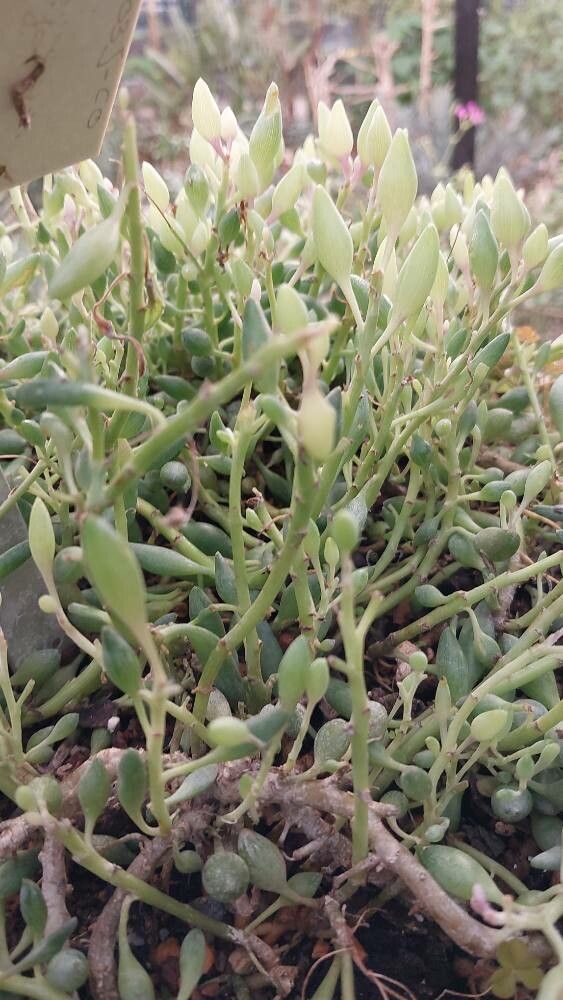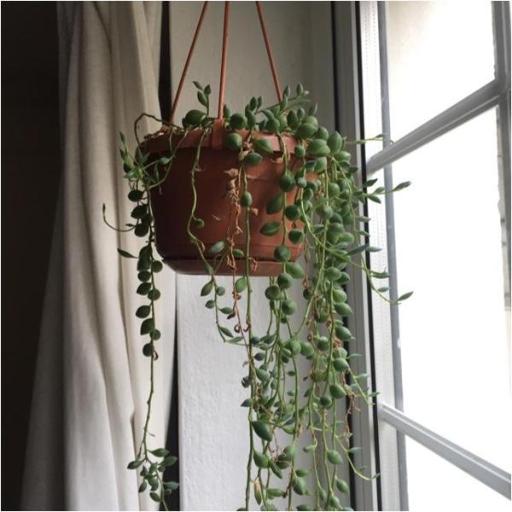
Curio rowleyanus, syn. Senecio rowleyanus, is a flowering plant in the daisy family Asteraceae. It is a creeping, perennial, succulent vine native to the drier parts of southwest Africa. In its natural environment its stems trail on the ground, rooting where they touch and forming dense mats. It often avoids direct sunlight by growing in the shade of other plants and rocks. It is commonly known as string-of-pearls or string-of-beads. "String-of-beads" and several other common names are shared with Curio herreanus (string of watermelons), which has teardrop-shaped leaves, rather than spherical.
String of Beads or String of Pearls: This plant is named after the British botanist Gordon Douglas Rowley, who specialized in the study of cacti and succulents. In its natural habitat, the plant's stems trail along the ground, rooting wherever they touch and forming dense mats. The common name "string of pearls" or "string of beads" comes from its unique leaf characteristics, which resemble small peas in both size and shape.
String of pearls has moderate disease resistance but is particularly sensitive to humidity and overwatering. It becomes more prone to illness if kept in low light and overwatered. Regarding care, String of pearls is drought-tolerant and can withstand long periods without watering. It needs little fertilizer and only occasional pruning. These characteristics make it suitable for people at any level of experience, especially those who prefer to spend less time on plant care and who may be away from home for extended periods. It is a good option for anyone who does not want to devote much time to plant maintenance yet still wants an easy-to-care-for plant.
How to keep Curio Rowleyanus.
Light
The string of pearls prefers plenty of light because its native environment is very bright. It also tolerates moderate sun exposure. However, excessively strong rays can damage the plant and cause sunburn. Conversely, insufficient light may result in poor growth and development.
Water
The string of pearls plant thrives in dry conditions and needs only minimal watering, about once every three weeks. It's best suited for indoor settings, where well-draining soil can help prevent root rot. Its natural moisture-retaining ability makes it an ideal choice for low-maintenance care.
Humidity
This plant will thrive in moderate humidity, which is probably the level in your home. However, misting it a few times a week can be very beneficial. Make sure the room has good ventilation.
Temperature
The string of pearls generally grows in warm, dry climates and prefers average temperatures of 68℉ to 100℉ (20℃ to 38℃). In colder months, keep the plant out of drafty spots and ensure the temperature remains above 50℉ (10℃) to avoid damage.
Fertilizer
String of Pearls requires only light fertilizer applications 1-2 times a year during the growing season. Do not fertilize in winter or summer when the plant is dormant. Use reduced fertilizer on recently repotted plants and wait a couple of months after repotting before applying fertilizer. Fertilizing helps maintain healthy growth and encourages blooms.
Pot & Repot
When repotting String of pearls, choose a pot slightly bigger than the current one that has good drainage. Fill it with a gritty, well-draining succulent or cactus mix. Gently remove the plant from its old container, brush off excess soil, and place it at the same depth in the new pot. Wait a few days before watering to let any root damage heal. Repot in spring or fall and keep the plant in a brightly lit spot.
Botanical profile.
- Plant Type
- Succulent, Vine, Herb
- Life Cycle
- Perennial
- Genus
- Curio
- Family
- Asteraceae
- Hardiness Zone
- 9-12
- Mature Height
- 61 cm to 91 cm
- Mature Spread
- 46 cm
- Leaf Color
- Green
- Leaf Type
- Evergreen
- Flower Color
- White
- Flower Size
- 2.54 cm
- Bloom Time
- Early spring, Mid spring, Winter
- Planting Time
- Spring, Autumn, Winter
- Harvest Time
- Fall, Early winter
- Native Area
- South Africa