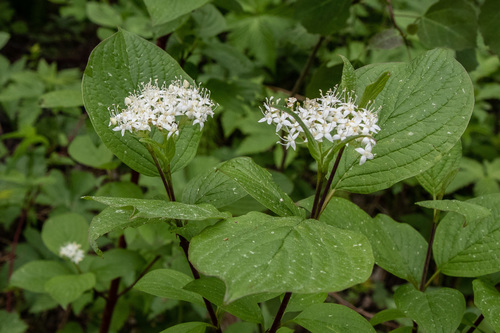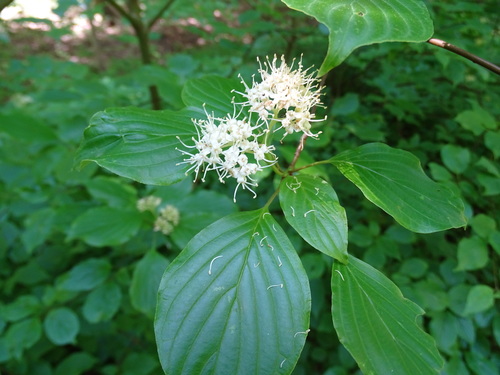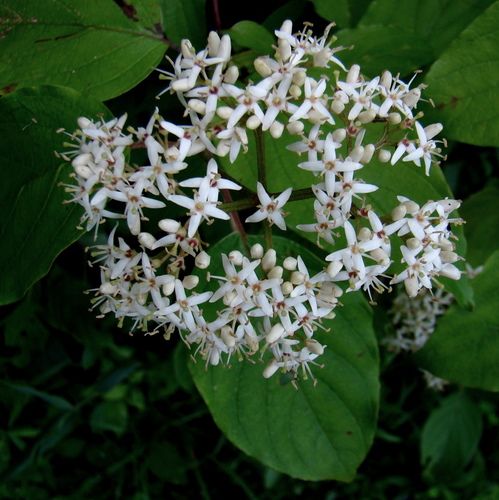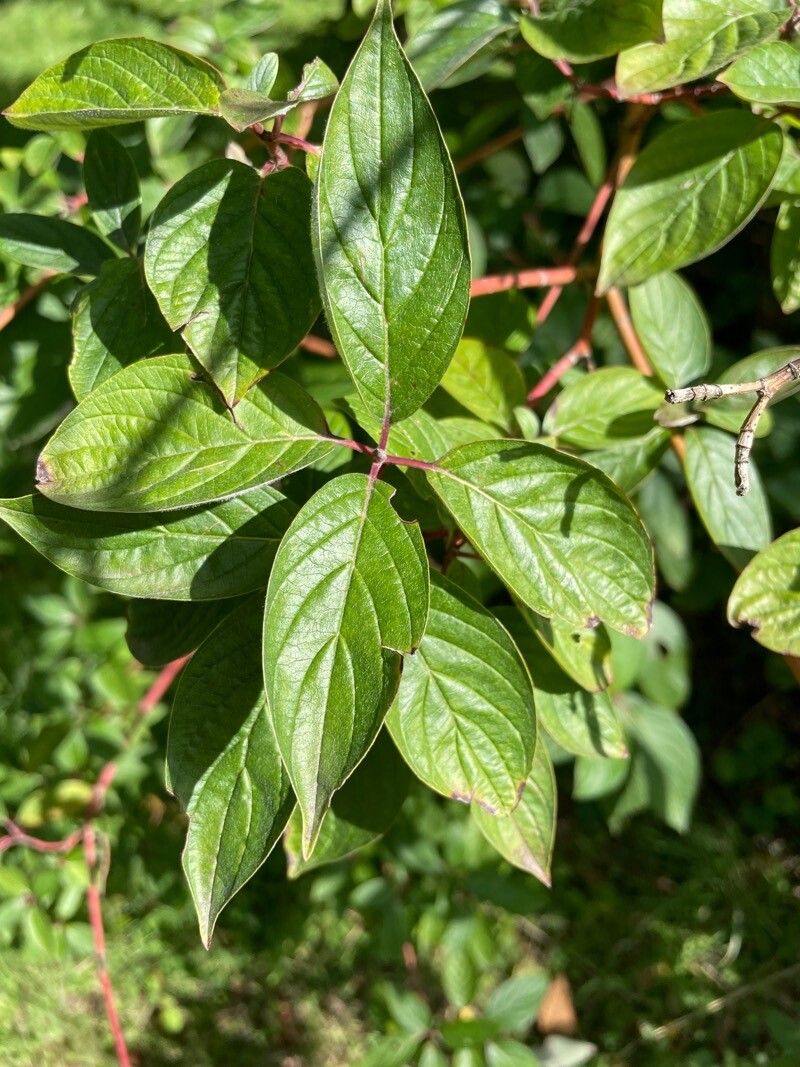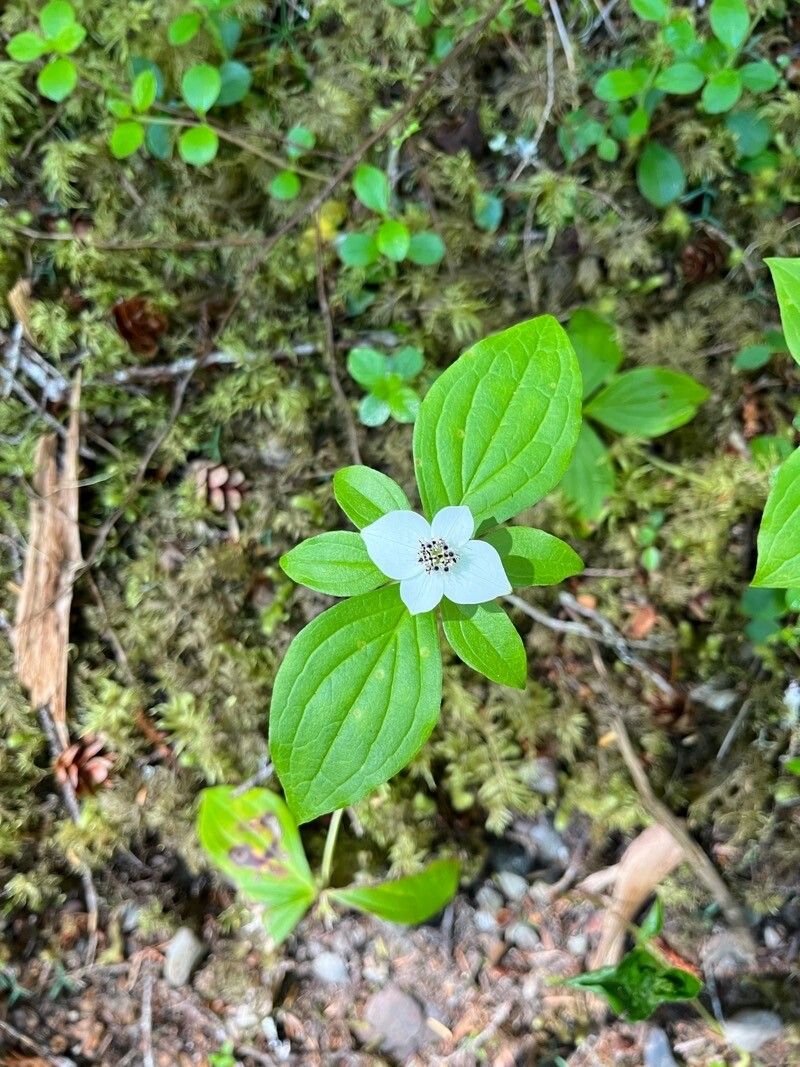
Cornus × unalaschkensis is a species of flowering plant in the Cornaceae, the dogwood family. Common names for the plant include Alaskan bunchberry, western cordilleran bunchberry, or simply western bunchberry.The species is native to the west coast of North America from Alaska to California, as well as Magadan in Russia. In the northwestern United States it is a common plant, even abundant.This is a rhizomatous subshrub with stems up to 20 centimetres (7.9 in) tall. Leaves are borne in a whorl and are oval in shape and up to 8 centimetres (3.1 in) long. The leaves are hairless to hairy. Flowers are borne in a cyme inflorescence, but are much smaller than the four white or pinkish bracts surrounding them. These bracts are 1 or 2 cm long; the petals at the center are only about a millimetre long. The fruit is a bright red drupe 6 to 8 mmm in length.Its habitat includes forests and bogs, especially with layers of decaying matter.The taxonomy of this plant is not entirely certain. This particular plant is not always considered a species in its own right. It is sometimes called a hybrid, or Cornus × unalaschkensis. Sometimes it is listed as the same species as Cornus canadensis. However, many authors consider it to be an allopolyploid, with chromosomes descended from C. canadensis and C. suecica. The three species can be told apart by careful examination of the petal and leaf morphology. Also, C. unalaschensis does not usually grow in the same regions as the other two plants.The fruit of this plant is edible, and has been used for food by various Native American groups, such as the Bella Coola and Kitasoo. For example, the Haisla mixed the berries with oolichan grease and served the mash for dessert.
Western cordilleran bunchberry shows strong disease resistance and is generally not prone to illnesses. That said, it can be vulnerable to pests and diseases present in its environment. Such infections are typically mild. Care-wise, the plant needs a moderate level of maintenance. It should be pruned regularly to preserve a good appearance and support healthy growth. Applying fertilizer can also help encourage flowering. Western cordilleran bunchberry is appropriate for anyone with outdoor space, such as a garden or patio, and does not require a lot of care experience. When grown indoors, it may need more attentive care.
How to keep Cornus Unalaschkensis.
Light
Western cordilleran bunchberry needs full sun to grow healthily, though it can adapt to moderately lit areas. The plant originates from regions with long daylight hours. Insufficient light can cause stunted growth, while too much exposure may lead to wilting or leaf burn.
Water
The Western Cordilleran Bunchberry thrives in moist, forested environments and prefers soil that remains consistently moist. For best results, water it weekly to ensure optimal hydration and support its lush foliage throughout the growing season. This plant is typically grown outdoors and flourishes in cooler climates due to the benefits of natural rainfall patterns.
Temperature
Western cordilleran bunchberry is native to habitats with moderate temperatures and grows best between 41 and 95 °F (5 and 35 °C). Alter watering routines as temperatures change with the seasons, keeping them cooler during dormant periods.
Fertilizer
The best time to fertilize a Western cordilleran bunchberry is in early spring, as it comes out of dormancy and starts active growth. Fertilizing supplies essential nutrients needed for healthy development. Although Western cordilleran bunchberry has fairly low fertilizer requirements, applying fertilizer once a year can improve its survival and encourage better, longer-lasting flowers.
Pruning
The Western Cordilleran bunchberry is a low-growing shrub known for its striking white flowers and red berries. To ensure optimal growth, prune the shrub between early and late spring. Remove any dead branches and thin out crowded areas to improve airflow. It's important to use clean, sharp tools and to avoid heavy pruning to preserve the plant's structure and vigor.
Botanical profile.
- Plant Type
- Herb
- Life Cycle
- Perennial
- Genus
- Cornus
- Family
- Cornaceae
- Hardiness Zone
- 4-9
- Mature Height
- 10 cm to 20 cm
- Mature Spread
- 30 cm to 61 cm
- Leaf Color
- Green, Dark Green
- Leaf Type
- Deciduous
- Flower Color
- White
- Flower Size
- 2.54 cm to 5.08 cm
- Bloom Time
- Mid spring, Late spring
- Planting Time
- Spring, Autumn
- Harvest Time
- Late summer, Early fall
Other names.
Reader questions.
What are the sunlight requirements for Western cordilleran bunchberry?
Western cordilleran bunchberry requires full exposure to sunlight for healthy growth, benefiting from places with considerable daylight hours. Full sun is described as above 6 hours of sunlight, while partial sun refers to about 3-6 hours of sunlight. It's crucial to observe how sunlight moves through your garden to ensure that your plants receive the perfect balance of light and shade, ensuring their happiness and optimal growth.
What is the preferred temperature range for the Western cordilleran bunchberry?
The Western cordilleran bunchberry, botanically known as Cornus unalaschkensis, thrives best in environments with moderate temperatures, favoring a range between 41 to 95°F (5 to 35°C). It is important to adjust watering routines with the seasonal temperature transitions, ensuring to keep the plant cooler during its dormant periods. This species exhibits strong cold resistance, making special frost protection measures unnecessary in most winter conditions. However, when winter temperatures are expected to plummet below -30°C, it is crucial to provide cold protection by covering the plant with materials such as soil or straw. Additionally, watering the plant abundantly before the first freeze in autumn is recommended to maintain soil moisture and prevent drought and water scarcity during winter and early spring.
How can artificial lighting be used for indoor Western cordilleran bunchberry?
When natural sunlight is insufficient, especially during winter or in less sunny spaces, artificial lights provide a vital solution for indoor Western cordilleran bunchberry. Opt for LED lights customized to the specific wavelengths your plants need. Full sun plants require 30-50W/sq ft of artificial light, partial sun plants need 20-30W/sq ft, and full shade plants require 10-20W/sq ft. Ensure the light source is 12-36 inches above the plant, mimicking natural sunlight, and maintain the lighting for 8-12 hours daily to promote faster, healthier growth.
How does the Western cordilleran bunchberry react to low temperatures?
The Western cordilleran bunchberry is remarkably cold-tolerant and performs optimally when the temperature stays above 5°C. During winter, it is advisable to keep the temperature above -25°C. However, when temperatures fall below -30°C, while there may not be noticeable changes during the winter, the plant might experience a decrease in sprouting or may not sprout at all come springtime. To mitigate these effects, it is recommended to remove any parts of the plant that have failed to sprout in spring, thereby promoting healthy growth and recovery.
What are the symptoms of inadequate sunlight for Western cordilleran bunchberry?
Symptoms of light deficiency in Western cordilleran bunchberry include smaller new leaves, leggy or sparse growth, faster leaf drop, slower or no new growth, lighter-colored new leaves, chlorosis, sunscald, leaf curling, wilting, and leaf scorching. These symptoms occur due to inadequate or excessive sunlight, impacting the plant's ability to photosynthesize, maintain healthy growth, and nutrient absorption.
How should the Western cordilleran bunchberry be cared for in high temperatures?
In summer, it is crucial to ensure that the Western cordilleran bunchberry is not exposed to temperatures above 35°C. If the temperature rises beyond 38°C, the plant's leaves may start to lighten in color, curl, become prone to sunburn, and in severe cases, the entire plant may wilt and dry out. To combat these issues, sunburned and dried-up parts of the plant should be pruned away. It's also advisable to move the plant to a shadier location or use a shade cloth to protect it from the midday and afternoon sun. Additionally, watering the plant in the morning and evening will help keep the soil consistently moist and reduce stress on the plant.
What solutions can help improve sunlight exposure for Western cordilleran bunchberry?
To improve sunlight exposure for Western cordilleran bunchberry, gradually move plants to sunnier locations until they receive at least 6 hours of direct sunlight daily. For indoor plants, use a south-facing window or artificial light for at least 8 hours daily. Outdoors, avoid sudden changes in light intensity to prevent sunburn. If your plants are blocked by obstructions, consider pruning or transplanting to areas with ample sunlight and good drainage. It's important to note that parts of the plant affected by insufficient sunlight may not recover, but new growth will be healthy after adjusting the light exposure.