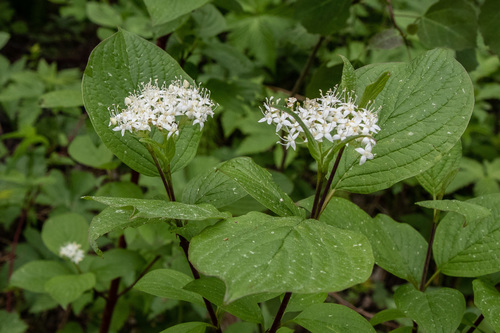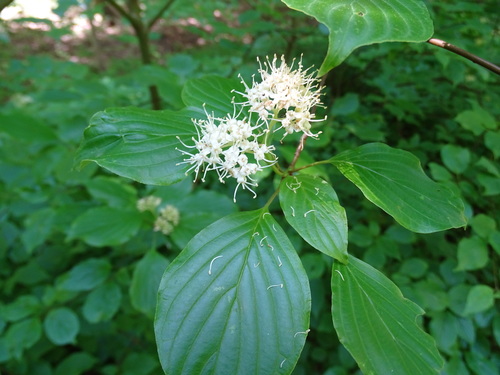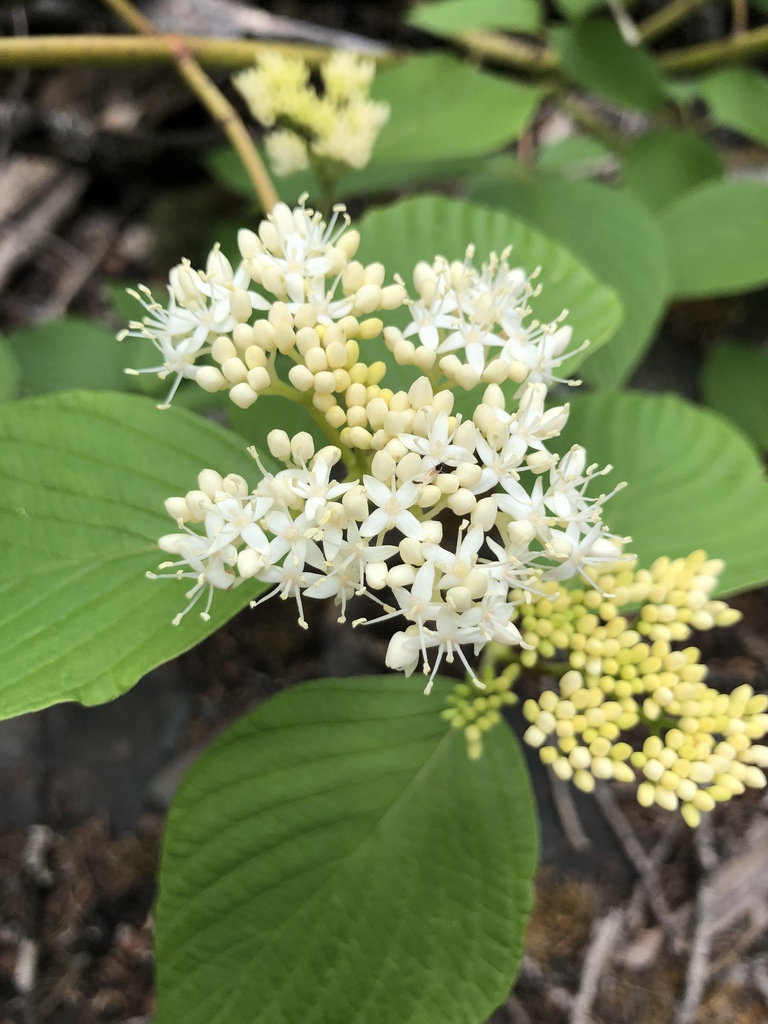
Cornus rugosa, commonly known as round-leaved dogwood, is a deciduous shrub native to North America. It typically reaches a height of 6 to 10 feet and has a spread of 8 to 12 feet. The plant features an upright growth habit with arching branches, forming an appealing rounded shape.
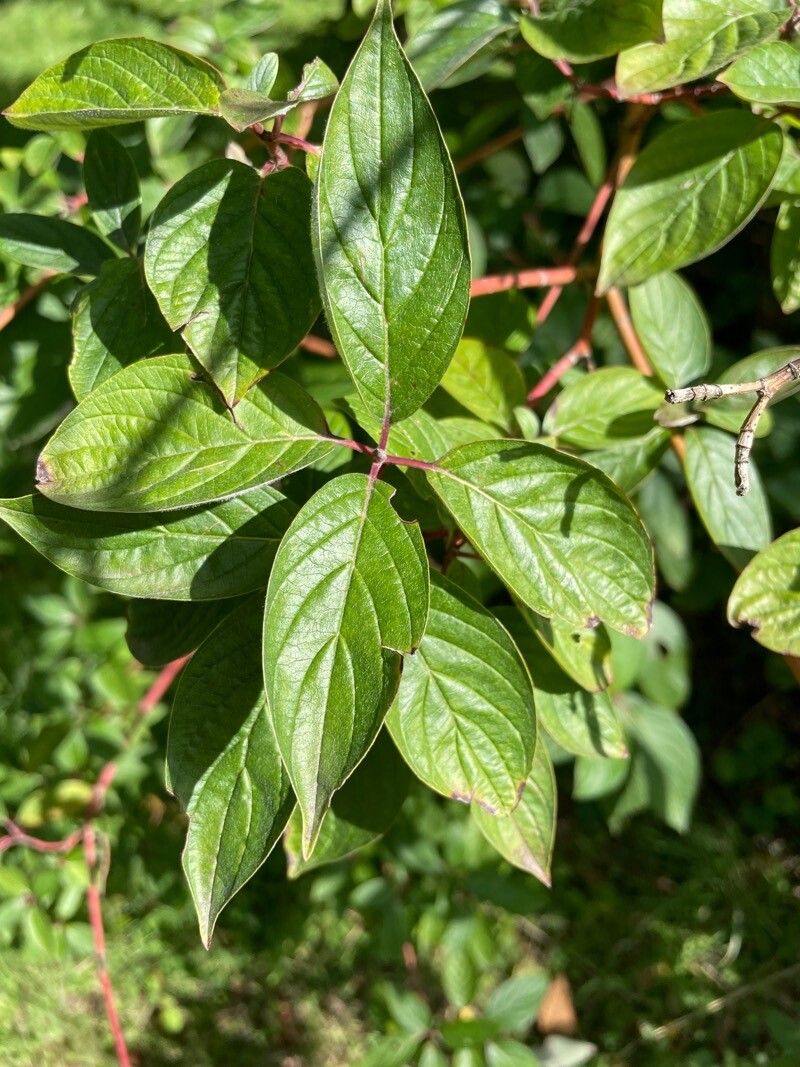
The oval-shaped leaves of Cornus rugosa are a glossy dark green. In the fall, the leaves turn vibrant shades of red and purple before shedding for the winter.
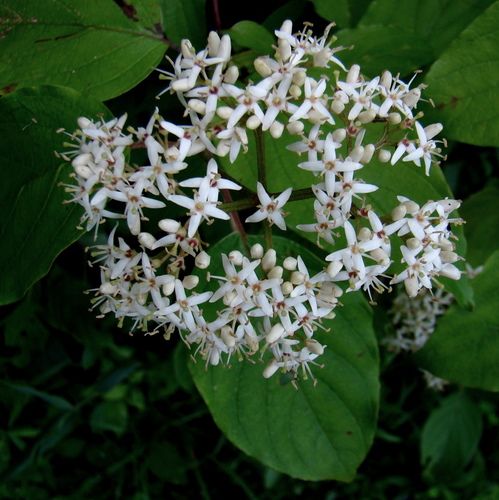
In late spring or early summer, the plant produces small clusters of white flowers, followed by blue-black berries in late summer or early fall. These berries attract birds and other wildlife.
Cornus rugosa thrives in moist, well-drained soil but can tolerate some drought once established. It grows best in full sun to partial shade, although it can also adapt to full shade.
This shrub is often used as an ornamental plant in gardens because of its attractive foliage, flowers, and berries. Additionally, it provides habitat for wildlife such as birds and butterflies.
Round-Leaved Dogwood has strong disease resistance and is typically not susceptible to diseases. In terms of upkeep, this plant is fairly low-maintenance. When grown outdoors it needs only minimal watering, and larger specimens usually do not require pruning. Smaller specimens, however, should be pruned after they finish blooming. Round-Leaved Dogwoodt is suitable for anyone with an outdoor area, like a garden or deck, and does not require much care experience.
How to keep Cornus Rugosa.
Light
Round-Leaved Dogwood grows best in moderate sunlight, though it can tolerate stronger light. Native to environments with scattered light, it is adapted to those conditions. However, excessive light can stress the plant, and too much shade may impede its growth.
Water
Round-Leaved Dogwood thrives in conditions of moderate humidity and can tolerate drought. It should be watered every 2-3 weeks, making sure to balance watering with natural rainfall. Typically an outdoor plant, Round-Leaved Dogwood requires close attention to rainfall patterns to ensure its watering needs are met effectively.
Temperature
Round-Leaved Dogwood is native to areas where temperatures range from 41 to 90 °F (5 to 32 ℃). It does best in cool to moderately warm conditions. Seasonal temperature adjustments may be required to support its health.
Fertilizer
The timing of fertilization is important for Round-Leaved Dogwood. Apply fertilizer in early spring and continue once a month until early summer. Fertilizer promotes attractive blooms and supplies energy during both dormant and active growth periods.
Pruning
The Round-Leaved Dogwood is characterized by its round leaves and white flowers, and it thrives when pruned in early spring. To promote healthier growth, remove any dead branches and thin out crowded areas to improve air circulation. Rejuvenation pruning can invigorate mature plants. Regular pruning enhances both the aesthetics and structure of the plant. For guidance specific to your region, consult local horticultural experts.
Botanical profile.
- Plant Type
- Tree
- Life Cycle
- Perennial
- Genus
- Cornus
- Family
- Cornaceae
- Hardiness Zone
- 4-8
- Mature Height
- 1.83 m to 3.05 m
- Mature Spread
- 1.83 m to 3.66 m
- Leaf Color
- Green, Dark Green
- Leaf Type
- Deciduous
- Flower Color
- White
- Flower Size
- 3.05 cm to 6.35 cm
- Bloom Time
- Late spring, Early summer
- Planting Time
- Spring, Summer
- Harvest Time
- Mid summer
Other names.
Reader questions.
What's the best way to water my Round-Leaved Dogwood?
To ensure excellent root development, it is recommended to place a garden hose at the base of the plant. Avoid spraying the leaves directly, as this can be detrimental. If the plant is outdoors and exposed to direct sunlight, the leaves will require more watering. Bubblers or soaker hoses can be used to moisten the roots of each plant. When adding or removing plants, consider using soaker hoses that cover the entire garden or bed to encourage deep root growth. After watering, drain any excess water and allow the soil to dry before watering again. Watering at ground level is ideal to prevent the onset of diseases. On a sunny day, it may be beneficial to spray the entire bush with water. Whether the plant is potted or in the ground, it is important to remember that Round-Leaved Dogwood prefers deep watering rather than light sprinkling.
Why is it necessary to use fertilizer on my Round-Leaved Dogwood?
No matter what type of Round-Leaved Dogwood you have, fertilizing regularly will promote good overall health. Providing the proper nutrients will result in stronger growth and increased resilience to challenging conditions, as well as improved ability to fight diseases and pests. Maintaining the attractive foliage of your Round-Leaved Dogwood is important, so make sure to follow a specific fertilization schedule. This will encourage the development of vibrant, deep-colored leaves for a lush appearance.
What are the sunlight requirements for Round-Leaved Dogwood?
Round-Leaved Dogwood thrives best in moderate levels of sunlight, ideally in conditions that mimic its natural habitat with scattered light. The plant can endure more intense light but suffers under excessive exposure. Partial sun refers to about 3-6 hours of sunlight daily, while full sun demands over 6 hours. It's crucial to note how sunlight moves through your garden to select sites that offer a beneficial mix of light and shade, ensuring the plant's well-being.
What is the ideal temperature range for Round-Leaved Dogwood?
Round-Leaved Dogwood thrives in environments where temperatures range between 41 to 90 °F (5 to 32 °C). It is well-adapted to cool to moderately warm climates, ensuring seasonal temperature adjustments may be beneficial for its health.
What should I do if I give Round-Leaved Dogwood too much or too little water?
An overwatered Round-Leaved Dogwood can show signs such as yellowing, dropping off, and wilting leaves. The plant may also appear dull and unhealthy, with mushy stems. Adjusting your watering schedule is recommended when these signs start to appear. Wilting can also indicate under watering, with crispy and dry leaves as a possible indication. In such cases, check the soil for dryness and provide sufficient water accordingly. Even with enough water, the plant may still have dry and yellow leaves due to a damaged root system, but they will eventually stop yellowing once the plant recovers. When keeping Round-Leaved Dogwood indoors, always monitor the moisture levels and avoid overwatering. Look out for black spots and let the soil dry out for a few days if they are present. Overwatering can lead to root rot, so transfer the plant to a different pot if discolored and slimy roots are visible. Preventing root rot and avoiding excessively soggy soil is important. When planting Round-Leaved Dogwood outdoors, check the soil moisture by digging a bit deeper. If the soil is too dry, it may indicate under watering, and adequate watering is necessary to help the plant recover.
When should I fertilize my Round-Leaved Dogwood?
To help your Round-Leaved Dogwood grow healthily, it's best to fertilize it in late winter or early spring. This provides the necessary nutrients for growth once the weather becomes warm. In warm climate regions, it can be beneficial to give your dogwood another dose of fertilizer in early fall. This not only adds nutrients for the following growing season but also helps the dogwood become more resilient to winter damage. Fertilizing earlier in fall allows the branches enough time to grow and withstand the cold winter.
How should I use artificial lighting for indoor Round-Leaved Dogwood plants?
Indoor Round-Leaved Dogwood plants benefit significantly from proper artificial lighting, especially when natural sunlight is not enough. LED lights are recommended because they can be tailored to provide specific light wavelengths needed by plants. For full sun plants, 30-50W per square foot is adequate, for partial sun plants 20-30W per sq ft, and for full shade plants, 10-20W per sq ft is sufficient. The artificial light source should be placed 12-36 inches above the plant, mimicking natural sunlight as closely as possible, with an exposure of 8-12 hours per day to promote optimal growth.
How do you protect Round-Leaved Dogwood from extreme cold?
Despite its strong cold resistance, protection is advised when winter temperatures are expected to dip below -30°C. Wrapping the trunk and branches with non-woven fabric or cloth can provide necessary cold protection. Additionally, watering the plant abundantly before the first freeze in autumn keeps the soil moist and prevents drought and water scarcity during the colder months.
How much water does my Round-Leaved Dogwood need?
The Round-Leaved Dogwood prefers deep watering sessions, with about a gallon of water each time, especially when in pots. Potted plants have limited water storage, so the soil dries out faster. In cold regions, watering should be done every 3 to 5 days, preferably in the morning when the soil is dry. You can check if watering is needed by observing the top 2-3 inches of soil - if it's dry, give the plant a thorough watering. During hot days, monitor the moisture levels daily as the heat can quickly dry out the soil in pots. If you have a garden, irrigation of the soil is necessary. In hot climates, watering once a week should suffice. Check if the top 2-3 inches of soil are too dry before watering. Take into account the amount of rainfall and avoid overwatering to prevent root rot. The Round-Leaved Dogwood mainly grows during spring and fall. When outdoors, add 3 to 4 inches of mulch to conserve water. Sandy soil drains faster, so more frequent watering is needed. On the other hand, clay soil requires less frequent watering, with a gap of 2-3 days to let the plant dry out and prevent root rot. Consider marking the watering dates on a calendar and be attentive if the leaves start drooping, as it may indicate a need for timely watering.
When is it a bad idea to put fertilizer on my Round-Leaved Dogwood?
There are a few times when you should not fertilize your Round-Leaved Dogwood. Firstly, during the early and mid-winter months when the plant is dormant and does not need feeding. Secondly, it is not recommended to fertilize this plant during late spring and all of summer because the weather is usually hotter and drier, which can have a negative impact on the plant's response to fertilization. To prevent any issues, it is best to stick to a fertilization schedule that involves feeding only in early spring and early fall.
What are the signs of insufficient light in Round-Leaved Dogwood?
When Round-Leaved Dogwood does not receive enough light, several symptoms may manifest, including smaller new leaves, leggy or sparse growth, faster leaf drop, halted or absent new growth, and lighter-colored or pale new leaves. Other signs include chlorosis, or yellowing of leaves, indicating a breakdown of chlorophyll; sunscald, characterized by damaged tissue from excessive light; curling or twisting of leaves as a defense against sunlight; wilting from increased water loss; and leaf scorching, recognizable by brown, dry edges on leaves due to too much sun.
What are the symptoms and solutions for Round-Leaved Dogwood in low temperatures?
In low temperatures, if it falls below -30°C, the branches of Round-Leaved Dogwood may become brittle and dry by springtime, failing to produce new shoots. The solution to this issue is to prune away any dead branches that didn't generate new leaves come spring.