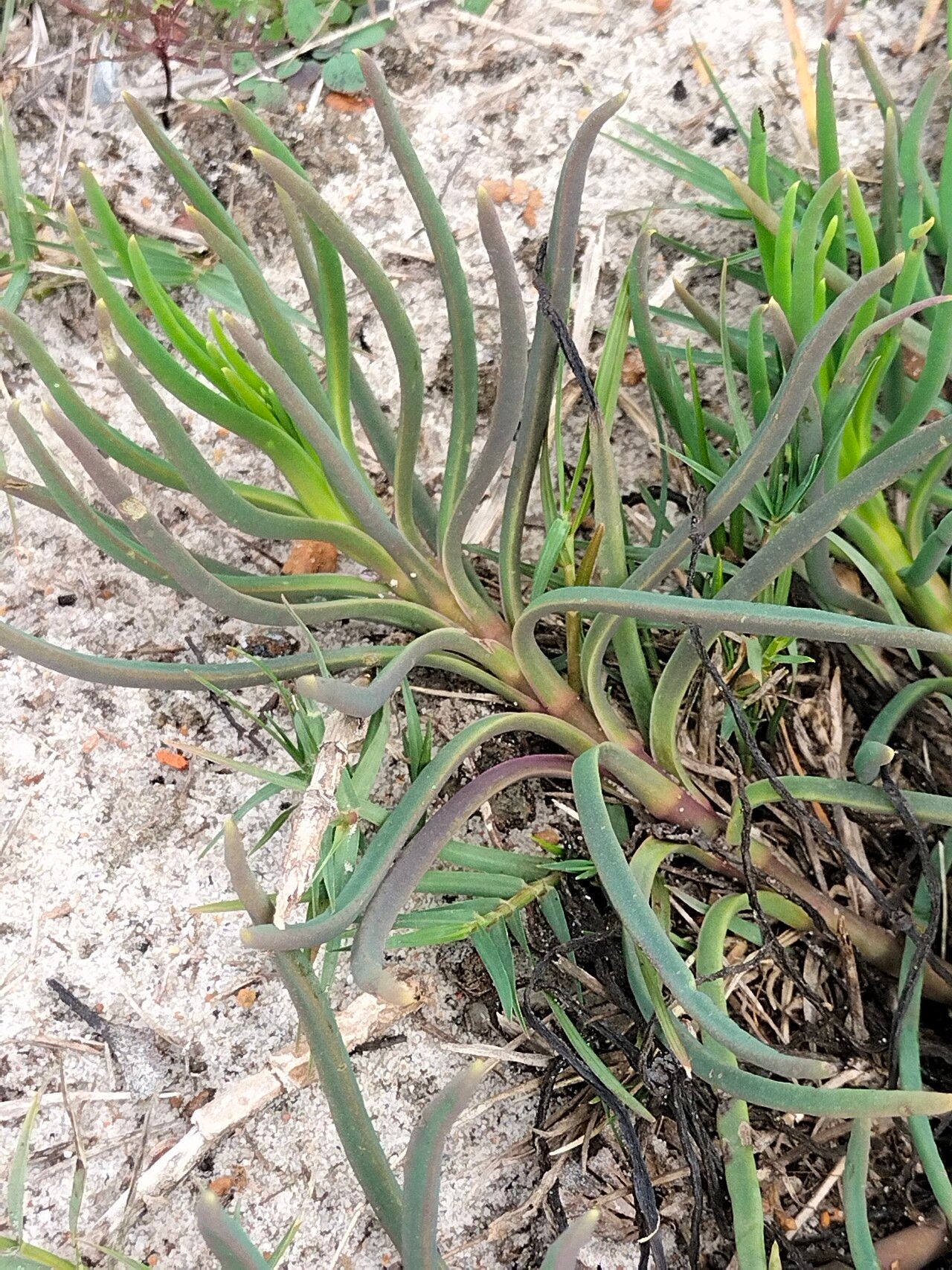
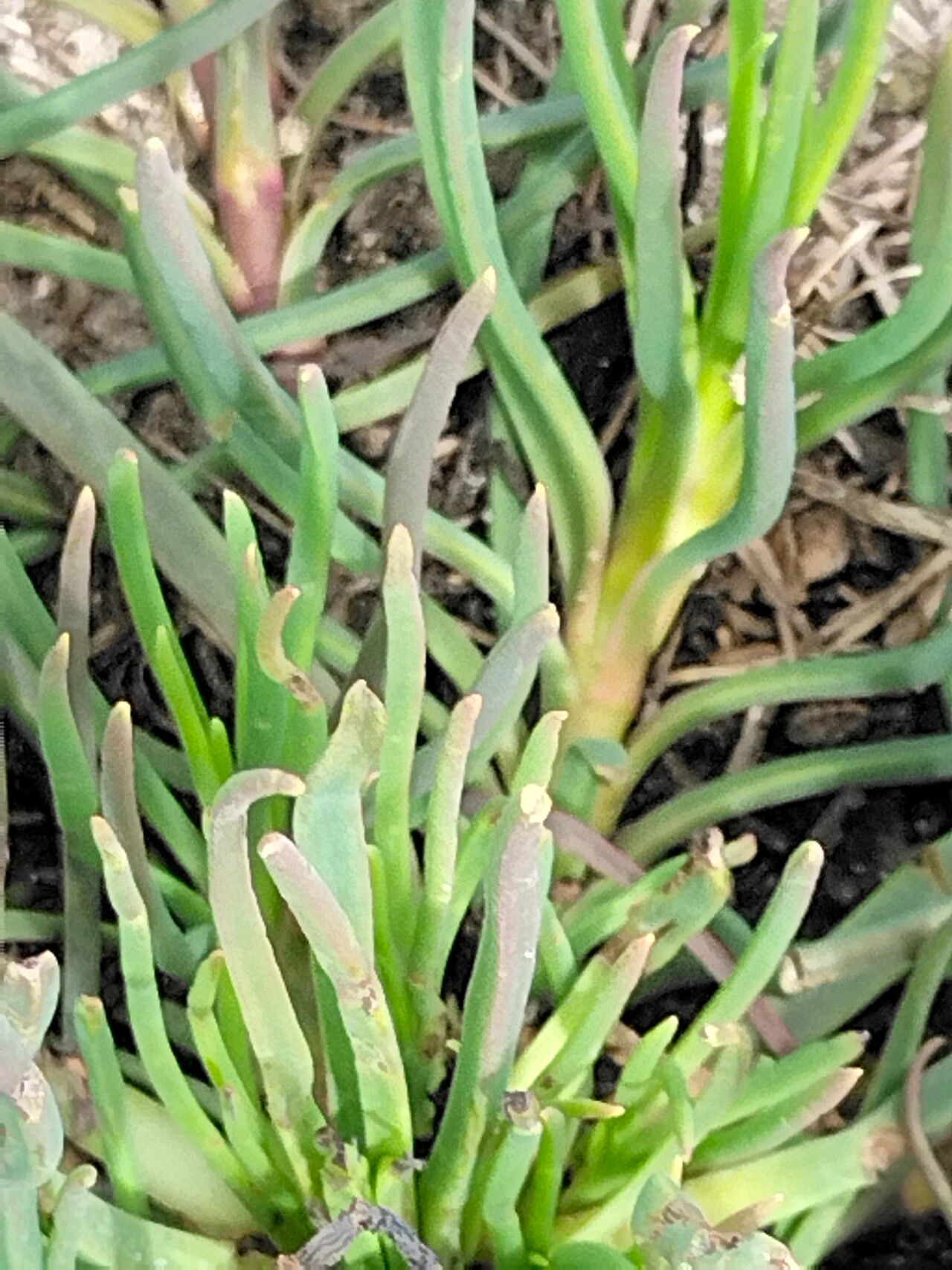
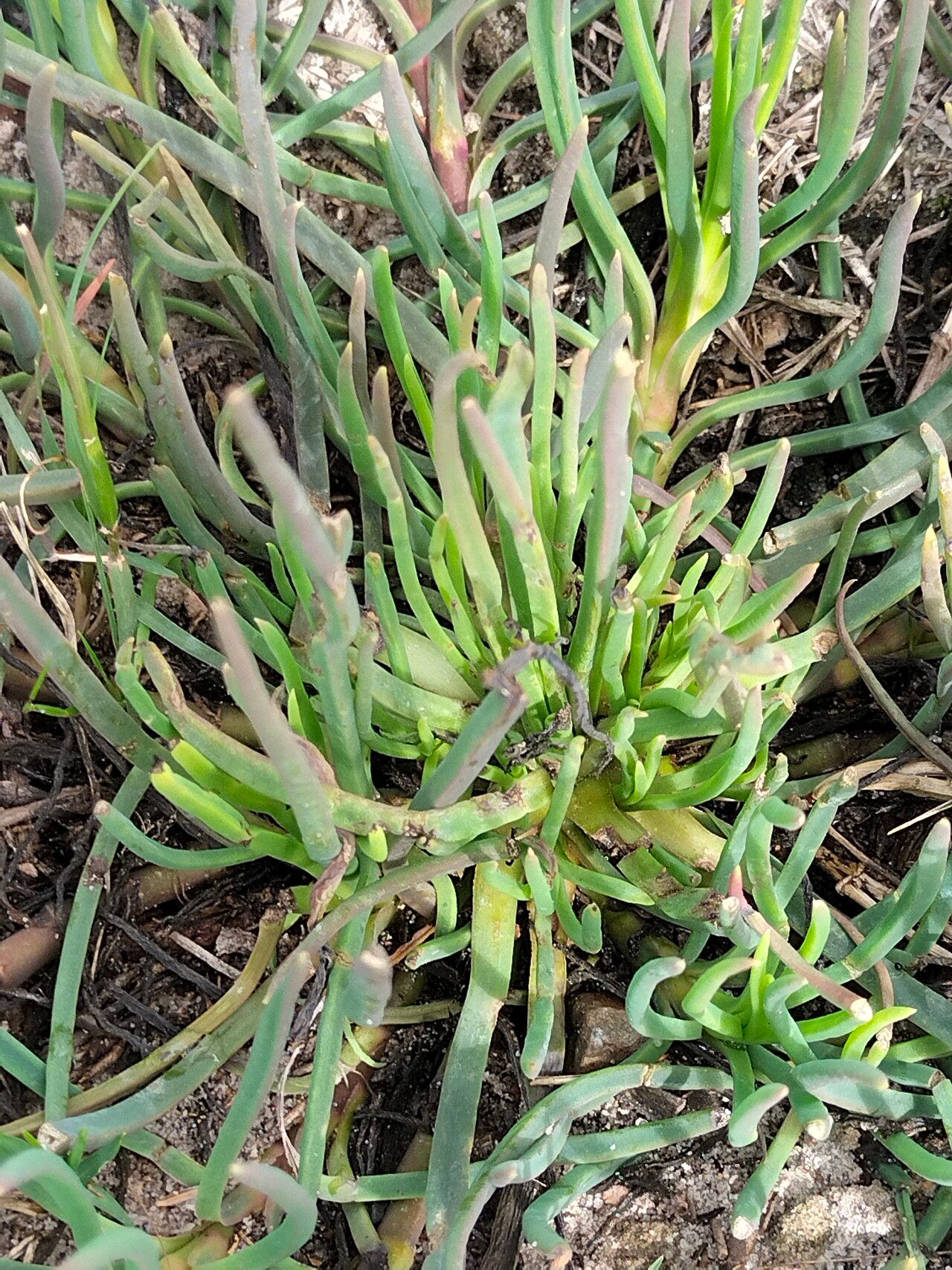
Conicosia pugioniformis is a species of succulent plant in the ice plant family known by the common names narrow-leaved iceplant and pigroot. It is native to South Africa and it is known on other continents as an introduced species and sometimes a noxious weed. It is an invasive species on the Central Coast of California, where it is a minor threat to native coastal vegetation, although not as harmful as other species of invasive iceplant. This is a short-lived perennial herb growing from an underground caudex. It can sprout vegetatively from the caudex if its aboveground parts are destroyed. The fingerlike leaves are fleshy, gray-green, hairless, and up to 20 centimeters long. The inflorescence is a solitary, malodorous flower up to 8 centimeters wide. It has rings of up to 250 thin petals.
Narrow-leaved ice plant has moderate resistance to disease but is more vulnerable to high humidity and overwatering. It becomes especially prone to disease if it is kept in low light and is overwatered. Regarding care, the Narrow-leaved ice plant tolerates drought and can go long periods without watering. It requires little fertilizer and only needs pruning occasionally. This makes it appropriate for growers at any experience level, particularly people who prefer to spend less time on plant care or who may be away from home for extended periods. It is a suitable option for those who do not want to devote much time to maintenance yet still want an easy-to-care-for plant.
How to keep Conicosia Pugioniformis.
Light
The narrow-leaved ice plant thrives in spots that receive plentiful sunshine all day, though it can tolerate areas with partial shade. In the wild it occupies open, sunny habitats. Improper light levels can hinder its growth: too much sun may cause sunscorch, while too little light leads to weak development.
Temperature
Narrow-leaved ice plant originates from areas with moderate temperatures, ideally between 68 and 100 °F (20 to 38 ℃). While acclimating, small adjustments may be required as seasons change to maintain its healthy growth.
Fertilizer
For the Narrow-leaved ice plant, light applications of fertilizer once or twice a year during the growing season are sufficient. Do not fertilize in winter or in summer while it is dormant. Use less fertilizer for plants that have been repotted, and wait a couple of months after repotting before feeding. Fertilizing helps support healthy growth and encourages blooms.
Pruning
The narrow-leaved ice plant features succulent leaves and striking yellow flowers. To promote growth, prune the plant in early spring by removing any dead stems. Gentle shaping helps prevent overgrowth and improves air circulation. Make sure to use clean, sharp tools for effective pruning, which encourages a healthier plant overall.
Botanical profile.
- Plant Type
- Herb
- Life Cycle
- Perennial
- Genus
- Conicosia
- Family
- Aizoaceae
- Hardiness Zone
- 9-11
- Mature Height
- 30 cm
- Mature Spread
- 20 cm to 30 cm
- Leaf Color
- Light Green
- Leaf Type
- Evergreen
- Flower Color
- Yellow
- Flower Size
- 7.62 cm
- Bloom Time
- Mid spring, Late spring, Early summer
- Planting Time
- Spring, Autumn
- Harvest Time
- Summer
Other names.
Reader questions.
What are the sunlight requirements for a Narrow-leaved ice plant?
The Narrow-leaved ice plant, or Conicosia pugioniformis, thrives in a range of sunlight exposures. It can flourish under full sun, which means it requires more than 6 hours of sunlight daily, and can also adapt to partial sun conditions, needing about 3-6 hours of sunlight a day. It's important to observe the movement of sunlight through your garden to find spots that offer an ideal balance of light and shade, ensuring optimal growth and health for your plants.
What are the essentials for growing a Narrow-leaved ice plant successfully?
The key to successfully growing a Narrow-leaved ice plant lies in providing adequate sunlight. This plant prefers locations that receive a generous amount of sun throughout the day but can manage in areas where light is more diffuse. Its natural habitat comprises open, well-lit environments. Insufficient or excessive light can adversely affect its growth, potentially causing sunscorch in extreme sunlight or weak and sparse growth in low light conditions. For indoor plants, artificial lighting such as LED lights can be crucial, especially when natural sunlight is limited. These artificial lights should be tailored to offer the correct intensity needed by the plant, with full sun plants requiring 30-50W/sq ft, partial sun plants 20-30W/sq ft, and full shade plants 10-20W/sq ft. Proper placement (12-36 inches above the plant) and the duration of light exposure (8-12 hours per day) are also important to mimic natural conditions.
What symptoms indicate light deficiency in Narrow-leaved ice plants?
Symptoms of light deficiency in Narrow-leaved ice plants can include smaller new leaves than previously observed, leggy or sparse growth indicating the plant is stretching out for more light, early leaf drop as a conservation measure, halted or no new growth as the plant enters survival mode, and pale or irregularly colored new leaves due to insufficient sunlight. In contrast, too much sunlight can cause chlorosis, where leaves turn yellow and lose their green color, sunscald with visible pale or damaged areas on leaves or stems, leaf curling as a defense against too much light, wilting from excessive water loss, and leaf scorching marked by brown, dry edges or patches on leaves.
What solutions can help a Narrow-leaved ice plant with insufficient or excessive sunlight?
To address insufficient sunlight, gradually move your Narrow-leaved ice plant to a sunnier location each week until it receives at least 6 hours of direct sunlight daily. For plants that are large or difficult to move, consider using artificial light, keeping a desk or ceiling lamp on for at least 8 hours daily, or invest in professional plant grow lights. If moving outdoors, do so gradually to prevent sunburn. Note that parts of the plant affected by insufficient sunlight may not recover, but new growth will be healthy following increased light exposure. Additionally, to combat obstruction of sunlight, especially outdoors, consider pruning trees or branches that shade your plant, or transplant smaller plants during their dormant season to a sunnier location with better drainage.