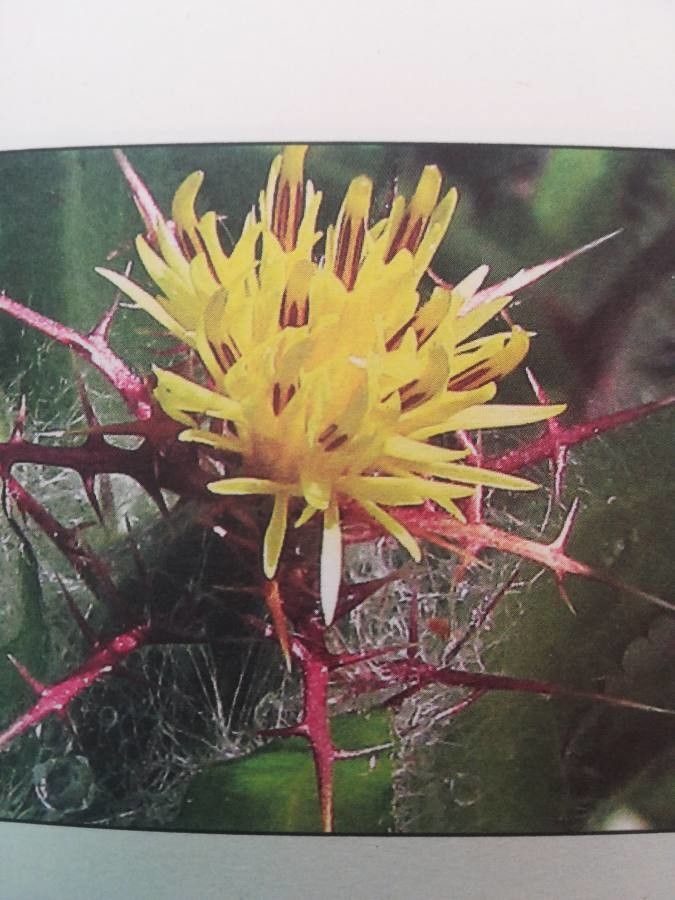
Cnicus benedictus, known by the common names St. Benedict's thistle, blessed thistle, holy thistle and spotted thistle, is a thistle-like plant in the family Asteraceae, native to the Mediterranean region, from Portugal north to southern France and east to Iran. It is known in other parts of the world, including parts of North America, as an introduced species and often a noxious weed. It is the sole species in the monotypic genus Cnicus. Other species once included in the genus have largely been reclassified to Cirsium, Carduus, and Centaurea. The related genus Notobasis is included in Cnicus by some botanists; it differs in slender, much spinier leaves, and purple flowers.
Blessed thistle is fairly disease-resistant and usually not prone to illnesses. However, it can be vulnerable to pests and diseases present in its environment. These problems are typically not serious. For care, this plant requires moderate maintenance. It should be pruned regularly to keep a good appearance and healthy growth. Fertilizing can also help encourage flowering. Blessed thistle is suitable for anyone with outdoor space, such as a garden or patio, and does not demand a lot of gardening experience. It may need more attention when grown indoors.
How to keep Cnicus Benedictus.
Light
Thriving under the harsh and direct sunlight, blessed thistle has adapted to environments with plenty of sun exposure. An ample amount of sunlight is essential for its optimal growth and health. A deficiency or excess of sunlight can result in hindered growth, faded color, or wilting, which interferes with its standard physiological functions.
Temperature
Blessed thistle comes from temperate regions and therefore does best in temperatures of 68 to 95 °F (20 to 35 ℃). It is well adapted to warm climates, although seasonal temperature adjustments may be necessary to meet its ideal growth conditions.
Fertilizer
When majority of the flowers on the Blessed thistle have fully blossomed, this signifies that it is time to commence fertilization once again. Initiate fertilization process on a frequency of every three to four weeks, provided the weather conditions are favorable, particularly when the flowers are in their maximum bloom. Conversely, when the Blessed thistle begins to generate fewer new flowers, discontinue the fertilization. There isn't a necessity for fertilization when the plant is incapable of producing additional flowers.
Botanical profile.
- Plant Type
- Herb
- Life Cycle
- Annual, Perennial
- Genus
- Cnicus
- Family
- Asteraceae
- Hardiness Zone
- 5-9
- Mature Height
- 49 cm to 61 cm
- Mature Spread
- 20 cm to 30 cm
- Leaf Color
- Green, Dark Green
- Leaf Type
- Semi-evergreen
- Flower Color
- Yellow
- Flower Size
- 3.05 cm to 4.06 cm
- Bloom Time
- Mid spring, Late spring, Early summer
- Planting Time
- Spring, Summer
- Harvest Time
- Summer
- Native Area
- Saudi Arabia, Tajikistan, Turkey, Slovakia, Cyprus, Bulgaria, Pakistan, Armenia, Greece, Slovenia, Croatia, Ukraine, Lebanon, Uzbekistan, Russia, Serbia, China, Iraq, Afghanistan, Syria, Kyrgyzstan, Kazakhstan, Italy, Spain, Iran, Albania, Azerbaijan, Hungary, Turkmenistan, Portugal