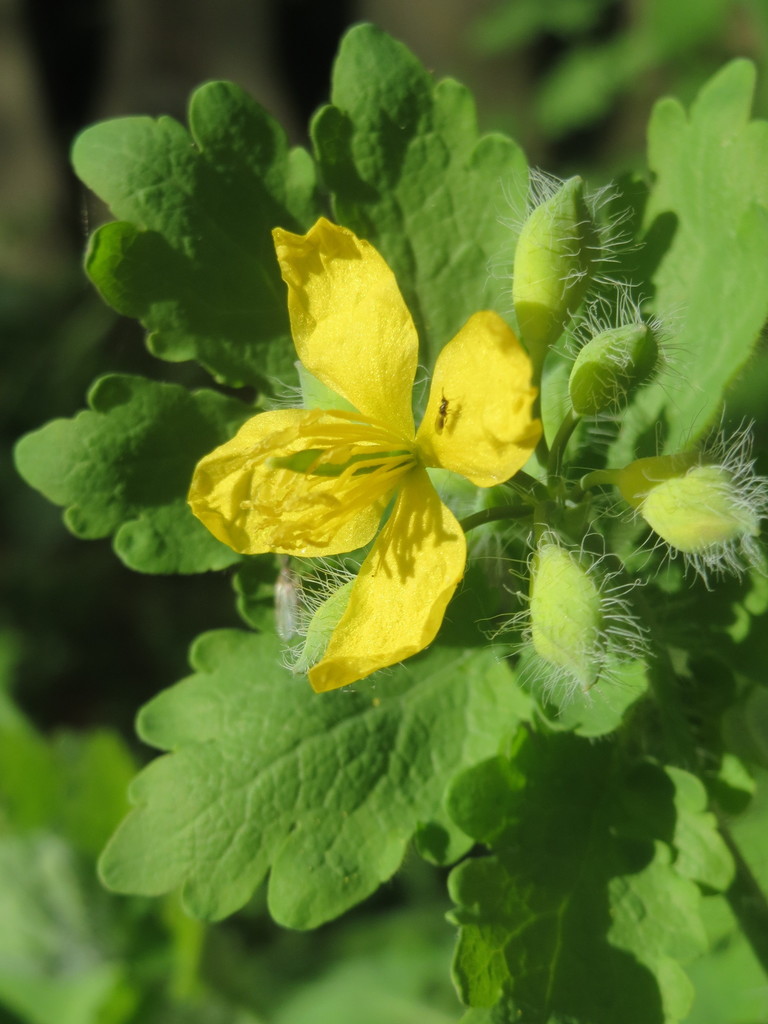
Chelidonium majus, commonly known as greater celandine, is a perennial herbaceous plant in the poppy family. Native to Europe and western Asia, it has been introduced and naturalized in many parts of the world. The plant can grow up to 1 meter tall and features deeply lobed, bluish-green leaves. Its bright yellow flowers, consisting of four petals, bloom from May to August.
Greater celandine has a long history of medicinal use, dating back to ancient Greece, where it was valued for its analgesic properties. It was also employed to treat various ailments, including warts, skin diseases, liver problems, eye infections, and respiratory issues.
The active compounds in Chelidonium majus include alkaloids such as chelidonine, which have demonstrated anti-inflammatory properties. The plant also contains flavonoids, known for their antioxidant effects.
However, despite its medicinal benefits, Chelidonium majus can be toxic if ingested in large quantities due to the presence of alkaloids like chelerythrine, which can cause liver damage or even death if consumed excessively.
Beyond its medicinal uses, Chelidonium majus is also valued for ornamental purposes, thanks to its attractive yellow flowers that bloom during the summer months.
Greater celandine is fairly disease-resistant and generally not prone to illnesses. However, it can be vulnerable to pests and diseases present in its surroundings. These infections are usually mild. In terms of care, this plant requires moderate maintenance. It should be pruned regularly to keep a neat appearance and support healthy growth. Fertilizing can also help encourage flowering. Greater celandine is suitable for anyone with an outdoor space, such as a garden or patio, and does not demand much care experience. It may need more attention when grown indoors.
How to keep Chelidonium Majus.
Light
The greater celandine plant favors locations that get a moderate level of sunlight during the day. It also thrives in places that are either consistently sunny or somewhat shady, indicating its adaptability to diverse lighting conditions. Overexposure to sunlight could cause its leaves to burn, whereas underexposure could lead to frail and elongated growth.
Water
Greater celandine, native to European and Asian woodlands, thrives in moist environments and needs weekly watering for optimal growth. This hardy perennial flourishes with sufficient rainfall or additional irrigation during its active growing season, highlighting the strong link between water availability and its growth cycle.
Temperature
The greater celandine plant is originally indigenous to temperate regions, favoring balanced climates that range from 68 to 95 °F (20 to 35 ℃). To maintain the plant's health and long life, regulating the temperature appropriately across different seasons is crucial.
Fertilizer
A one-time application of fertilizer in the spring is often adequate for Greater celandine, however, increased feedings can optimize growth. Fertilize every month to month and a half. Fertilization improves the look and function of the leaf, encouraging uniform color and a healthy texture. Additionally, it promotes root development and nutrient intake, contributing to the prolonged well-being of the plant.
Pruning
Greater celandine is a herbaceous perennial plant known for its bright yellow flowers and latex-like sap. To promote healthy growth, it's best to prune the plant in the spring. This involves removing dead stems and thinning out dense clusters to improve air circulation. Regular pruning not only encourages vigorous growth but can also extend the blooming period.
Pot & Repot
For replanting Greater celandine, opt for a pot that's 1-2 inches (2.5-5 cm) wider with sufficient drainage features. Employ a potting mix that offers good drainage. Carry out the repotting process either in the spring or fall season, making certain that the root lump is a tad lower than the flower pot's edge. After the repotting is performed, water it sufficiently and position it in a warm place that gets indirect sunlight.
Botanical profile.
- Plant Type
- Herb
- Life Cycle
- Perennial, Biennial
- Genus
- Chelidonium
- Family
- Papaveraceae
- Hardiness Zone
- 4-8
- Mature Height
- 30 cm to 91 cm
- Mature Spread
- 30 cm to 40 cm
- Leaf Color
- Green, Blue
- Leaf Type
- Deciduous
- Flower Color
- Yellow
- Flower Size
- 1.52 cm to 2.54 cm
- Bloom Time
- Late spring, Early summer, Mid summer
- Planting Time
- Spring, Autumn
- Harvest Time
- Early summer, Mid summer
- Native Area
- Turkey, Sweden, Austria, Slovakia, Montenegro, Slovenia, Morocco, Croatia, Belarus, Russia, Germany, Estonia, Romania, Latvia, Belgium, Portugal, Netherlands, France, Czech Republic, Bulgaria, Armenia, Poland, Greece, Ukraine, Serbia, China, Lithuania, Norway, Kyrgyzstan, Kazakhstan, Italy, Spain, Switzerland, Denmark, Mongolia, Finland, Iran, Azerbaijan, United Kingdom, Hungary, Algeria
Other names.
Reader questions.
How should I water my Greater celandine?
To properly water the Greater celandine, it's best to use filtered water at room temperature. Tap water may have harmful particles, so filtration is preferred. The water should be at room temperature or slightly warmer because this plant is accustomed to a warm environment and cold water can be detrimental. Avoid overhead watering as it can cause issues with the foliage. Instead, water the plant by applying filtered room temperature water directly onto the soil until it is fully saturated. This method benefits the plant by moistening the roots and aiding in nutrient absorption.
Why should I use fertilizer on my Greater celandine?
The Greater celandine mainly consists of leaves, and fertilization is crucial for them to look good and function properly. When properly fertilized, the leaves will have consistent color and a healthy texture. Fertilization also benefits the plant below the soil's surface by promoting new root growth and maintaining existing roots. This not only keeps the plant healthy in the present, but also ensures it can efficiently absorb nutrients from the soil in the future.
What are the sunlight requirements for Greater Celandine?
Greater Celandine thrives best in areas that receive a moderate amount of sunlight throughout the day but is versatile enough to grow in both constant sun or low sunlight environments. It requires about 3-6 hours of sunlight for partial sun conditions and more than 6 hours for full sun or full shade settings. It's important to watch how sunlight moves through your garden to provide your plants with the perfect balance of light and shade, ensuring their growth and health. Too much sun exposure may cause the leaves to scorch, while insufficient light can lead to weak and leggy growth.
What is the native environment of Greater celandine?
Greater celandine is initially native to a temperate environment, thriving best in moderate climates with temperatures ranging between 68 to 95 °F (20 to 35 °C). It's essential to manage temperature variations across different seasons to support the plant's health and longevity.
What should I do if I give my Greater celandine too much or too little water?
Both overwatering and underwatering can harm the health of your Greater celandine, but overwatering is more common and serious. When this plant gets too much water, its stems and leaves may wilt and turn yellow. Prolonged overwatering can also cause root rot, mold, and mildew, which can kill the plant. Underwatering is less likely, as the Greater celandine can tolerate drought, but it can still happen. In this case, the leaves may become brittle and brown. It's important to notice signs of overwatering early on. Some diseases, like root rot, may not be fixable if not addressed promptly. If you see early signs of overwatering, reduce your watering schedule and check the soil quality. If the soil drains poorly, replace it with a loose, well-draining potting mix. If you see signs of underwatering, simply water more frequently until the signs go away.
When should I fertilize my Greater celandine?
To properly fertilize your Greater celandine, watch for new growth in early spring. This signals that it's time to begin fertilizing. Generally, a single application of fertilizer is sufficient. However, if you want to promote maximum growth, consider fertilizing multiple times throughout the spring and early summer. For this approach, feed your plant roughly once every month to a month and a half.
How can artificial lighting be used for Greater Celandine?
When natural sunlight is not enough, especially during winter or in less sunny spaces, artificial lighting becomes an essential solution for growing Greater Celandine indoors. LED lights are preferred because they can be customized to provide specific wavelengths of light needed by your plants. Full sun plants should have 30-50W/sq ft of artificial light, partial sun plants need 20-30W/sq ft, and full shade plants require 10-20W/sq ft. The light source should be placed 12-36 inches above the plant to mimic natural sunlight, ensuring the plant receives 8-12 hours of light per day for optimal growth.
Does Greater celandine require frost protection measures during winter?
Greater celandine has strong cold resistance, so it normally doesn't need special frost protection measures. However, should winter temperatures drop below the plant's growth-limiting temperature, it's important to provide cold protection. This can be achieved by covering the plant with materials such as soil or straw and ensuring to water it abundantly before the first freeze in autumn. The aim is to keep the soil moist going into the frozen state to prevent drought and water scarcity for the plant during the colder months and early spring.
How frequently should I water my Greater celandine?
If your Greater celandine is in a pot, you can check if it needs water by putting your finger in the soil. If the top two to three inches are dry, it's time to water it. If you have it planted outdoors, you can use the same method. When the top few inches are dry, add water. In the spring and early fall, you'll usually need to water once a week. In very hot weather, you may need to water twice a week or more. However, mature Greater celandine plants can handle drought well.
When is it not a good idea to fertilize my Greater celandine?
During the late fall and winter, Greater celandines go into a dormant phase and stop growing. It's best to avoid fertilizing them during this time. In spring and summer, if you choose to fertilize multiple times, start decreasing the fertilization rate as summer approaches since the growth rate of the plant slows down. In general, it's not a good idea to fertilize Greater celandines during unusually hot weather or when the soil is exceptionally dry. Fertilizing in these conditions can stress the plant and cause it to die prematurely.
What are some common symptoms of light deficiency in Greater Celandine?
Light deficiency in Greater Celandine can lead to several symptoms indicating the need for more sunlight. These include smaller new leaves, leggy or sparse growth, faster leaf drop, slower or halted growth, and lighter-colored new leaves. Additional issues like Chlorosis, where leaves lose their green color and turn yellow, Sunscald, Leaf Curling, Wilting, and Leaf Scorching may also occur due to inappropriate light conditions, signifying the plant's inability to photosynthesize effectively.
How does lower than suitable temperature affect Greater celandine, and what are the solutions?
Greater celandine is cold-tolerant and thrives best above its minimum suitable growth temperature. If kept above its tolerable minimum growing temperature during winter, it generally maintains well-being. However, temperatures dropping below the growth-limiting temperature, while not showing immediate visible changes, may result in diminished sprouting or even a total lack of sprouting come spring. In such cases, it's advisable to remove any parts of the plant that have failed to sprout as a springtime solution.