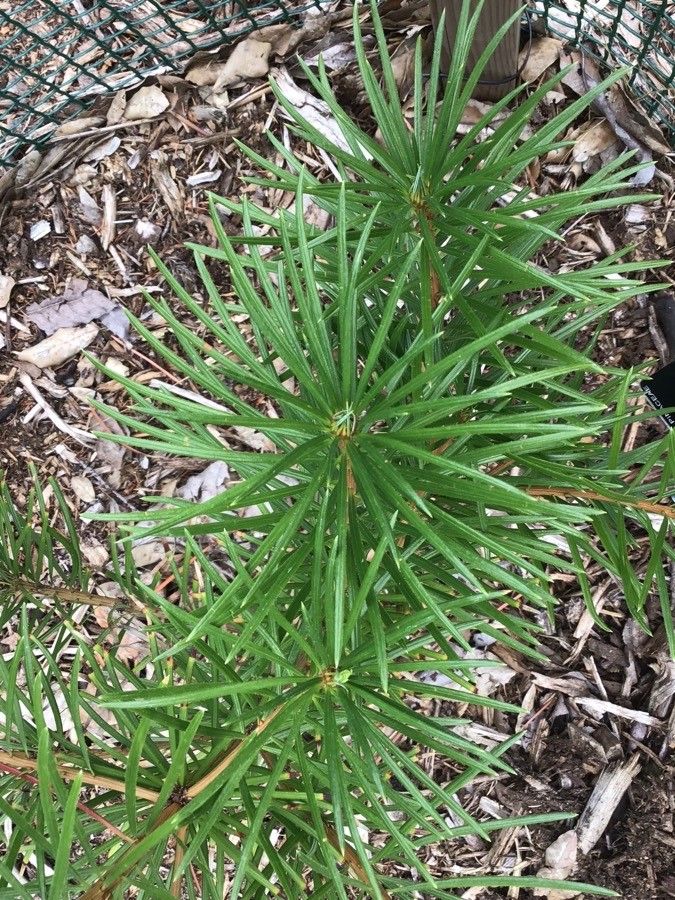
Cathaya is a genus in the pine family, Pinaceae, with one known living species, Cathaya argyrophylla. Cathaya is a member of the subfamily Laricoideae, most closely related to Pseudotsuga and Larix. A second species, C. nanchuanensis, is now treated as a synonym, as it does not differ from C. argyrophylla in any characters. Cathaya is confined to a limited area in southern China, in the provinces of Guangxi, Guizhou, Hunan and southeast Sichuan. It is found on steep, narrow mountain slopes at 950–1800 m altitude, on limestone soils. A larger population has been reduced by over-cutting before its scientific discovery and protection in 1950. The leaves are needle-like, 2.5–5 cm long, have ciliate (hairy) margins when young, and grow around the stems in a spiral pattern. The cones are 3–5 cm long, with about 15–20 scales, each scale bearing two winged seeds. One or two botanists, unhappy with the idea of a new genus in such a familiar family, tried to shoehorn it into other existing genera, as Pseudotsuga argyrophylla and Tsuga argyrophylla. It is however very distinct from both of these genera, and these combinations are not now used. The Butchart Gardens in Victoria, British Columbia had a small living specimen. The tree died in 2017.
Silver-leaved cathaya shows strong resistance to disease and is generally not susceptible to illnesses. In terms of care, this plant is fairly low-maintenance. When grown outdoors it needs only minimal watering, and larger specimens typically do not require pruning. However, smaller specimens should be pruned after they have finished blooming. Silver-leaved cathayat is suitable for anyone with outdoor space, such as a garden or deck, and does not require a lot of care experience.
How to keep Cathaya Argyrophylla.
Light
Silver-leaved cathaya naturally occurs in places like forest understories or rocky sites, where it grows in shaded conditions. It prefers partial sun but can also tolerate full sun or full shade, reflecting its adaptable, hardy nature.
Water
The silver-leaved cathaya flourishes in environments with moderate moisture and can withstand short periods of dryness. For optimal growth, it should be watered consistently every 1-2 weeks, using well-draining soil to prevent root rot, particularly during its active growing season. Although it is typically cultivated outdoors, it is important to monitor its watering schedule to strike the right balance between adequate hydration and its natural drought tolerance.
Temperature
Silver-leaved cathaya comes from habitats with temperatures between 59 to 89.6 °F (15 to 32 ℃). It performs best within that temperature range. When ambient temperatures differ substantially, steps to replicate those conditions are necessary.
Fertilizer
Silver-leaved cathaya has specific nutrient needs and does not require heavy fertilization. Fertilizing in spring is best for promoting optimal growth. Supplying nutrients improves its health, raises its resistance to pests and diseases, and helps sustain its long lifespan.
Pruning
Silver-leaved cathaya has striking, silver-like foliage and thrives when pruned annually during its dormant period, which is from early to late winter. When pruning, focus on removing dead or crossing branches to promote healthy growth and improve air circulation. Thinning out the plant helps prevent disease and maintains its shape and vigor, ensuring it remains healthy. It's also a good idea to consult reliable sources for tips on climate-specific care practices.
Botanical profile.
- Plant Type
- Tree
- Life Cycle
- Perennial
- Genus
- Cathaya
- Family
- Pinaceae
- Hardiness Zone
- 7
- Mature Height
- 20.12 m
- Mature Spread
- 1.83 m
- Leaf Color
- Dark Green
- Leaf Type
- Evergreen
- Flower Color
- Yellow, Green
- Flower Size
- 5.08 cm to 6.35 cm
- Bloom Time
- Mid spring, Late spring
- Planting Time
- Spring, Summer
- Harvest Time
- Late summer, Early fall, Mid fall
- Native Area
- China
Other names.
Reader questions.
What are the sunlight requirements for Silver-leaved cathaya?
Silver-leaved cathaya thrives in environments that mimic its native understorey or rocky habitats, making partial sun (about 3-6 hours of sunlight) its ideal condition. However, it can also flourish in full shade. When gardening, it's beneficial to observe how sunlight dances through your space over time to find the ideal balance of light and shade that best supports the growth and happiness of your plants.
What is the ideal temperature range for growing Silver-leaved cathaya?
Silver-leaved cathaya, or Cathaya argyrophylla, is native to environments with temperatures ranging from 59 to 89.6 °F (15 to 32 °C). It thrives best within these temperature conditions. It is important to adjust the environment to imitate these conditions when natural temperatures deviate significantly. This species exhibits strong cold resistance, negating the need for special frost protection measures in most cases. However, if temperatures are expected to drop below -15°C, cold protection measures should be taken to prevent damage. This can involve wrapping the trunk and branches with non-woven fabric or cloth. Additionally, abundant watering before the first autumn freeze to ensure the soil is moist and enters a frozen state helps to prevent drought and water scarcity for the plant during winter and early spring.
How can artificial lighting support indoor Silver-leaved cathaya?
For Silver-leaved cathaya grown indoors, adequate lighting is crucial, especially in conditions where natural sunlight is insufficient. Artificial lighting, such as LED lights, serves as an excellent alternative, promoting healthier and faster growth. These lights should be tailored to provide specific wavelengths ideal for the plant's needs, with full sun plants requiring 30-50W/sq ft, partial sun plants requiring 20-30W/sq ft, and full shade plants needing 10-20W/sq ft of light. The artificial light source should be positioned 12-36 inches above the plant to simulate natural sunlight and be kept on for 8-12 hours daily to mimic the natural daylight hours.
How does low temperature affect Silver-leaved cathaya and what remedies are available?
Silver-leaved cathaya shows a notable tolerance to cold, thriving best when temperatures remain above 15°C. During winter, it is crucial to ensure that the temperature does not fall below -10°C. In cases where the temperature drops below -15°C, the plant may not exhibit noticeable changes during winter. However, come spring, its branches may become brittle and dry, and fail to produce new shoots. The best remedy for this is to prune away any dead branches that have failed to sprout new leaves in the spring, encouraging healthy growth.
What are the symptoms of inadequate light for Silver-leaved cathaya?
Insufficient light can trigger several symptoms in Silver-leaved cathaya, such as smaller new leaves, leggy or sparse growth, faster leaf drop, and a halt in new growth, indicating the plant has entered a survival mode. Additionally, one might observe lighter-colored new leaves, chlorosis (yellowing due to chlorophyll breakdown), sunscald (bleached areas from intense light exposure), leaf curling as a defense mechanism against high light, wilting from excessive water loss, and leaf scorching marked by brown, dry edges on leaves.
What are the effects of high temperature on Silver-leaved cathaya and how can they be mitigated?
During the summer, Silver-leaved cathaya should ideally be kept in temperatures below 32°C. Exposure to temperatures above 35°C can cause the leaves to lighten in color and the tips to dry and wither, making the plant more prone to sunburn. To mitigate these effects, it is recommended to trim away the sunburned and dried-up parts of the plant. Moving the plant to a location that offers shade from the midday and afternoon sun, or utilizing a shade cloth, can provide protection. Additionally, watering the plant in the morning and evening to maintain soil moisture can help reduce stress on the plant due to high temperatures.
What solutions can address light deficiency symptoms for Silver-leaved cathaya?
To address light deficiency in Silver-leaved cathaya, gradually acclimatize the plant to more sunlight by shifting its position weekly until it achieves 3-6 hours of direct sunlight daily. For plants that are large or difficult to move, supplementing with artificial light for at least 8 hours a day can be beneficial. Outdoor plants should also be moved gradually to avoid sunburn. It's important to note that while parts of the plant already affected by insufficient sunlight may not recover, new growth will be healthy with improved light conditions. Additionally, reducing obstructions like pruning trees can help, and for smaller plants, transplanting during their dormant period into a sunnier location could provide a definitive solution.