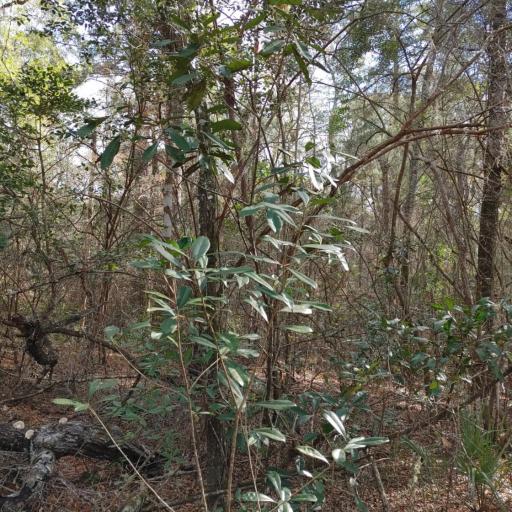
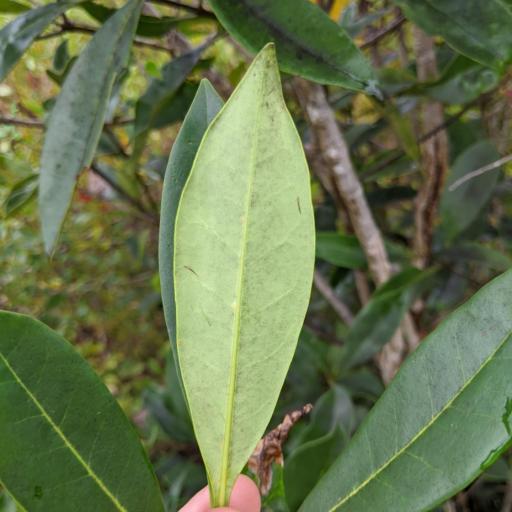
Cartrema americana, commonly called American olive, wild olive, or devilwood, is an evergreen shrub or small tree native to southeastern North America, in the United States from Virginia to Texas, and in Mexico from Nuevo León south to Oaxaca and Veracruz. Cartrema americana was formerly classified as Osmanthus americanus. Following the discovery that Osmanthus was polyphyletic, it was transferred to the segregate genus Cartrema together with Osmanthus floridanus and five Asian species. Cartrema americana grows to 4–7 m (13–23 ft), rarely to 11 m (36 ft) tall. The leaves are 5–14 cm (2.0–5.5 in) long and 2–4 cm (0.79–1.57 in) broad, with an entire margin. Its flowers, produced in early spring, are small (1 cm long), white, with a four-lobed corolla and have a strong fragrance. The fruit is a globose dark blue drupe 6–15 mm (0.24–0.59 in) diameter, containing a single seed. It is cultivated as an ornamental plant in gardens for its fragrant flowers.
Cartrema americana shows good resistance to disease and is generally not susceptible to illnesses. In terms of care, this plant is fairly low-maintenance. When planted outdoors, it requires only infrequent watering, and larger specimens typically do not need pruning. Smaller specimens, however, should be pruned after they have bloomed. Cartrema americanat is suitable for anyone with outdoor space, such as a garden or deck, and does not require extensive care experience.
How to keep Cartrema Americana.
Light
Cartrema americana is indigenous to settings like forest understories or rocky terrains, where it is naturally shaded. It best thrives in partially sunlight conditions, yet showcases its adaptable and resilient characteristics by tolerating both full sun or comprehensive shade.
Water
Cartrema americana thrives in moderate moisture levels but can adapt well to drier conditions. It is best to water the plant every 1-2 weeks, making sure the soil remains moist without becoming waterlogged. When cultivated outdoors, take its adaptability to fluctuating rainfall into account. This plant is particularly resilient during the growing season, making it ideal for areas with sporadic rain.
Temperature
The Cartrema americana shows remarkable flexibility in adapting to different weather conditions, be it intense heat of summer or the cold of winter. Nevertheless, it does have a preferred temperature range for optimal growth. The plant is vulnerable to stress from overwhelming heat and humidity, which could potentially lead to its death. In areas where the temperatures come close to its minimum tolerance for cold, it is crucial to take steps to insulate the plant for its protection.
Fertilizer
The right timing for fertilizing Cartrema americana is of great importance. Start fertilizing early in the spring and continue on a monthly basis until the start of summer. The fertilizer aids in the production of beautiful flowers and supplies energy during both dormant and active growth stages.
Pruning
Prune Cartrema americana in early spring to maintain its shape and promote healthy foliage. Remove any dead branches and thin out crowded areas to improve air circulation. Be careful not to over-prune, as excessive cutting can increase the risk of disease. Proper pruning enhances flowering and boosts the overall vitality of this hardy plant.
Botanical profile.
- Plant Type
- Tree
- Life Cycle
- Perennial
- Genus
- Cartrema
- Family
- Oleaceae
- Hardiness Zone
- 7-10
- Mature Height
- 4.57 m to 7.62 m
- Mature Spread
- 3.05 m to 4.57 m
- Leaf Color
- Dark Green
- Leaf Type
- Evergreen
- Flower Color
- White
- Flower Size
- 0.51 cm to 0.76 cm
- Bloom Time
- Early spring, Mid spring
- Planting Time
- Spring, Summer, Autumn
- Harvest Time
- Late summer, Early fall, Mid fall
- Native Area
- Honduras, Mexico
Other names.