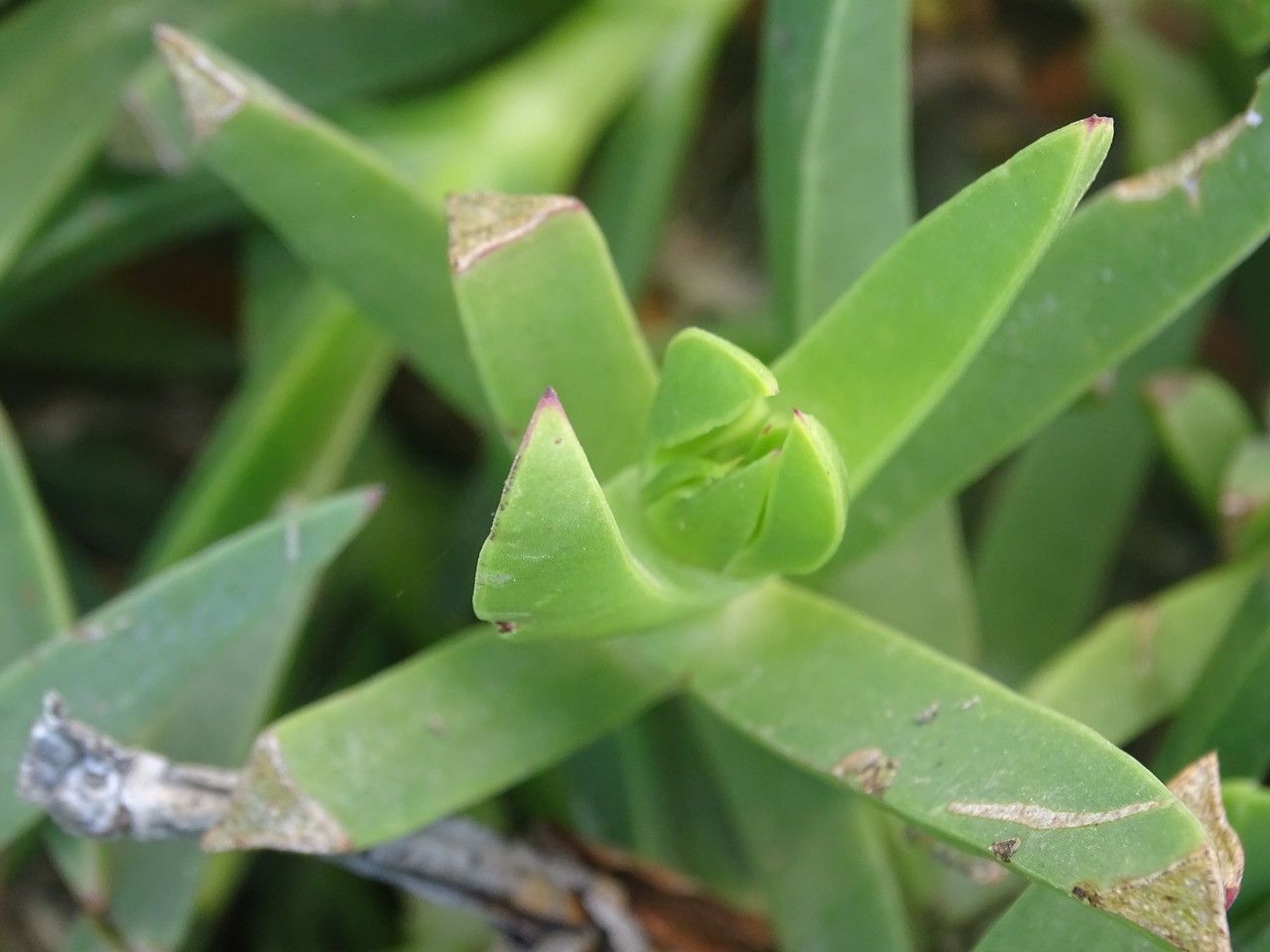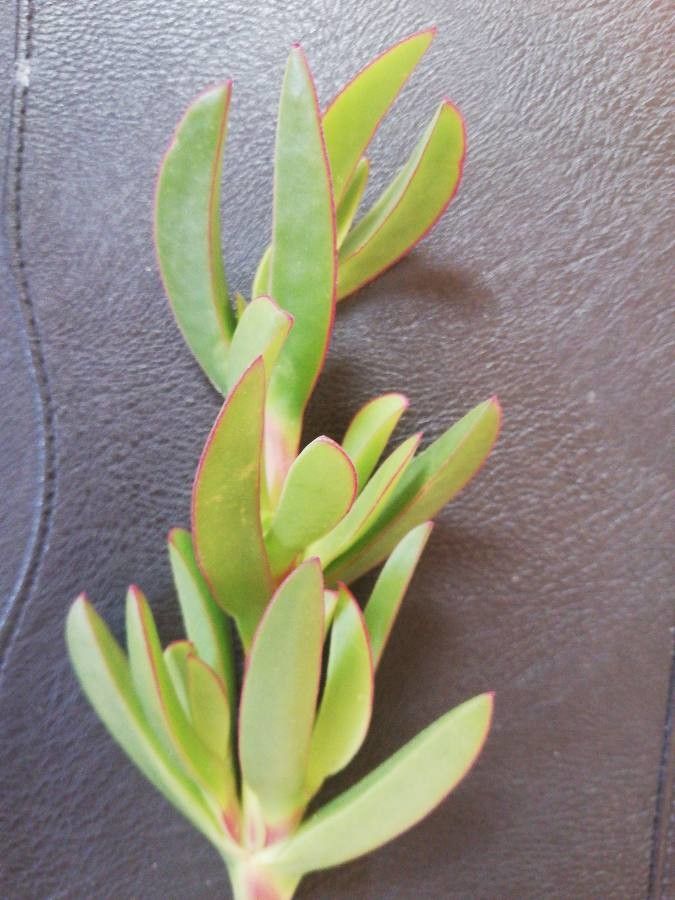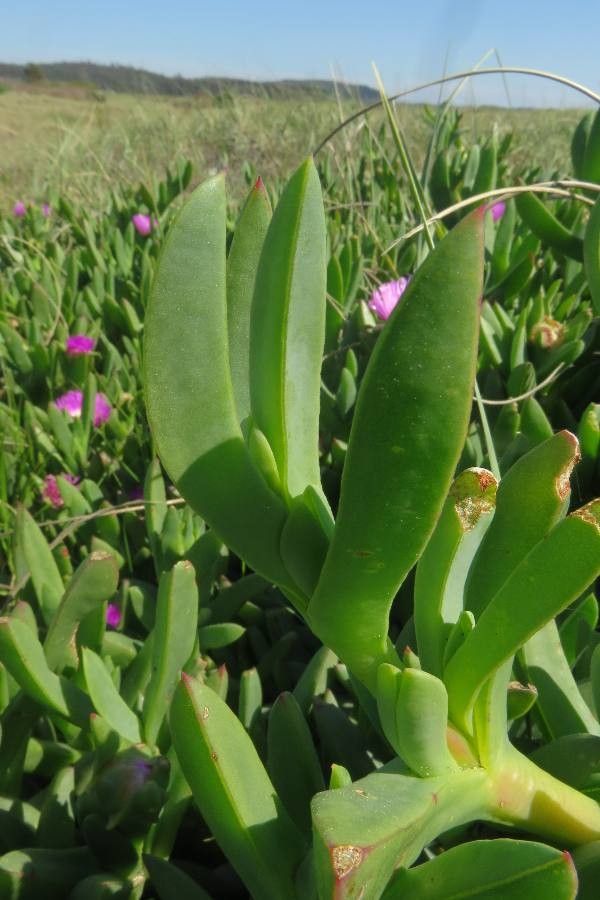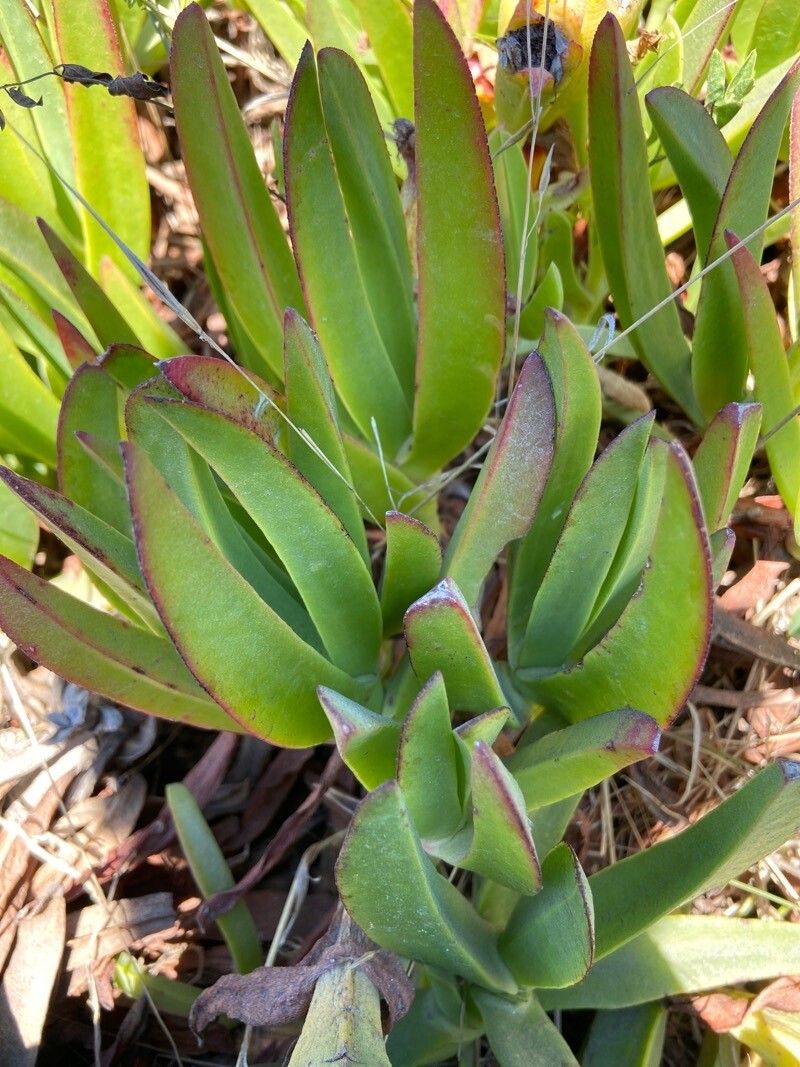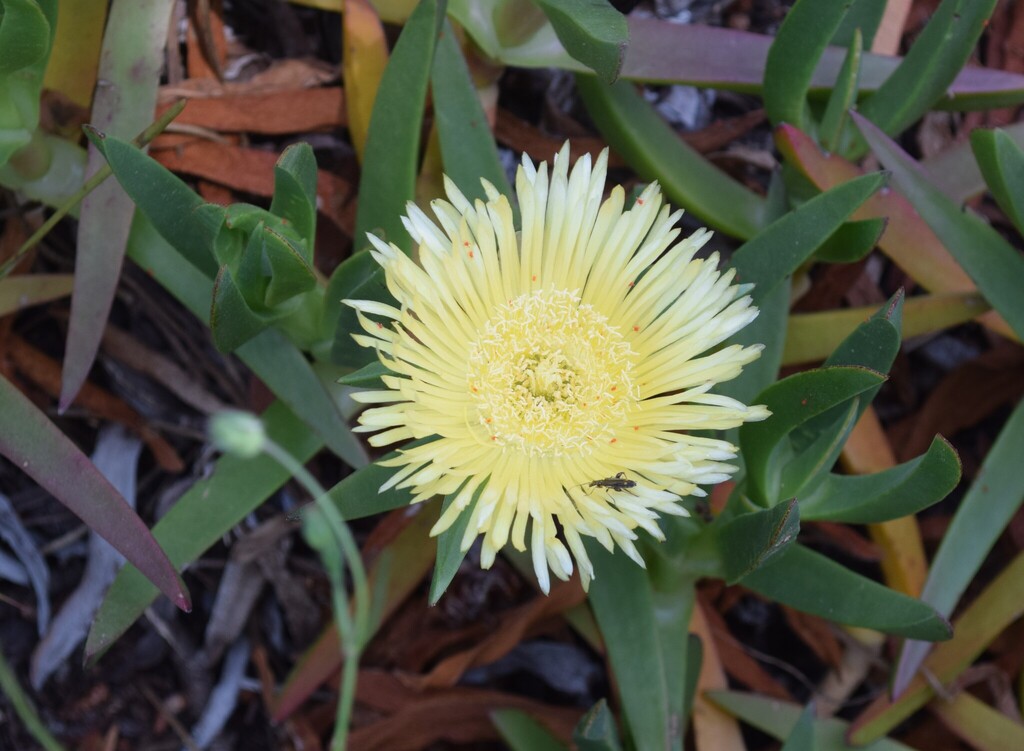
Carpobrotus edulis, commonly known as the Hottentot fig or sour fig, is a succulent plant species native to South Africa. It is a low-growing perennial that can reach up to 1 meter in height and 3 meters in width. The leaves are fleshy and triangular, with a bluish-green color that can turn reddish-purple during the winter months.
The Hottentot fig produces large, showy flowers that range in color from white to pink or purple. These blooms appear from late spring through summer, followed by edible fruit resembling small figs. The fruit is sweet-tasting with a slightly sour flavor.
Due to its attractive appearance and drought tolerance, Carpobrotus edulis has been widely introduced around the world as an ornamental plant. However, in many areas, it has become an invasive species, outcompeting native vegetation for resources.
The Hottentot fig serves as a source of food for a wide range of animals. Tortoises feast on the leaves, while baboons and antelopes savor the flowers. Various animals eat the fruits, helping to disperse the seeds in the process. Additionally, these plants offer shelter to small reptiles like lizards and snakes. FUN FACT · FROM THE LIBRARY
The Hottentot fig has been used for medicinal purposes by indigenous South African people for centuries, owing to its anti-inflammatory properties. It also contains high levels of vitamin C, making it a useful dietary supplement.
Overall, Carpobrotus edulis is an intriguing succulent with both ornamental and medicinal value. However, it should be used with caution outside its native range due to its invasive tendencies.
Hottentot Fig: The origin of the name "Hottentot" is difficult to determine. While this plant is commonly referred to as the Hottentot Fig, many believe that the term "hottentot" has discriminatory and derogatory connotations.
Hottentot fig has moderate resistance to disease but is more vulnerable to humidity and excess watering. It becomes especially prone to disease if it is kept in low light and is overwatered. Regarding care, the Hottentot fig is drought-tolerant and can endure extended periods without water. It requires little fertilizer and only needs pruning occasionally. For these reasons, it suits growers of all skill levels, particularly those who prefer to spend less time on plant care or who may be away from home for long stretches. It is a solid option for people who do not want to devote much time to maintenance yet still want an easy-to-care-for plant.
How to keep Carpobrotus Edulis.
Light
The Hottentot fig requires plenty of light for healthy growth and can tolerate partly sunny conditions. Native to bright habitats, the plant may suffer stunted growth and underdeveloped foliage if it does not receive enough sunlight. Excessive exposure can lead to leaf bleaching.
Water
The Hottentot fig, originally from South Africa, is well-suited for arid environments with scarce rainfall, thanks to its drought-tolerant succulent leaves. It should be watered sparingly, about once every three weeks. This plant, which is excellent for ground cover outdoors, thrives in full sun and well-draining soil, helping to maximize its ability to retain water.
Humidity
This plant will thrive in moderate humidity, which is probably the level in your home. However, misting it a few times a week can be very beneficial. Make sure the room has good ventilation.
Temperature
In its native habitat, the hottentot fig thrives at temperatures of 68 to 100 ℉ (20 to 38 ℃). It adapts to seasonal temperature shifts as sunlight and water availability change, but overall favors warmer conditions. In hot periods, providing light shade and adequate watering helps prevent stress.
Fertilizer
For Hottentot fig, small amounts of fertilizer applied one to two times a year during the growing season are sufficient. Do not fertilize in winter or during the summer dormancy. Cut back on fertilizer for plants that have been repotted and wait a couple of months after repotting before fertilizing. Fertilizing supports healthy growth and promotes blooms.
Pruning
To maintain their ideal shape, large succulent plants like the Hottentot fig benefit from pruning, especially in the spring and autumn. This process removes any excess or densely packed branches. For propagation, cut healthy stems with 5-6 leaves, treat the wounds with sulfur powder, and keep the soil moist to encourage successful rooting.
Pot & Repot
When repotting a Hottentot fig, choose a pot slightly larger than the current one with good drainage. Use a gritty, well-draining cactus or succulent mix. Gently take the plant out of its old pot, brush off excess soil, and plant it at the same depth. Wait a few days before watering to allow any root damage to heal. Repot in spring or fall and place it in a brightly lit location.
Toxicity
The Carpobrotus edulis is considered toxic for humans and pets and can cause allergies upon ingestion.
Further reading →
The toxicity and danger assessments provided are for reference only. We do not assure their accuracy, so it's crucial not to depend on them. Seek professional advice when necessary for accurate guidance.
Botanical profile.
- Plant Type
- Succulent, Herb
- Life Cycle
- Perennial
- Genus
- Carpobrotus
- Family
- Aizoaceae
- Hardiness Zone
- 9-11
- Mature Height
- 3.05 m
- Mature Spread
- 61 cm to 91 cm
- Leaf Color
- Green
- Leaf Type
- Evergreen
- Flower Color
- Yellow, Pink
- Flower Size
- 5.08 cm to 8.89 cm
- Bloom Time
- Early spring, Mid spring, Fall, Winter
- Planting Time
- Spring, Summer, Autumn
- Harvest Time
- Summer, Fall
- Native Area
- South Africa
Other names.
Reader questions.
What should I do if I give too much or too little water to my Hottentot fig?
Hottentot figs are known for their ability to withstand long periods without water, so it's rare to find them suffering from underwatering. However, if you neglect to water your Hottentot fig for a month or more, you will likely notice that it looks thirsty and may have leaf damage. Signs of underwatering include shriveled, dry, and flat leaves, some of which may have dried up completely, turned brown and crispy, or fallen off the plant. The soil will also be completely dried out. To remedy this, give your Hottentot fig plenty of water by submerging the pot in water for 5-10 minutes. When the soil feels moist on the surface, the watering is done properly. If there are dried out leaves still attached, remove them to make room for new growth. Overwatering is dangerous for Hottentot figs and can be fatal if not addressed. Too much moisture over time leads to root rot, which prevents the roots from absorbing nutrients and water from the soil. Root rot occurs when wet conditions encourage fungi and bacteria to thrive in the soil and feed on the roots. Symptoms of overwatering include yellow, swollen, and translucent leaves that may burst open. If not treated, leaves may turn brown or black and easily fall off. It's important to check the soil to confirm overwatering as the cause, as other issues can produce similar symptoms. Saving an overwatered plant is challenging but possible if caught early. Start by removing the plant from its pot and examining the roots and soil. Gently remove wet soil from around the roots, then rinse them in room-temperature water to remove any lurking fungus and assess their health. If the roots are dark brown or black, soft, mushy, or slimy, root rot has likely developed. When most of the roots are affected, it may be impossible to save the plant. In this case, remove any healthy leaves and try propagating a new Hottentot fig from them. However, if only some roots are affected, it might be salvageable. Use a sterilized cutting tool to remove unhealthy-looking roots, dipping the remaining firm, pale roots in a fungicide to eliminate any remaining spores. Repot the Hottentot fig in fresh, well-draining soil. While this doesn't always save a succulent with root rot, it often allows the plant to make a full recovery and produce new growth in the next growing season.
Why should I put fertilizer on my Hottentot fig plant?
Applying plant food to Hottentot fig helps provide nutrients to the growing medium. While it already stores water and nutrients, fertilizing during the growing season promotes healthy growth and encourages mature specimens to produce blooms.
What are the sunlight requirements for Hottentot fig?
Hottentot fig needs a generous amount of sunlight to grow healthily, thriving in full sun conditions of above 6 hours of sunlight daily or can adapt to partial sun conditions with about 3-6 hours of sunlight. Originating from light-abundant environments, this plant can experience stunted growth and underdevelopment if it doesn't receive sufficient light. However, overexposure to sunlight might result in leaf bleaching, indicating the need to find a perfect balance between light and shade for the plant's optimum growth.
What temperature is best for your Hottentot fig plant?
To ensure the optimal growth of the Hottentot fig, it is recommended to maintain specific temperature ranges. Ideally, temperatures between 75-90℉ (25-32℃) are most suitable for this plant. During early winter, it is important to avoid temperatures below 75℉ (25℃) to protect the Hottentot fig. It can also be moved indoors for additional protection against extreme weather conditions. While the Hottentot fig can survive in some extreme temperatures, such as lows of 50℉ (15℃), it is not ideal. Therefore, if winter conditions are expected outside, it is advisable to bring the plant indoors.
How frequently do I need to water my Hottentot fig plant?
The frequency of watering for Hottentot fig plants is not set in stone. To determine when to water, it's best to check the soil's moisture levels and only water when it is completely dry. You can use your finger or a moisture meter to assess the soil below the surface. If you have planted the fig in a deep pot, you can use a stick or chopstick to do this. If the soil feels slightly damp, it is better to wait a few days and check again. In general, most people will need to water their Hottentot fig plants approximately every two weeks during summer and once a month in winter. However, there are various factors that can influence this watering frequency. The following section highlights some considerations that can help determine how often you should water your Hottentot fig plant.
When should I fertilize my Hottentot fig?
Hottentot fig, like other plants, needs some extra nutrients. However, it only requires a small amount of fertilizer during the growing season. To achieve optimal growth, it is recommended to fertilize your Hottentot fig 1-2 times a year. The best times to fertilize are in the spring and autumn, while avoiding winter and summer when the plant is dormant. When you repot the plant, be cautious and use less fertilizer. It's advisable to wait a couple of months after repotting before applying any fertilizer.
Can artificial lighting be used for Hottentot fig, and how?
Yes, artificial lighting can be a viable solution for Hottentot figs, especially when natural sunlight is not adequate, such as during winter or in less sunny spaces. LED lights are recommended for their ability to provide specific wavelengths needed by plants. For full sun plants, 30-50W/sq ft of artificial light is suggested; for partial sun plants, 20-30W/sq ft; and for full shade plants, 10-20W/sq ft. The light source should be placed 12-36 inches above the plant, and it's important to mimic natural daylight hours, ensuring most plants receive 8-12 hours of light per day.
How do I change the temperature for my Hottentot fig as it grows?
The Hottentot fig plant goes through different phases of growth. It starts as a dormant seed, which then develops into a seedling. For this process to happen, the seeds require specific conditions in their environment, such as a temperature range of 75-90℉ (25-32℃) for germination. The best time for the plant to grow vigorously is during the summer, when temperatures around 85℉ (30℃) are most suitable. To ensure enough sunlight, you can move your Hottentot fig plant from indoors to a sunny spot during the hot summer months.
What do I need to think about when watering my Hottentot fig?
Watering your Hottentot fig plant properly depends on several environmental factors. These include the size of the container, type of soil, temperature, and humidity. The container and soil you use will determine how often and how much to water. It's important to use a container with good drainage so excess water can escape. Smaller containers hold less moisture and need more frequent watering, while larger pots hold more moisture and require less frequent watering. Avoid using an oversized pot, as this can lead to overwatering. When repotting, choose a container just one size larger than the current one. Shallow containers work best since Hottentot figs have shallow roots. In terms of seasons, Hottentot figs need less water in winter when growth is slower and evaporation is lower. The soil stays wetter for longer during this time. The climate around your home also affects the watering needs. In humid and rainy regions, you will need to water less frequently compared to dry and arid climates. Remember that the same geographic location may have different conditions throughout the year due to seasons and indoor climate control. For Hottentot figs planted in the ground, they generally receive sufficient water from precipitation and dew once their root system is established. However, during prolonged dry periods, occasional watering may be required. In areas where Hottentot figs can only be grown in containers, they can be moved outside during spring and summer and brought indoors when temperatures start to drop. Keep in mind that potted Hottentot figs kept outside will typically require more water due to increased sun exposure, even if they are placed on a shaded porch.
When is the best time to not fertilize my Hottentot fig plant?
Hottentot fig, like most plants, goes through a dormancy period. During this time, it's best to avoid applying fertilizer. The plant stops growing in both summer and winter, so that's another good time to hold off on fertilizing. Additionally, it's recommended to halt fertilization for a few months after repotting in the spring.
What are the signs of insufficient light in Hottentot figs?
Signs of insufficient light in Hottentot figs include lighter-colored new leaves indicating a lack of chlorophyll and essential nutrients, leggy or sparse growth where the space between leaves or stems becomes elongated, and potential impacts on flowering and fruiting. Moreover, symptoms like chlorosis, sunscald, leaf curling, wilting, and leaf scorching can occur from both under and overexposure to sunlight.
How do I keep my Hottentot fig plant warm when it's cold outside?
To protect your Hottentot fig from harsh winter conditions, it is recommended to bring it indoors. Some people choose to buy grow lights to ensure sufficient sunlight for the plant, but if your home is not very dark, these lights may not be necessary. Instead, place your plants in a sunny location to provide enough light for the Hottentot fig to thrive in winter. If you have multiple Hottentot figs, you can rotate them to ensure they all receive adequate sunlight. However, if you live in northern areas with very cold weather, avoid placing your Hottentot fig too close to the window as the extreme cold may cause damage.