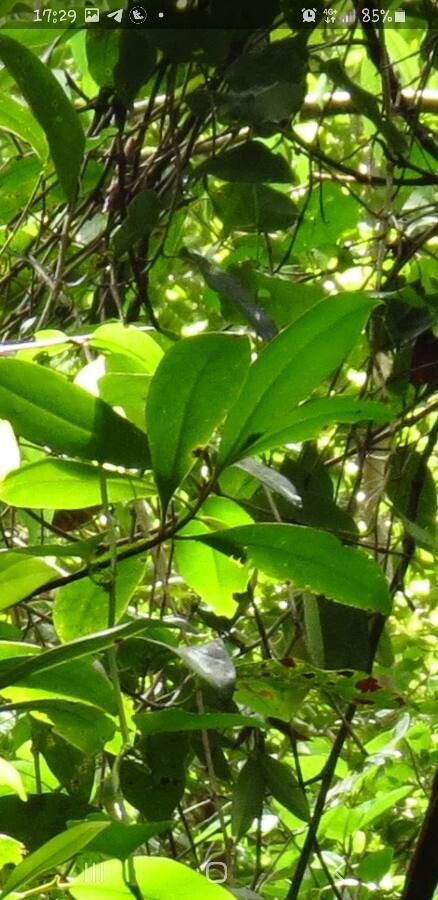
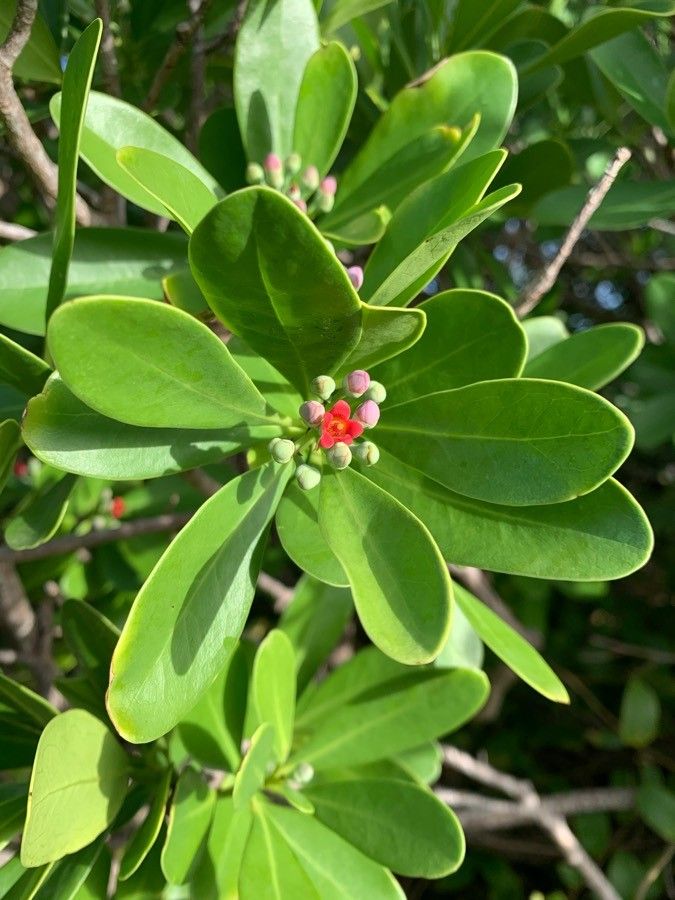
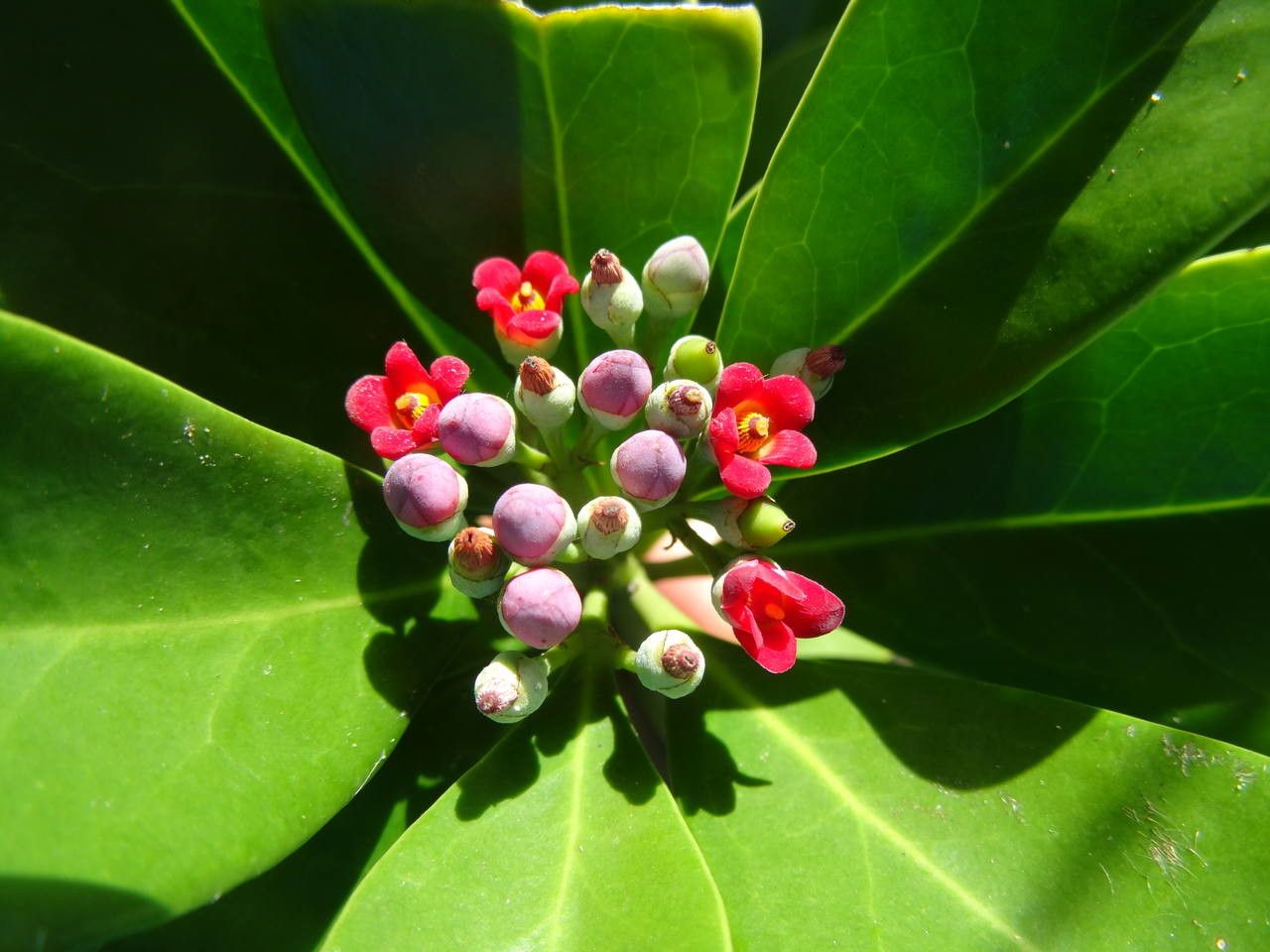
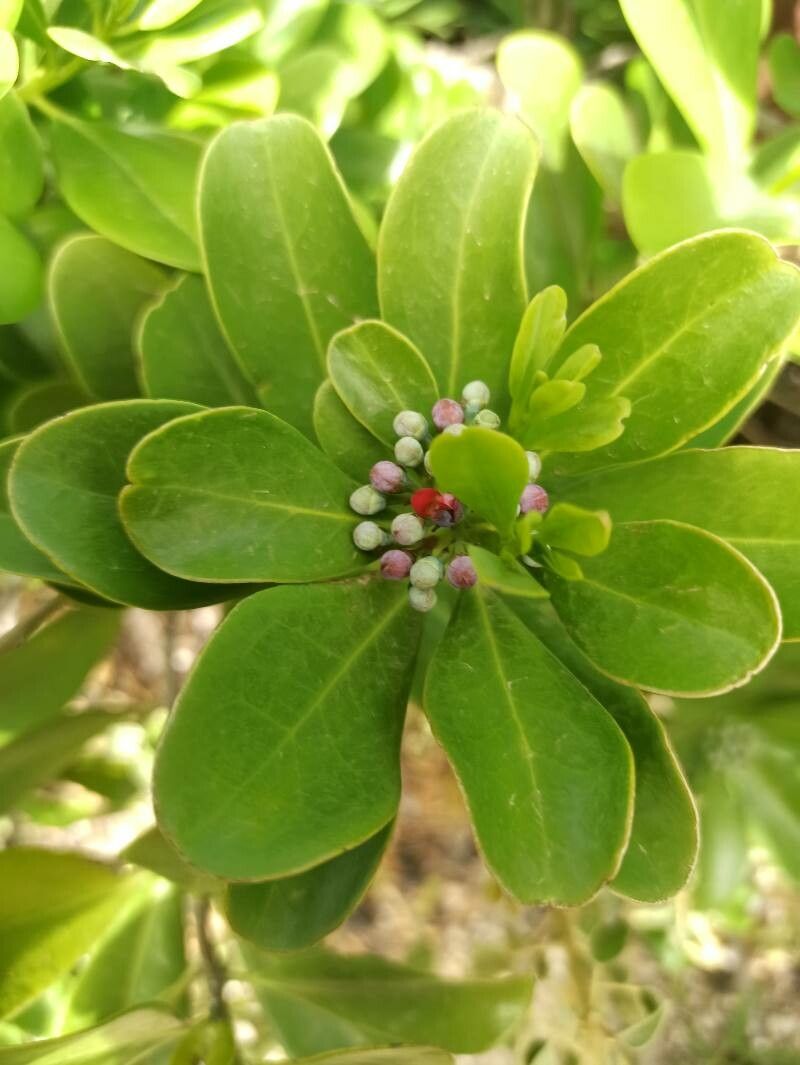
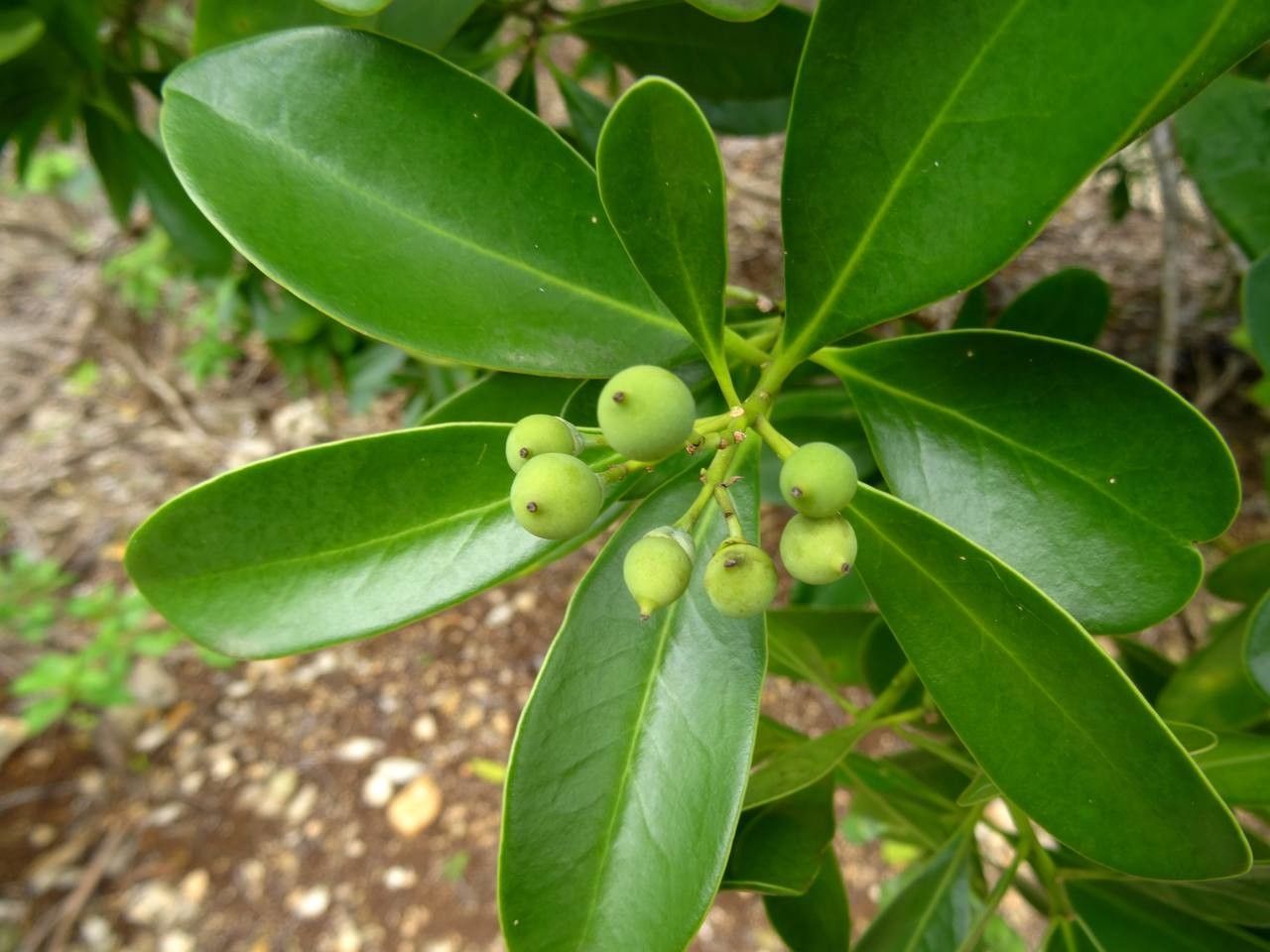
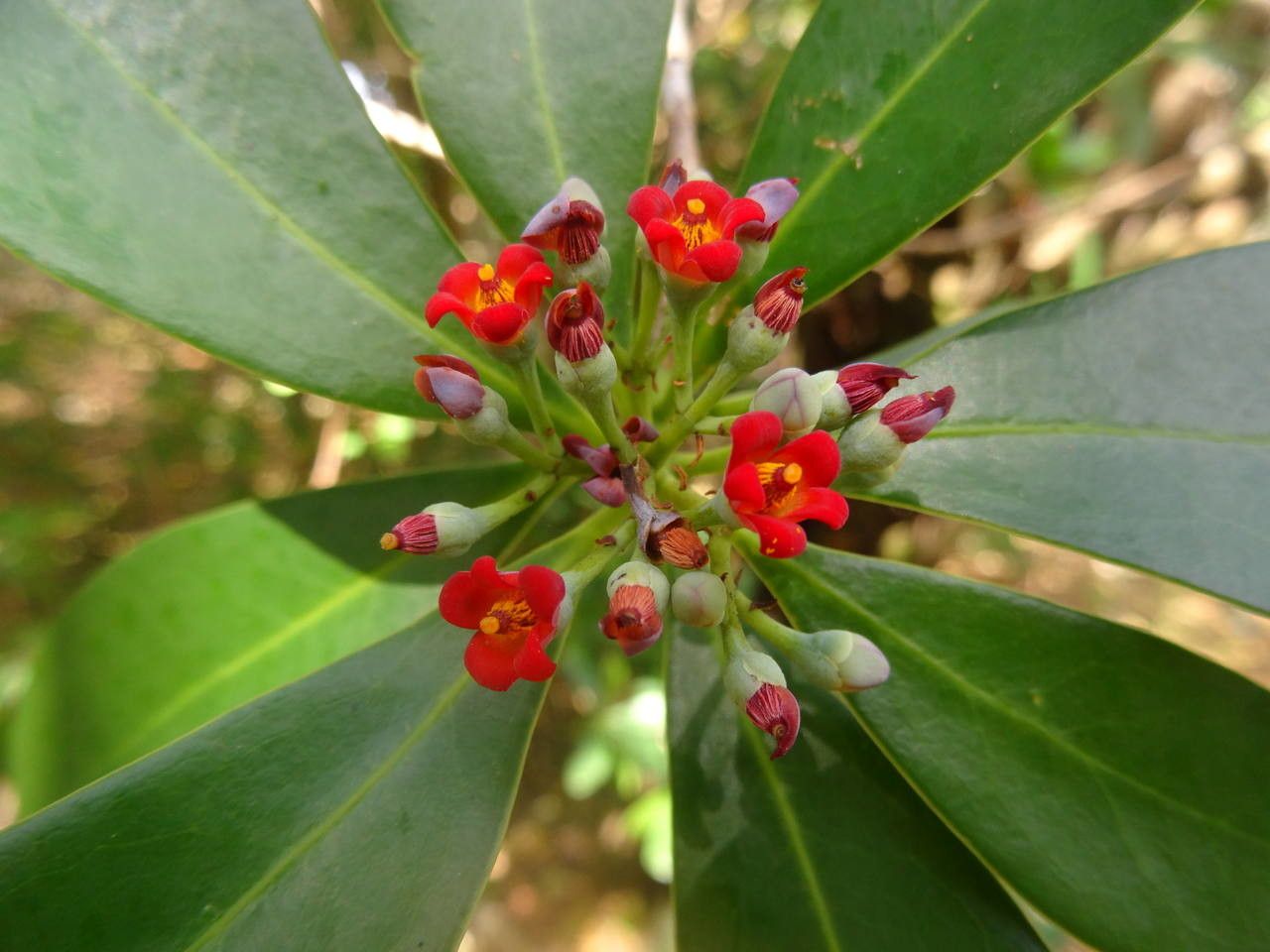
Canella is a monospecific genus containing the species Canella winterana, a tree native to the Caribbean from the Florida Keys to Barbados. Its bark is used as a spice similar to cinnamon, giving rise to the common names cinnamon bark, wild cinnamon, and white cinnamon.The wood of Canella is very heavy and exceedingly hard, strong, and close-grained, with numerous thin, inconspicuous medullary rays; it is dark red-brown, and the thick sapwood consists of 25 to 30 layers of annual growth, light brown or yellow in color. The specific gravity of the absolutely dry wood grown in Florida is 0.9893; a cubic foot of the dry wood weighs 61.65 pounds.Canella attains in Florida a height of 25 to 30 feet, with a straight trunk eight to 10 inches in diameter. On the mountains of Jamaica, it is said to grow sometimes to the height of 50 feet. The principal branches are slender, horizontal, and spreading, forming a compact round-headed top. The light gray bark of the trunk is an eighth of an inch thick, the surface is broken into many short thick scales rarely more than 2-3 in long, and about twice the thickness of the pale yellow, aromatic inner bark. The leaves are obovate, round or slightly emarginate at the apex, and contracted into a short, stout, grooved petiole; they are 3.5-5.0 in long, 1.5-2.0 in broad, bright deep green, and lustrous. The flowers open in the autumn, and the fruit ripens in March and April, when it is bright crimson, soft, and fleshy, and is eaten by many birds.
Wild cinnamon is resistant to disease and typically does not suffer from illnesses. As for upkeep, this plant is fairly low-maintenance. When grown outdoors it needs only light watering, and larger specimens usually do not require pruning. Smaller specimens, however, should be trimmed after they have finished blooming. Wild cinnamont is appropriate for anyone who has an outdoor area, like a garden or a deck, and it does not demand extensive gardening experience.
How to keep Canella Winterana.
Light
Wild cinnamon comes from open habitats, such as sunlit meadows and forest edges, which offer abundant light. It flourishes in Full Sun but can also tolerate Partial Sun, adapting well to a range of sunlight conditions.
Water
Wild cinnamon thrives in semi-arid regions because of its drought tolerance. It needs watering only every 2 to 3 weeks. For optimal growth, it prefers well-draining soil to avoid waterlogging, which mimics its natural dry habitat. This makes wild cinnamon well-suited for various outdoor weather conditions.
Temperature
Wild cinnamon originates in tropical regions, where the climate is generally warm and humid. Consequently, it is well adapted to high temperatures and moisture. It does not tolerate sudden temperature changes and prefers a stable thermal environment, so it is important to avoid temperature fluctuations indoors. It usually cannot withstand cold and requires higher temperatures for growth. If the surrounding temperature falls too low, the plant may stop growing or even die.
Fertilizer
The best time to fertilize a Wild cinnamon is in early spring as it breaks dormancy. This encourages overall growth and flower development. Fertilization improves the foliage, stems, and branches, and promotes large, vibrant, long-lasting flowers. It also helps transfer nutrients from the roots to the flowers and enhances the plant’s health and resistance to disease.
Pruning
Prune wild cinnamon between early and late winter to remove dead or diseased branches and promote healthy growth. Limit pruning to one-third of the plant to prevent stress. This practice improves its appearance and stimulates new growth for the coming season.
Botanical profile.
- Plant Type
- Tree, Shrub
- Life Cycle
- Perennial
- Genus
- Canella
- Family
- Canellaceae
- Hardiness Zone
- 10-11
- Mature Height
- 4.57 m to 13.72 m
- Mature Spread
- 4.57 m
- Leaf Color
- Green
- Leaf Type
- Evergreen
- Flower Color
- Purple, Violet
- Flower Size
- 1.02 cm to 1.52 cm
- Bloom Time
- Late spring, Summer
- Planting Time
- Spring, Summer, Autumn
- Harvest Time
- Late summer, Fall
- Native Area
- Bahamas, Cuba, Mexico, Venezuela, Jamaica
Other names.
Reader questions.
What are the sunlight requirements for Wild Cinnamon (Canella winterana)?
Wild Cinnamon (Canella winterana) thrives in environments that offer ample sunlight, such as open sunny meadows and forest edges. The plant prefers full sun, meaning it requires more than 6 hours of sunlight daily, but it can also tolerate partial sun, which consists of about 3-6 hours of sunlight each day. It's essential to observe how sunlight moves through your garden to ensure that your plants receive the right balance of light and shade, thus promoting their optimal growth and health.
What is Wild Cinnamon?
Wild Cinnamon, also known by its botanical name, Canella winterana, is a plant without additional specific details concerning essentials or symptoms provided in the dataset. Unfortunately, the provided information does not include further descriptions or characteristics about this plant.
How can artificial lighting be used for Wild Cinnamon if natural sunlight is insufficient?
When Wild Cinnamon does not receive enough natural sunlight, artificial lighting can be a critical solution, especially during winter or in less sunny spaces. Optimal growth under artificial lighting involves selecting the correct type of light, such as LED lights, which can be customized to provide specific light wavelengths needed by the plant. Full sun plants require 30-50W/sq ft of artificial light, partial sun plants need 20-30W/sq ft, and full shade plants should have 10-20W/sq ft. The lights should be placed 12-36 inches above the plant to mimic natural sunlight conditions, ensuring 8-12 hours of light per day to match natural daylight hours.
What are the common symptoms of insufficient light for Wild Cinnamon, and how can they be mitigated?
Wild Cinnamon may show several symptoms when exposed to insufficient light, such as smaller new leaves, leggy or sparse growth, faster leaf drop, slower or no new growth, lighter-colored new leaves, chlorosis, sunscald, leaf curling, wilting, and leaf scorching. Solutions include gradually moving the plant to a sunnier location or using artificial light for indoor plants, ensuring at least 6 hours of sunlight or 8 hours of artificial light daily. For outdoor plants, it's crucial to adjust their location gradually to prevent sunburn and ensure a smooth adaptation to the increased light. Moreover, reducing obstructions and transplanting smaller plants to sunnier locations can help improve light exposure. Note that while affected plant parts may not recover, new growth can be healthy with proper light adjustments.