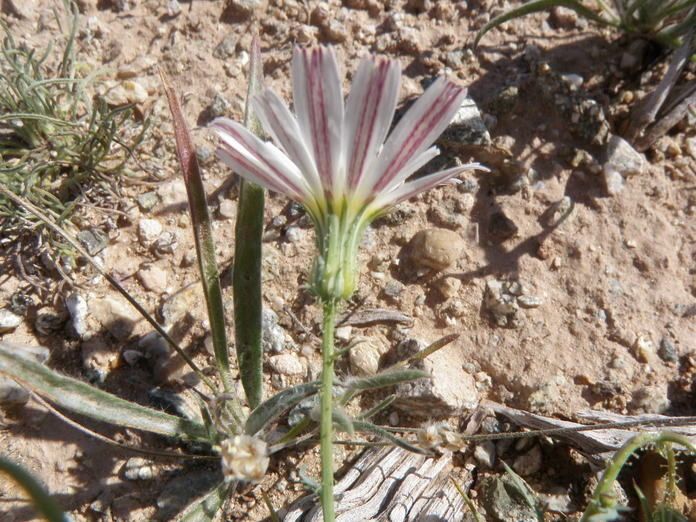
Calycoseris wrightii, commonly known as white tackstem, is an annual spring wildflower, one of two species in the genus Calycoseris; the other species is C. parryi, the yellow tackstem. They are part of the family Asteraceae. White tackstem is found in the southwestern United States and northwestern Mexico in California, Nevada, southwestern Utah (Washington County), New Mexico, Arizona, northern Baja California, Sonora, western Texas (El Paso County).United States Department of Agriculture .Calycoseris wrightii is a white daisy-like flower up to more than 2.0 inches (5 cm) across; when it grows supported amongst other plants it can be more than 45 cm (18 inches) tall. It has one easy distinguishing feature: the closed outside of the ray florets contain two linear purple stripes (fine reddish veins abaxially – 2 to 3 cm (1 in)). It is a spring wildflower found in the desert regions and is plentiful after winter rains. It grows up to 4000 ft (1,220 m) elevation.
White tack-stem is fairly disease-resistant and usually not prone to illness. Nevertheless, it can be affected by pests and diseases present in its environment. These problems are typically minor. For care, this plant requires moderate maintenance. It should be pruned regularly to preserve a neat appearance and healthy growth. Fertilizing can also encourage flowering. White tack-stem is suitable for anyone with outdoor space, such as a garden or patio, and does not demand extensive care experience. It may need more attention when grown indoors.
How to keep Calycoseris Wrightii.
Light
White tack-stem comes from bright, open habitats and does best in full sun. It can tolerate partial sun but favors direct sunlight for optimal growth. This plant, which may be annual or biennial, is known for its sun-loving nature.
Water
The white tack-stem is well adapted to dry environments, conserving water efficiently and thriving in arid conditions. However, it still requires occasional moisture to stay healthy. By watering it weekly, you can mimic natural rainfall patterns, which strengthens the plant's resilience and makes it an excellent choice for xeriscaping.
Temperature
White tack-stem can tolerate a wide range of temperatures, but its distribution may still be restricted by particular combinations of moisture and heat. It does best in warm summer climates with sufficient rainfall or watering. Extended periods of cloudy, rainy weather, as well as prolonged high temperatures, increase the chance of White tack-stem dying. In winter, adequate protection from cold improves the plant's survival rate.
Fertilizer
White tack-stem does well with frequent, weak fertilizer applications to encourage healthy leaf growth. You should fertilize White tack-stem about once a month during the summer. Nitrogen is essential for foliage, and supplying nitrogen-rich sources helps White tack-stem thrive.
Pruning
The white tack-stem plant has delicate white flowers and a sticky stem. It thrives with selective pruning during early to late spring. To promote its health and blooming, remove any dead or weak stems. Making clean cuts enhances airflow, reduces the risk of disease, and maintains the plant's aesthetic appeal, all of which encourage robust growth.
Botanical profile.
- Plant Type
- Herb
- Life Cycle
- Annual
- Genus
- Calycoseris
- Family
- Asteraceae
- Hardiness Zone
- 8-11
- Mature Height
- 5 cm to 46 cm
- Mature Spread
- 30 cm to 61 cm
- Leaf Color
- Green, Light Green
- Leaf Type
- Deciduous
- Flower Color
- White
- Flower Size
- 5.08 cm
- Bloom Time
- Early spring, Mid spring
- Planting Time
- Spring
- Harvest Time
- Mid spring, Late spring
- Native Area
- Mexico
Other names.
Reader questions.
What are the sunlight requirements for White tack-stem?
White tack-stem, scientifically known as Calycoseris wrightii, thrives in environments that offer full sun, which means it requires above 6 hours of sunlight daily. It can also tolerate partial sun, approximately 3-6 hours of sunlight. For optimal growth and health, positioning your plants to receive the right balance of sunlight and shade throughout the day is crucial. Paying attention to how sunlight moves through your garden helps in choosing spots that ensure your plants' happiness.
How does artificial lighting support White tack-stem indoor growth?
For indoor White tack-stem plants or when natural sunlight is inadequate, artificial lighting becomes essential for their growth. LEDs are recommended due to their ability to provide specific light wavelengths needed by plants. For full sun plants, 30-50W/sq ft is needed; partial sun plants require 20-30W/sq ft, and full shade plants need 10-20W/sq ft of artificial light. The light source should be placed 12-36 inches above the plant, mimicking natural sunlight. Additionally, to ensure healthy growth, most plants will need 8-12 hours of light per day.
What are the symptoms of inadequate light for White tack-stem?
White tack-stem shows several symptoms when grown under inadequate light conditions. These include smaller new leaves, leggy or sparse growth, faster leaf drop, and slower or no new growth, indicating a light deficiency. New leaves may appear lighter in color due to insufficient sunlight, leading to a lack of chlorophyll. In contrast, excessive sunlight can cause chlorosis (yellowing leaves), sunscald, leaf curling, wilting, and leaf scorching. These symptoms reflect the plant's struggle to adapt to inappropriate light conditions.
What solutions can optimize White tack-stem's exposure to sunlight?
To ensure White tack-stem receives optimal sunlight, gradually increase its exposure by moving it to sunnier spots each week until it gets at least 6 hours of direct sunlight daily. For indoor plants, especially large or non-movable ones, supplementing with artificial light for at least 8 hours daily or using professional grow lights can be beneficial. Outdoors, it's key to transition plants gradually to prevent sunburn. Reducing obstructions, such as pruning branches or relocating plants to brighter areas, enhances sunlight access. Remember, while parts of the plant that suffered due to low light may not fully recover, new growth will flourish under improved light conditions.
