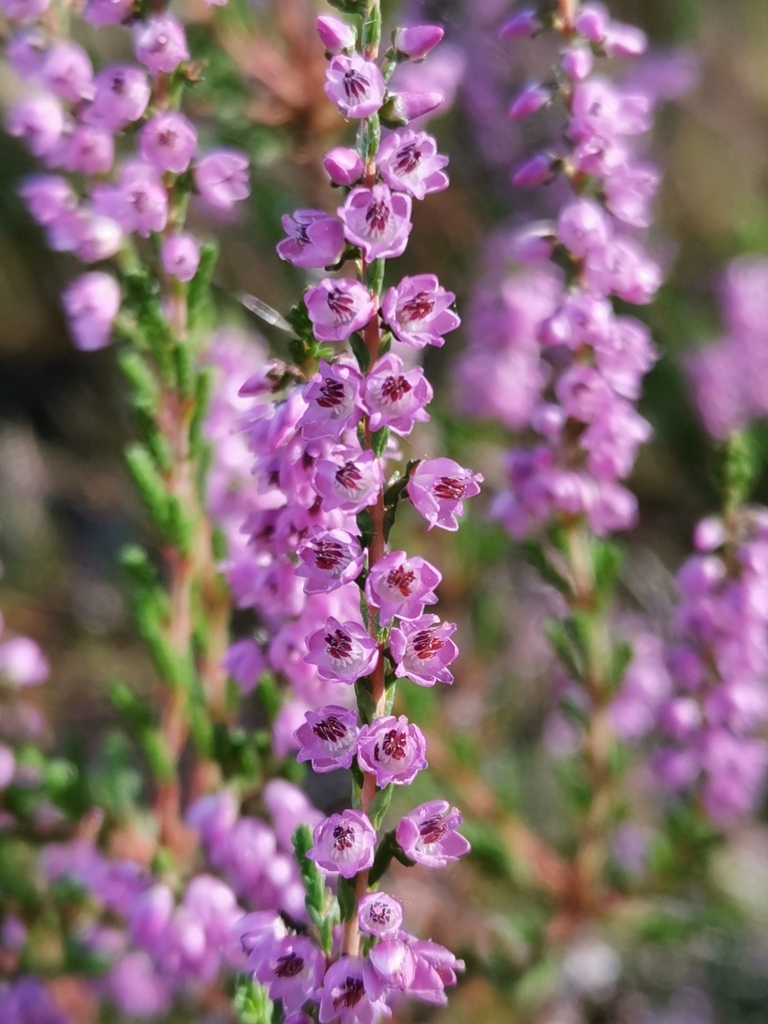
Calluna vulgaris, commonly known as heather, is a small evergreen shrub that belongs to the Ericaceae family. Native to Europe, it thrives in heathlands, moors, and rocky hillsides. The plant has a compact growth habit with woody stems covered in small, needle-like leaves. During the summer months, Calluna vulgaris produces an abundance of tiny pink or purple flowers arranged in dense clusters along the stems. Heather is a hardy plant that can tolerate poor soil conditions and harsh weather, including frost and drought. It prefers acidic soils with good drainage and full sun exposure but can also grow well in partial shade. The plant has been used for centuries for its medicinal properties, such as treating respiratory problems like coughs and bronchitis. Its antiseptic properties make it useful for treating skin infections. In addition to its medicinal uses, Calluna vulgaris is popular as an ornamental plant due to its attractive foliage, which ranges in color from greenish-yellow to deep purple, depending on the cultivar. Overall, Calluna vulgaris, or heather, is a versatile shrub with both ornamental and medicinal value, making it an excellent addition to any garden or landscape design project.
Heather is fairly disease-resistant and usually not prone to illnesses. However, if grown in poor conditions it can become more vulnerable to disease. It also has few problems with insect pests. Care requirements for this plant are moderate. It needs plenty of sunlight, since insufficient light can make it more disease-prone and cause spindly growth. As it is often kept indoors, it may need to be moved regularly to a bright spot. It does not need frequent watering. Overall, Heather is suitable for most people, though it performs best with those who can provide strong light conditions.
How to keep Calluna Vulgaris.
Light
Heather requires abundant sunlight to grow vigorously. It performs best beneath an unobstructed sky, though it can tolerate some shade. This need for extensive light is tied to its native habitat of open land. Too little light can restrict growth, while excessive exposure may cause damage.
Water
Scotch heather flourishes in well-drained soils and prefers consistent moisture while avoiding waterlogged conditions. It should be watered every 1-2 weeks, allowing the soil to dry out slightly between waterings. As an evergreen plant, scotch heather retains its foliage throughout the year, improving its water use efficiency in various climates.
Humidity
This plant will thrive in moderate humidity, which is probably the level in your home. However, misting it a few times a week can be very beneficial. Make sure the room has good ventilation.
Temperature
Heather favors a native growing environment with cooler temperatures of 41 to 68 ℉ (5 to 20 ℃). It can tolerate temperatures from 41 to 77 ℉ (5 to 25 ℃), though it favors the cooler range. Adjust watering schedules across seasons to keep moisture levels steady, because temperature changes can alter water needs.
Fertilizer
Timing is essential for fertilizing Heather. Apply fertilizer in early spring and continue monthly until early summer. Fertilizer promotes attractive blooms and supplies energy during both dormant and active growth phases.
Pruning
Scotch heather is an evergreen shrub with bell-shaped flowers that thrives in acidic soil. To care for it, prune in early spring using sharp shears. Remove any dead branches and trim new growth to promote bushiness and more blooms. It's important not to cut into old wood, as this helps maintain the plant's vitality and reduces the risk of disease.
Pot & Repot
When repotting Heather, select a pot 1-2 inches (2.5–5.1 cm) larger with ample drainage. Use a well-draining potting mix. Repot in spring or fall, making sure the root ball sits slightly lower than the rim of the flower pot. Water thoroughly after repotting and place it in a warm spot with indirect sunlight.
Botanical profile.
- Plant Type
- Shrub
- Life Cycle
- Perennial
- Genus
- Calluna
- Family
- Ericaceae
- Hardiness Zone
- 4-6
- Mature Height
- 20 cm to 49 cm
- Mature Spread
- 30 cm to 61 cm
- Leaf Color
- Green, Yellow, Gray, Red, Orange
- Leaf Type
- Evergreen
- Flower Color
- Pink, Purple, White
- Flower Size
- 2.54 cm
- Bloom Time
- Mid summer
- Planting Time
- Spring, Autumn
- Harvest Time
- Early spring, Mid spring, Late summer, Fall, Winter
- Native Area
- Turkey, Austria, Sweden, Slovakia, Montenegro, Croatia, Slovenia, Morocco, Belarus, Russia, Germany, Iceland, Estonia, Romania, Latvia, Belgium, Netherlands, France, Portugal, Czech Republic, Bulgaria, Poland, Ukraine, Serbia, Lithuania, Norway, Italy, Kazakhstan, Spain, Switzerland, Denmark, Finland, Ireland, United Kingdom, Hungary
Other names.
Reader questions.
How should I water my Scotch heather?
Your Scotch heather is not particular about how you water it. Almost any watering tool will work, such as watering cans, hoses, or even cups. It's important to water directly onto the soil to evenly moisten all areas and provide water to all parts of the root system. Using filtered water is recommended to avoid harmful particles in tap water. Additionally, it's best to use water that is at or slightly above room temperature to avoid shocking the Scotch heather. However, this plant typically responds well to any type of water.
Why is it important to put fertilizer on my Scotch heather?
Fertilizing your Scotch heather is important for several reasons. The most obvious is that it helps the plant produce beautiful blooms. To ensure excellent flower production in spring, it is best to fertilize in early spring. Additionally, fertilizer provides the plant with energy that it can store in the ground during its dormant growth phases. By giving your Scotch heather extra nutrients during fall planting or late spring, it will have more energy to use when it starts growing again.
What are the sunlight requirements for Scotch heather?
Scotch heather (Calluna vulgaris) requires ample exposure to sunlight for robust growth, thriving best under full sun conditions with more than 6 hours of sunlight. It can also grow in partial sun, which is about 3-6 hours of sunlight. Observing how sunlight moves through your garden and choosing spots that offer a balance of light and shade is recommended to ensure the plant's happiness. However, note that insufficient light might hinder the plant's growth, while overly strong exposure could cause harm.
What are the ideal temperature conditions for Scotch heather?
Scotch heather (Calluna vulgaris) flourishes in cooler temperatures, ideally ranging between 41 to 68°F (5 to 20°C). Though it can survive in temperatures up to 77°F (25°C), it truly thrives in cooler conditions. It's important to adjust watering schedules through different seasons to maintain consistent moisture levels, especially as temperature fluctuations can affect the plant's water needs. Additionally, Scotch heather is highly cold-tolerant, not requiring extra frost protection in winter. Nevertheless, it is advisable to water the plant generously before the first freeze of autumn to ensure the soil remains moist through the freeze, aiding in preventing drought and water scarcity during winter and early spring.
What should I do if I give my Scotch heather too much water or too little water?
Outdoor plants, especially newly planted ones or seedlings, are prone to lack of watering. It is important to water them consistently for a few months while they are small or recently planted. Once the roots are established, Scotch heather can often rely on rain for moisture. When Scotch heather is planted in pots, overwatering is more likely to occur. If you accidentally overwater your Scotch heather, there are steps you can take to remedy the situation. First, stop watering the plant immediately to minimize the impact of overwatering. Then, remove the Scotch heather from its pot to inspect the roots. If no root rot is present, you can return the plant to its container. If root rot is found, trim away the affected roots and consider applying a fungicide to prevent further damage. Lastly, make sure to repot the Scotch heather in well-draining soil. On the other hand, underwatering Scotch heather is a more easily fixable issue. If you notice the plant's leaves drooping, drying out, or falling off, increase the frequency of watering. The leaves should quickly regain their fullness after sufficient watering. It is important to correct your watering frequency promptly when underwatering occurs.
When should I fertilize my Scotch heather?
To effectively fertilize Scotch heather, timing is crucial. Applying fertilizer too early, while the plants are dormant, is not effective as it will be washed away by rainwater, causing waste and pollution. Instead, the first application of fertilizer should be done in early spring, and then continue to fertilize once a month until early summer.
How can artificial lighting be used for indoor Scotch heather plants?
For indoor Scotch heather plants, artificial lighting can be a vital solution when natural sunlight is insufficient, especially in winter or less sunny spaces. Adequate lighting promotes faster, healthier growth. LED lights are recommended as they can provide specific wavelengths needed by plants. Full sun plants require 30-50W/sq ft, partial sun plants 20-30W/sq ft, and full shade plants 10-20W/sq ft of artificial light. The light source should be placed 12-36 inches above the plant to mimic natural sunlight, and most plants need 8-12 hours of light per day.
How should you care for Scotch heather in temperatures below -30°C?
Scotch heather is extremely cold-tolerant, capable of withstanding winter temperatures down to -30°C. However, if temperatures fall below this threshold, you might not notice immediate changes during winter. Come spring, the plant's branches can become brittle and dry, failing to produce new shoots. To combat this, prune away any dead branches that did not produce new leaves once spring arrives. This helps encourage healthy new growth and maintains the plant's vitality.
How often should I water my Scotch heather plant?
Most outdoor plants can grow with rainfall, but if your area lacks rainfall, you should water them every two weeks in the spring and fall. In the summer, you'll need to water them more often. In the winter, when growth slows down, you can water them less frequently or not at all. If your Scotch heather is young or newly planted, it will need more frequent watering to help it establish and grow. For potted plants, there are two main methods to determine watering frequency for your Scotch heather. The first is to follow a predetermined schedule, watering once a week or every other week. However, this may not always account for the specific conditions of your Scotch heather's environment. Watering frequency can also change based on the season. During the summer, when the plant's water needs are highest, a predetermined schedule may not be enough. An alternative approach is to check the soil moisture before watering. Ideally, wait until the top two to four inches of soil, about one-third to one-half the depth of the pots, have completely dried out before watering again.
When is the best time to not fertilize my Scotch heather?
To ensure optimal growth and blooming of Scotch heather, it is important to be mindful of the timing and composition of fertilizer. Avoid using a fertilizer with excessive nitrogen, as this can cause an abundance of leaves but limited blooms. Instead, opt for a fertilizer with a lower nitrogen content compared to other nutrients. Additionally, refrain from fertilizing after early autumn, as this can result in excessive growth just before winter, which may be detrimental to the plant. Furthermore, avoid fertilizing Scotch heather during hot and dry periods, as dry soil does not effectively deliver fertilizer and the resulting growth may require more water than is available. It is advisable to apply fertilizer during cooler times of the year. Lastly, be cautious not to inadvertently provide nearby plants or lawns with a double dose of fertilizer, as Scotch heather can absorb fertilizer from surrounding areas.
What are the symptoms of light deficiency in Scotch heather?
Scotch heather shows several symptoms when it's not receiving enough light. New leaves may grow smaller than the older ones, and the plant could develop leggy or sparse growth, giving it a thin and stretched-out appearance. There might also be faster leaf drop as the plant tries to conserve resources and halt new leaf production, resulting in slower or no new growth, and new leaves may appear lighter-colored or pale, indicating a lack of chlorophyll and essential nutrients.
What steps should be taken if Scotch heather experiences high temperatures?
Scotch heather struggles in high temperatures, particularly those exceeding 25°C, which can lead to significant leaf drop or, in severe cases, the death of the plant. To mitigate damage from high temperatures, trim away any sunburned and dried-up parts of the plant. Relocate the Scotch heather to a shaded spot, particularly away from the midday and afternoon sun, or use a shade cloth to provide protection. Moreover, watering the plant during cooler parts of the day, like in the morning and evening, helps keep the soil adequately moist under hot conditions.