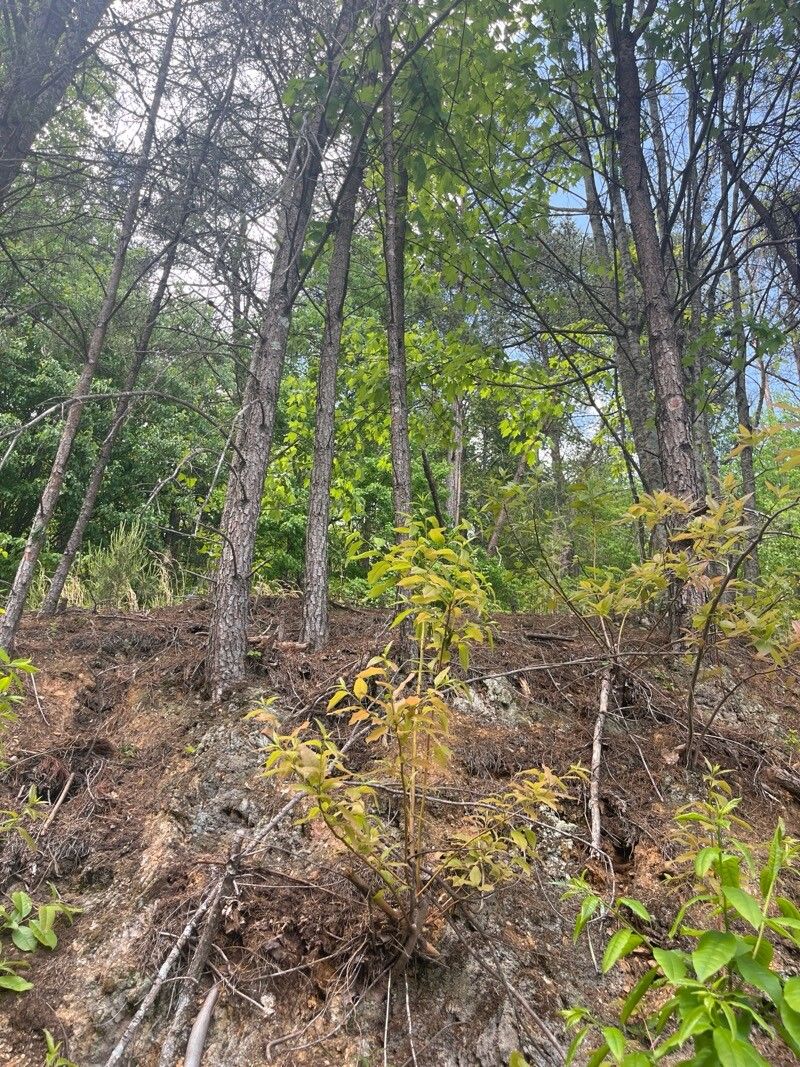
Buckleya distichophylla, commonly called piratebush, is a flowering plant in the family Santalaceae, native to the Southern United States. It is a rare plant, found only in sporadic mountainous areas of North Carolina, Tennessee, and Virginia.Buckleya distichophylla is a deciduous shrub growing to heights of up to 15 feet (4.6 m), with leaves that are 2-4 inches in length requiring direct sunlight to grow. Its flowers are 1 inch (2.5 cm) long with 4 yellow-green, long narrow bracts. What makes the piratebush unique is in how it survives. The plant does not survive on photosynthesis only as its pale green leaves indicate less chlorophyll than other plants. In addition to photosynthesis, piratebush receives nutrients through parasitizing other species. The plant is hemiparasitic, attaching itself to the root systems of other plants with structures called haustoria and draw nutrients through them. Although originally thought to attach itself only to hemlock trees, it has since been determined that piratebush can attach to many different species.At present, piratebush has only been identified in mountainous areas of North Carolina, Tennessee, and Virginia. The greatest concentration of the plant can be found within the Poor Mountain Natural Area Preserve atop Poor Mountain, approximately 2 miles (3.2 km) southwest of Roanoke in Roanoke County, Virginia. The number of piratebush plants on Poor Mountain is greater than all of the others existing at other locations. Although many other locations in the Appalachians feature habitats that seemingly would support piratebush, scientists have yet to determine why the plant exists in so few places.The plant was initially discovered and described as a member of the genus Borya in the olive family by Thomas Nuttall in 1818 along the French Broad River in the vicinity of Paint Rock in Western North Carolina. The plant was rediscovered in 1843 by Samuel Buckley with John Torrey classifying the plant as Buckleya distichophylla.
Piratebush is highly disease-resistant and is typically not susceptible to illnesses. Regarding care, the plant is fairly low-maintenance. Outdoors it needs only minimal watering, and larger plants usually do not require pruning. Smaller plants, however, should be pruned after they have finished blooming. Piratebusht is suitable for anyone with an outdoor space, such as a garden or deck, and does not require much care experience.
How to keep Buckleya Distichophylla.
Light
Piratebush is native to habitats like forest understories or rocky sites, where it grows in natural shade. It prefers partial sun but can tolerate full sun or deep shade, showing its adaptable and hardy nature.
Temperature
Piratebush is very adaptable to different climate conditions, from blistering summers to frigid winters. However, it does have a preferred temperature range for healthy growth. If temperatures get too high, the plant can experience heat and humidity stress, which may cause it to die. In locations where temperatures approach the lower limit of its cold tolerance, insulating the plant is important to protect it.
Fertilizer
Fertilize your Piratebush in early spring to encourage healthy growth. Regular feeding improves overall health, producing vigorous growth, increased resilience to difficult conditions, and enhanced resistance to diseases and pests. Keep to a specific fertilization schedule to maintain foliage that is bright with deep color and has a lush, full appearance.
Botanical profile.
- Plant Type
- Shrub
- Life Cycle
- Perennial
- Genus
- Buckleya
- Family
- Santalaceae
- Hardiness Zone
- 5-8
- Mature Height
- 30 cm to 91 cm
- Mature Spread
- 49 cm to 91 cm
- Leaf Color
- Green
- Leaf Type
- Evergreen
- Flower Size
- 0.25 cm to 0.51 cm
- Bloom Time
- Mid spring, Late spring
- Planting Time
- Spring, Summer
- Harvest Time
- Late summer, Early fall, Mid fall