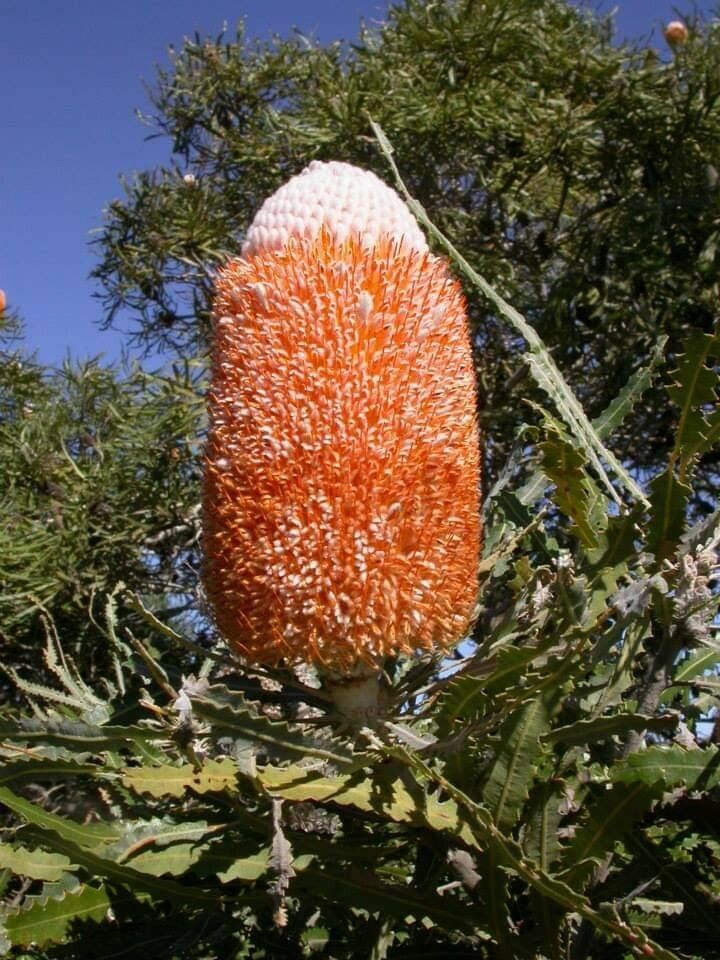
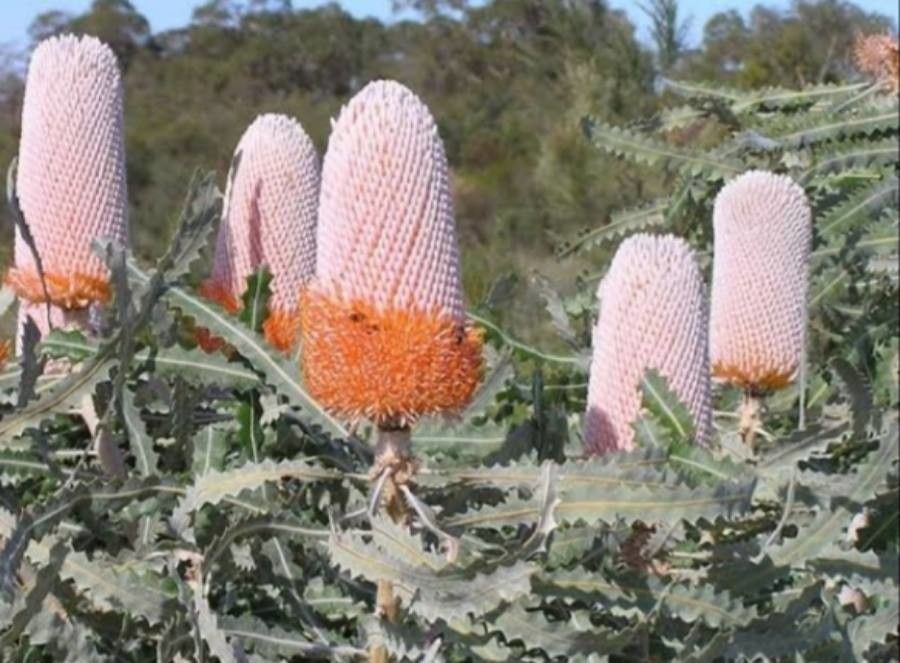
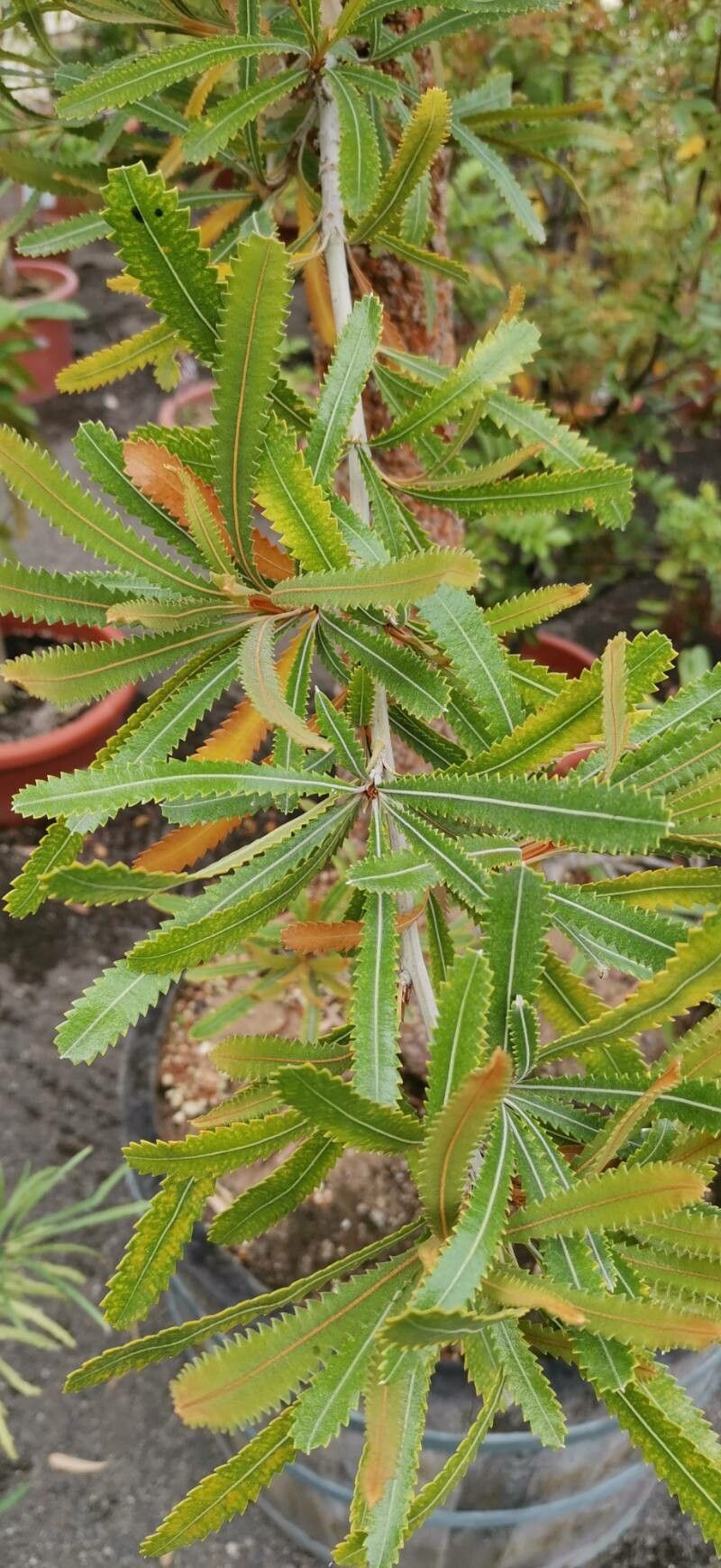
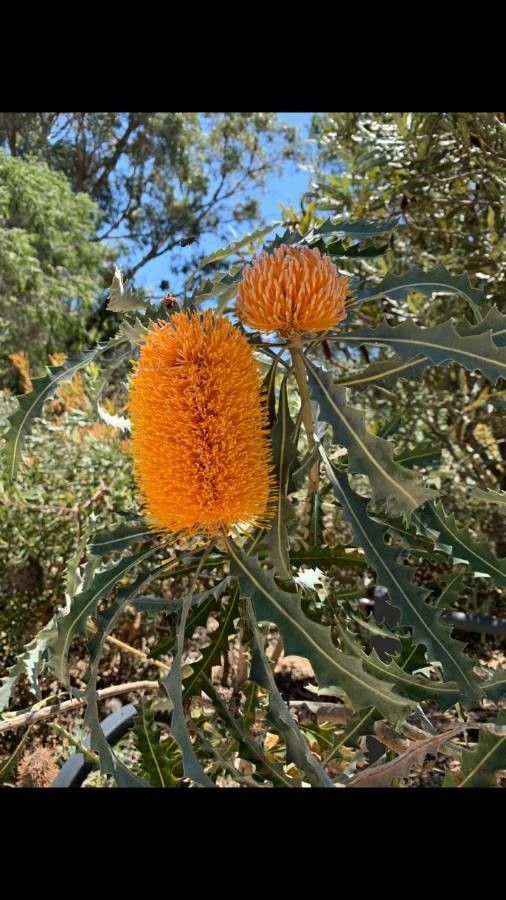
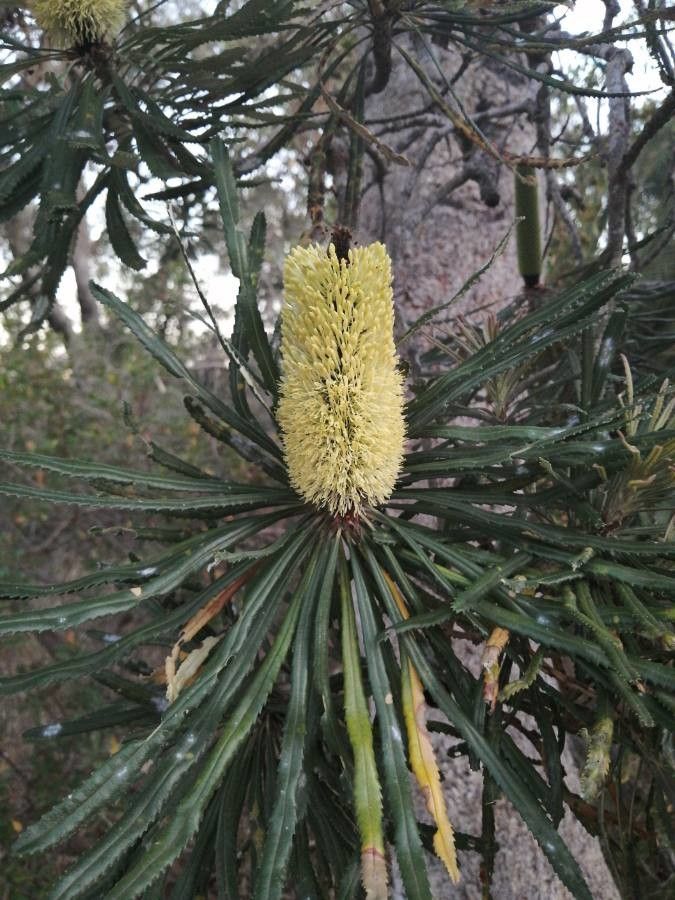
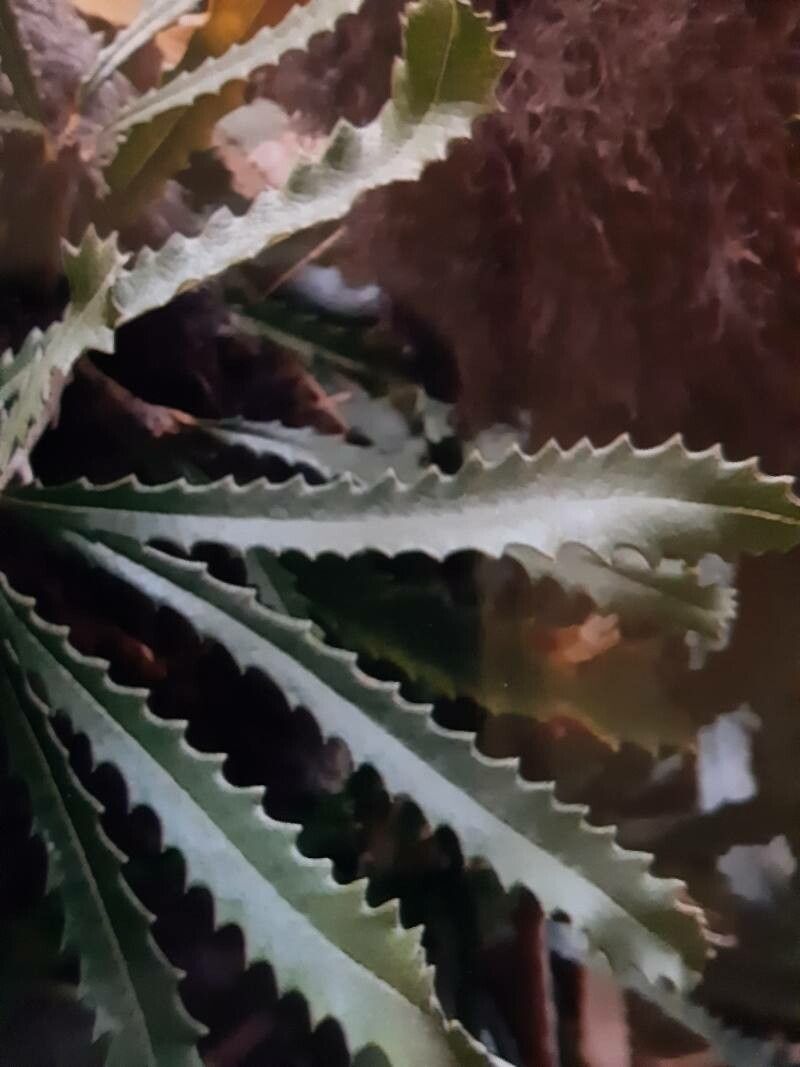
Banksia prionotes, commonly known as acorn banksia or orange banksia, is a species of shrub or tree of the genus Banksia in the family Proteaceae. It is native to the southwest of Western Australia and can reach up to 10 m (33 ft) in height. It can be much smaller in more exposed areas or in the north of its range. This species has serrated, dull green leaves and large, bright flower spikes, initially white before opening to a bright orange. Its common name arises from the partly opened inflorescence, which is shaped like an acorn. The tree is a popular garden plant and also of importance to the cut flower industry. Banksia prionotes was first described in 1840 by English botanist John Lindley, probably from material collected by James Drummond the previous year. There are no recognised varieties, although it has been known to hybridise with Banksia hookeriana. Widely distributed in south-west Western Australia, B. prionotes is found from Shark Bay (25° S) in the north, south as far as Kojonup (33°50′S). It grows exclusively in sandy soils, and is usually the dominant plant in scrubland or low woodland. Pollinated by birds, it provides food for a wide array of vertebrate and invertebrate animals in the autumn and winter months. It is an important source of food for honeyeaters (Meliphagidae), and is critical to their survival in the Avon Wheatbelt region, where it is the only nectar-producing plant in flower at some times of the year.
acorn banksia has strong disease resistance and is usually not prone to illness. In terms of care, this plant is fairly low maintenance. When planted outdoors it needs little watering, and larger plants generally do not require pruning. However, smaller plants should be pruned after they have bloomed. acorn banksia is suitable for anyone with an outdoor area, such as a garden or deck, and does not require much care experience.
How to keep Banksia Prionotes.
Light
acorn banksia comes from open habitats — for instance, sunlit meadows and forest margins — that offer abundant light. It flourishes in Full Sun but can tolerate Partial Sun, adapting well to a range of light conditions.
Temperature
acorn banksia shows strong adaptability to a range of climate conditions, whether in very hot summers or cold winters. Nonetheless, it has an ideal temperature range for healthy growth. If temperatures climb too high, the plant becomes vulnerable to heat and humidity stress, which can cause it to die. In locations where temperatures approach the lower limit of its cold tolerance, taking insulating measures to protect the plant is important.
Fertilizer
The timing of fertilizing acorn banksia is important. Apply fertilizer in early spring and continue monthly until early summer. Fertilizer encourages beautiful blooms and supplies energy during both dormant periods and active growth.
Botanical profile.
- Plant Type
- Tree
- Life Cycle
- Perennial
- Genus
- Banksia
- Family
- Proteaceae
- Hardiness Zone
- 9-11
- Mature Height
- 3.96 m to 10.06 m
- Mature Spread
- 2.13 m to 4.88 m
- Leaf Color
- Green, Dark Green
- Leaf Type
- Evergreen
- Flower Color
- Orange
- Flower Size
- 10.16 cm to 15.24 cm
- Bloom Time
- Winter, Early spring, Mid spring
- Planting Time
- Spring, Summer, Autumn
- Harvest Time
- Spring, Early summer, Mid summer
Other names.