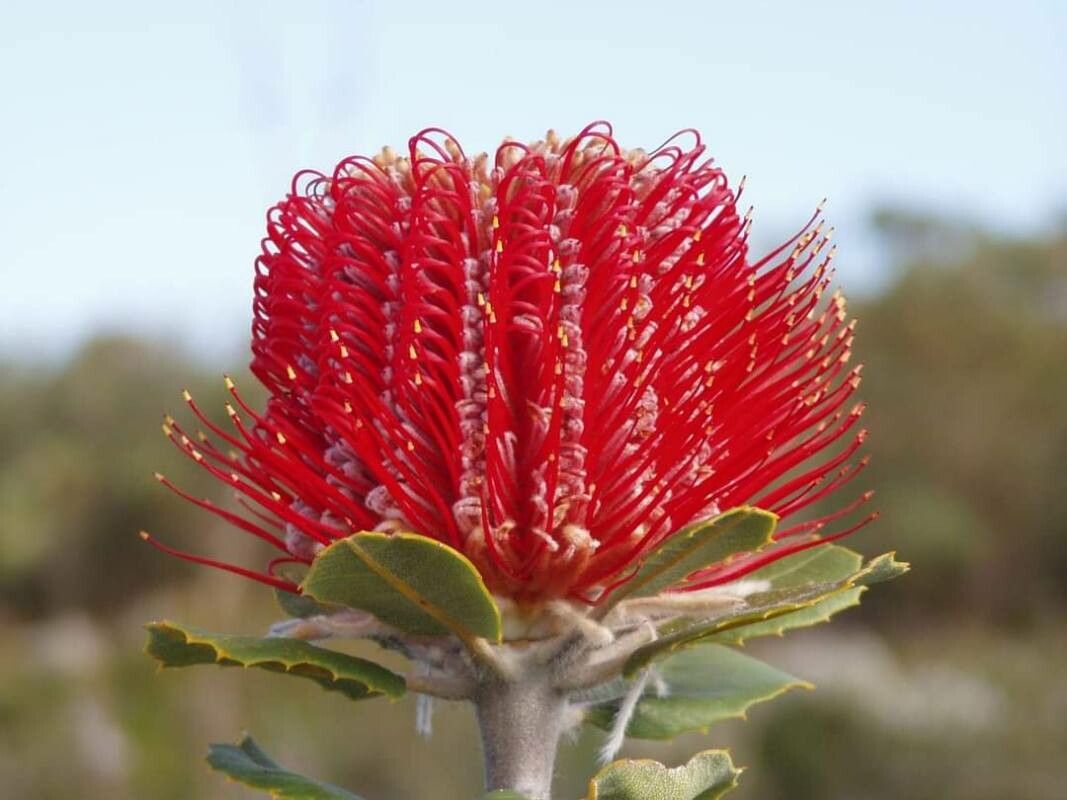
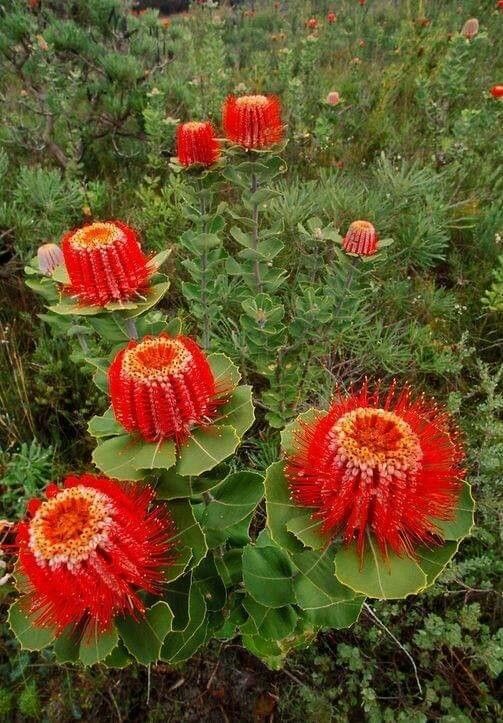
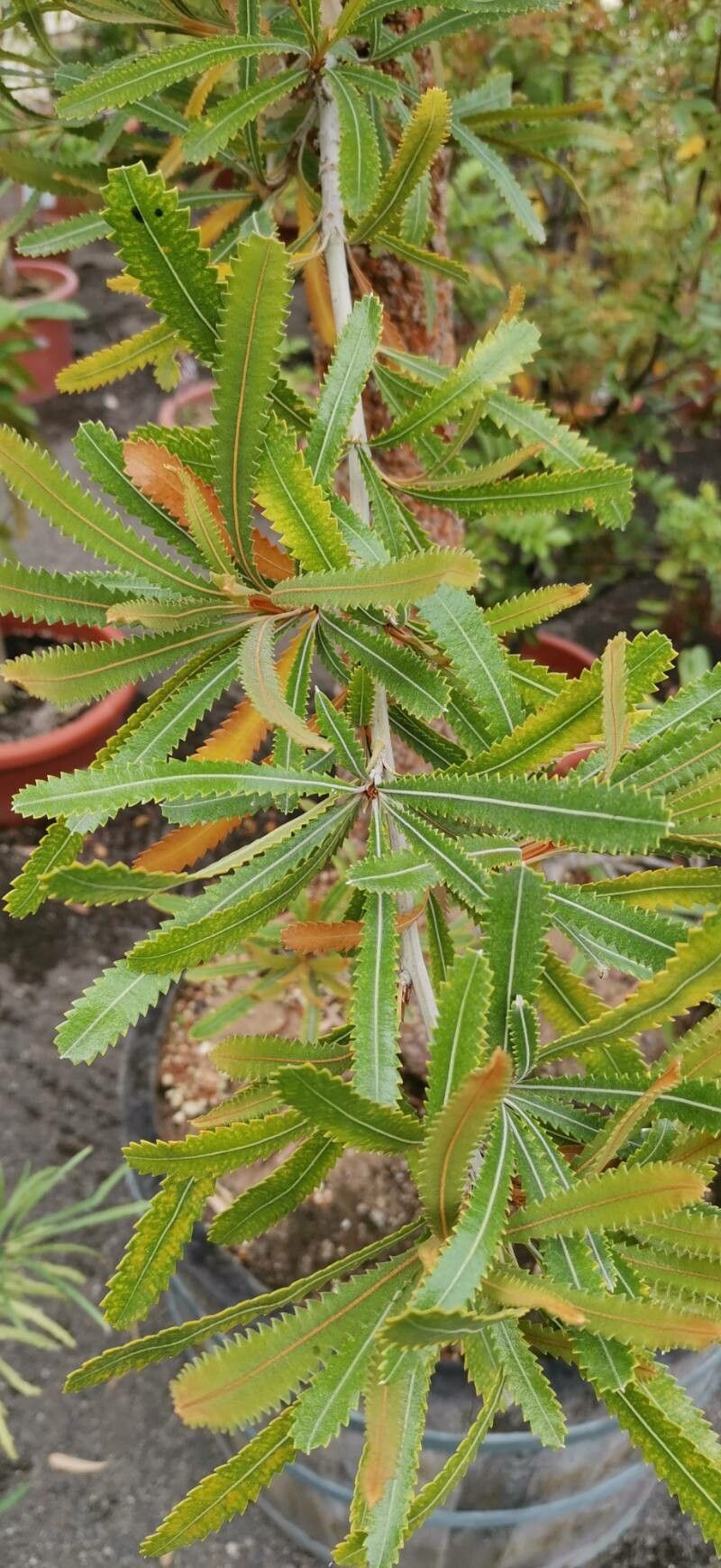
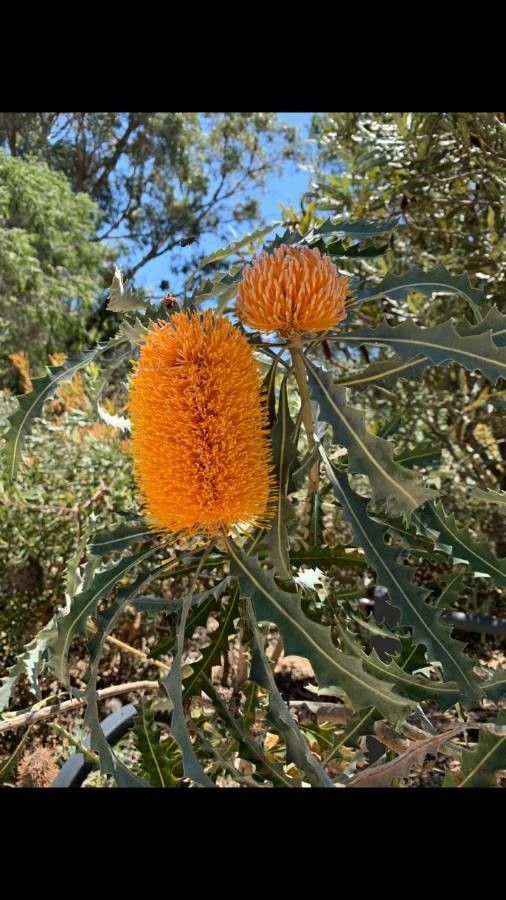
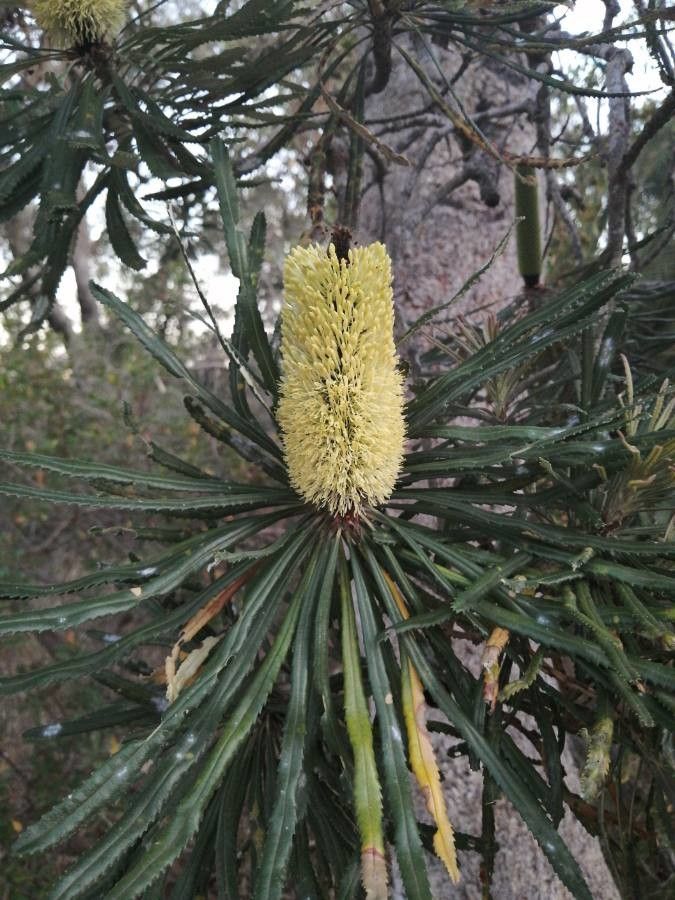
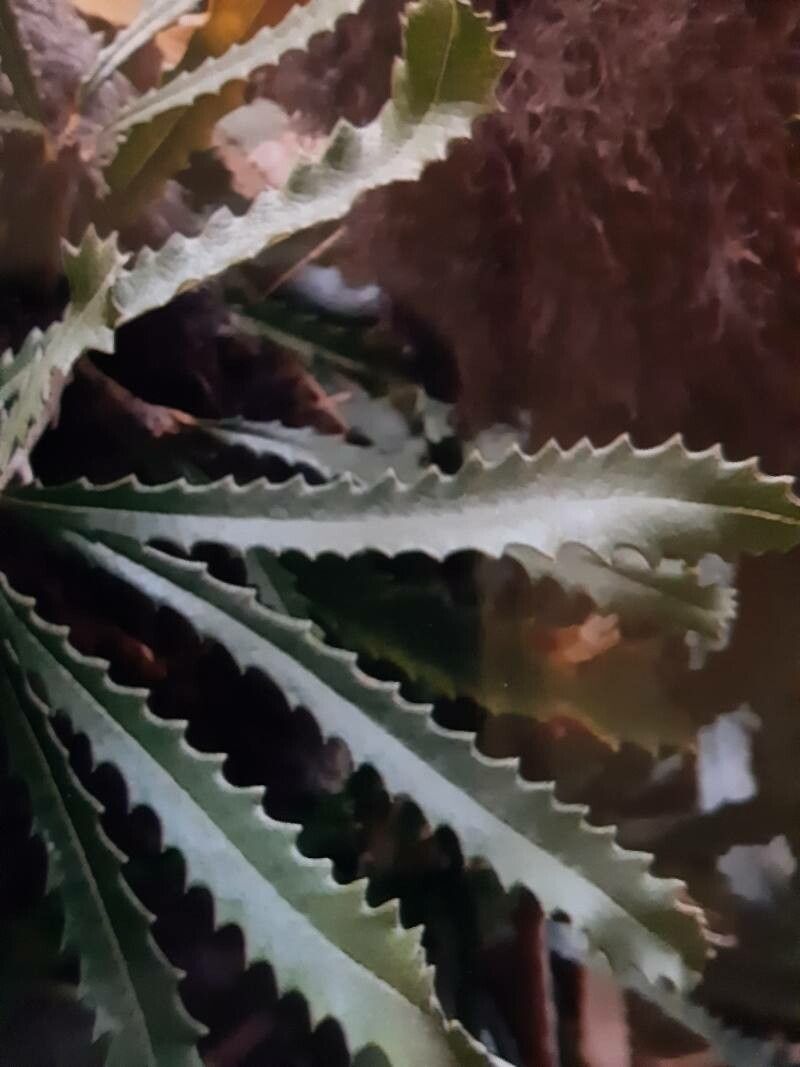
Banksia coccinea, commonly known as the scarlet banksia, waratah banksia or Albany banksia, is an erect shrub or small tree in the family Proteaceae. Its distribution in the wild is along the south west coast of Western Australia, from Denmark to the Stokes National Park, and north to the Stirling Range, growing on white or grey sand in shrubland, heath or open woodland. Reaching up to 8 m (26 ft) in height, it is a single-stemmed plant that has oblong leaves, which are 3–9 cm (1.2–3.5 in) long and 2–7 cm (0.8–2.8 in) wide. The prominent red and white flower spikes appear mainly in the spring. As they age they develop small follicles that store seeds until opened by fire. Though widely occurring, it is highly sensitive to dieback and large populations of plants have succumbed to the disease. Collected and described by Robert Brown in the early 19th century, Banksia coccinea appears to be most closely related to Banksia speciosa and B. baxteri. Banksia coccinea plants are killed by bushfire, and regenerate from seed. The flowers attract nectar- and insect-feeding birds, particularly honeyeaters, and a variety of insects. Widely considered one of the most attractive Banksia species, B. coccinea is a popular garden plant and one of the most important Banksia species for the cut flower industry; it is grown commercially in several countries including Australia, South Africa, Canada, the United States, New Zealand and Israel. In cultivation, B. coccinea grows well in a sunny location on well-drained soil, but it cannot survive in areas with humid or wet summers.
Scarlet banksia is fairly resistant to disease and typically does not suffer from many illnesses. For care, the plant is relatively low-maintenance. Planted outdoors it needs only minimal watering, and larger plants usually do not require pruning. Smaller plants, however, should be pruned after they have bloomed. Scarlet banksiat is appropriate for anyone with outdoor space, like a garden or deck, and does not need extensive care experience.
How to keep Banksia Coccinea.
Light
Scarlet banksia comes from open habitats, such as sunlit meadows and forest margins, which provide plenty of light. It does best in Full Sun but can also tolerate Partial Sun, showing good adaptability to different sunlight conditions.
Temperature
Scarlet banksia is quite adaptable to temperature, able to withstand high heat and considerable temperature fluctuations. During hot weather, attention should be paid to watering and providing appropriate shade to avoid sunburn. However, Scarlet banksia is relatively intolerant of low temperatures. Although it can endure some cold, extremely low temperatures can result in frost damage.
Fertilizer
Timing is essential for fertilizing Scarlet banksia. Apply fertilizer in early spring and continue once a month until early summer. The fertilizer encourages lovely blooms and supplies energy during both dormant periods and active growth.
Pruning
The Scarlet Banksia is known for its vibrant red flowers and unique foliage. To promote growth and maintain its shape, prune in early spring after it has finished flowering. Remove any dead stems and lightly trim the plant to control its size, but be cautious not to prune too heavily, as this can hinder future blooms. Regular pruning helps improve air circulation and overall plant health.
Botanical profile.
- Plant Type
- Shrub
- Life Cycle
- Perennial
- Genus
- Banksia
- Family
- Proteaceae
- Hardiness Zone
- 9-11
- Mature Height
- 2.13 m to 7.92 m
- Mature Spread
- 2.13 m to 3.96 m
- Leaf Color
- Dark Green
- Leaf Type
- Semi-evergreen
- Flower Color
- Red
- Flower Size
- 6.35 cm to 10.16 cm
- Bloom Time
- Fall
- Planting Time
- Spring
- Harvest Time
- Winter
Other names.