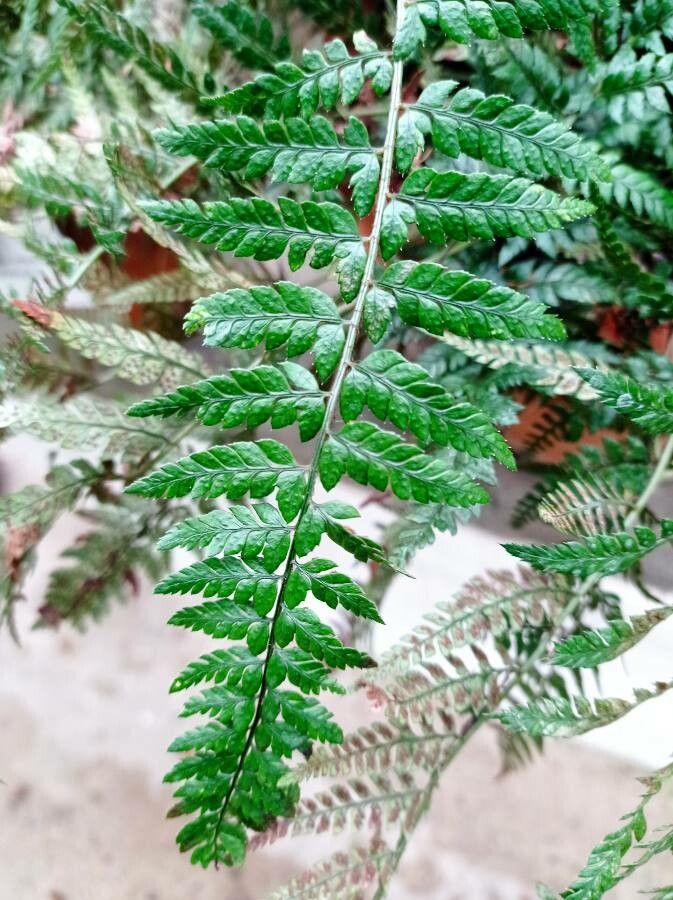
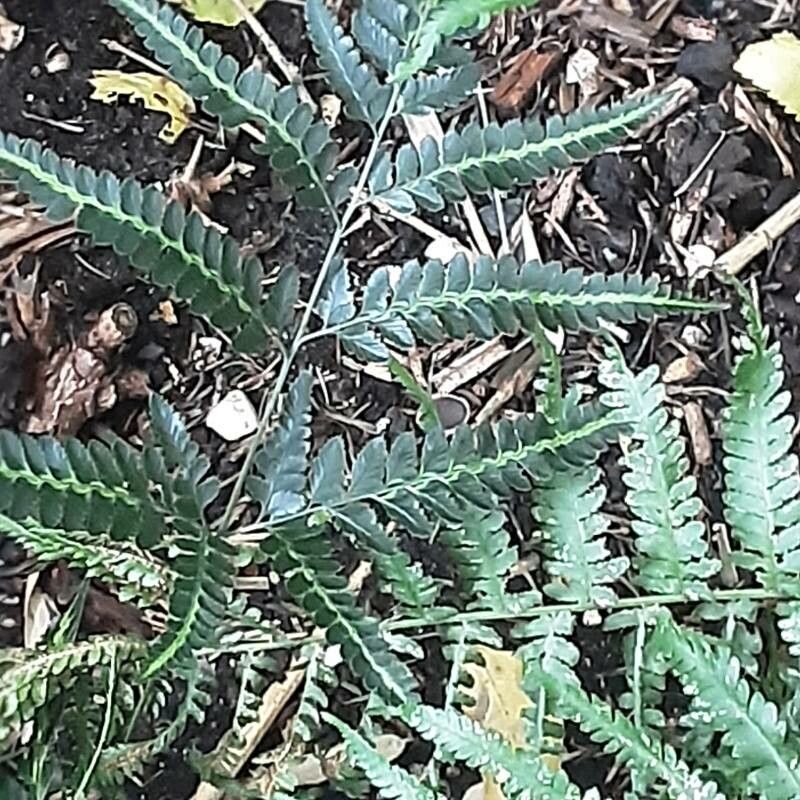
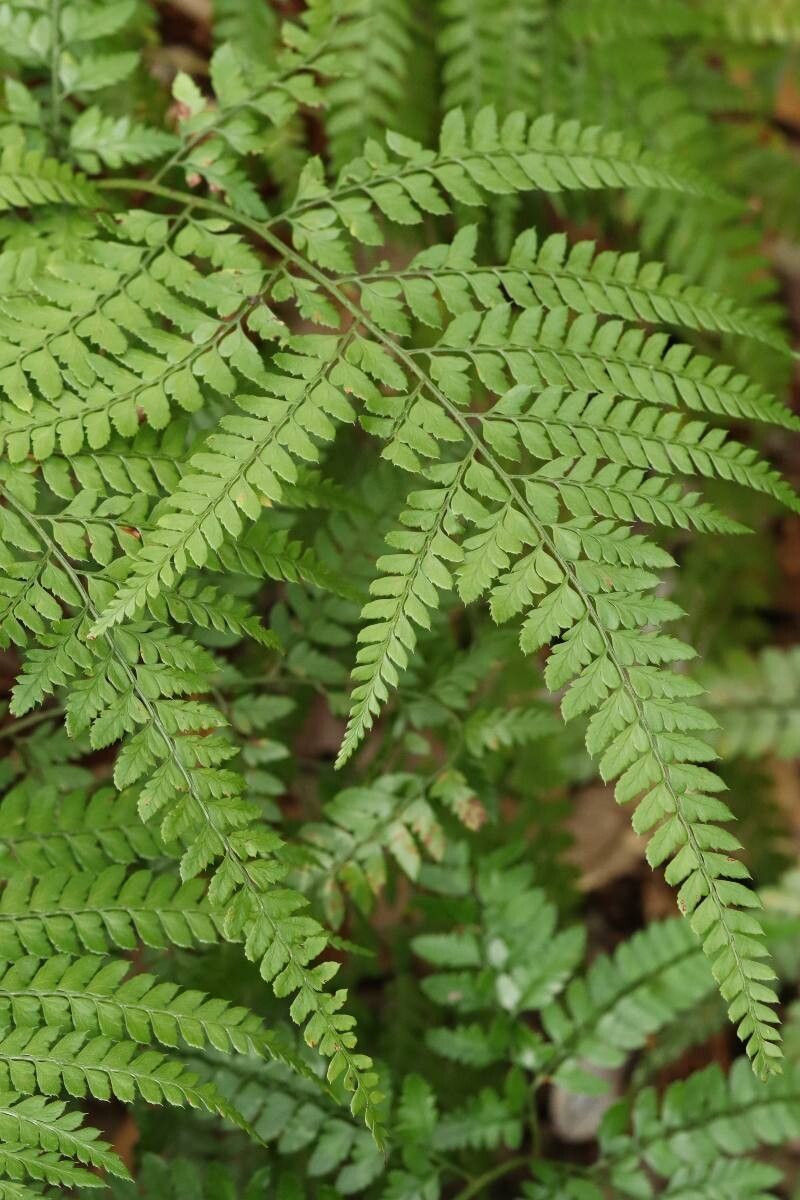
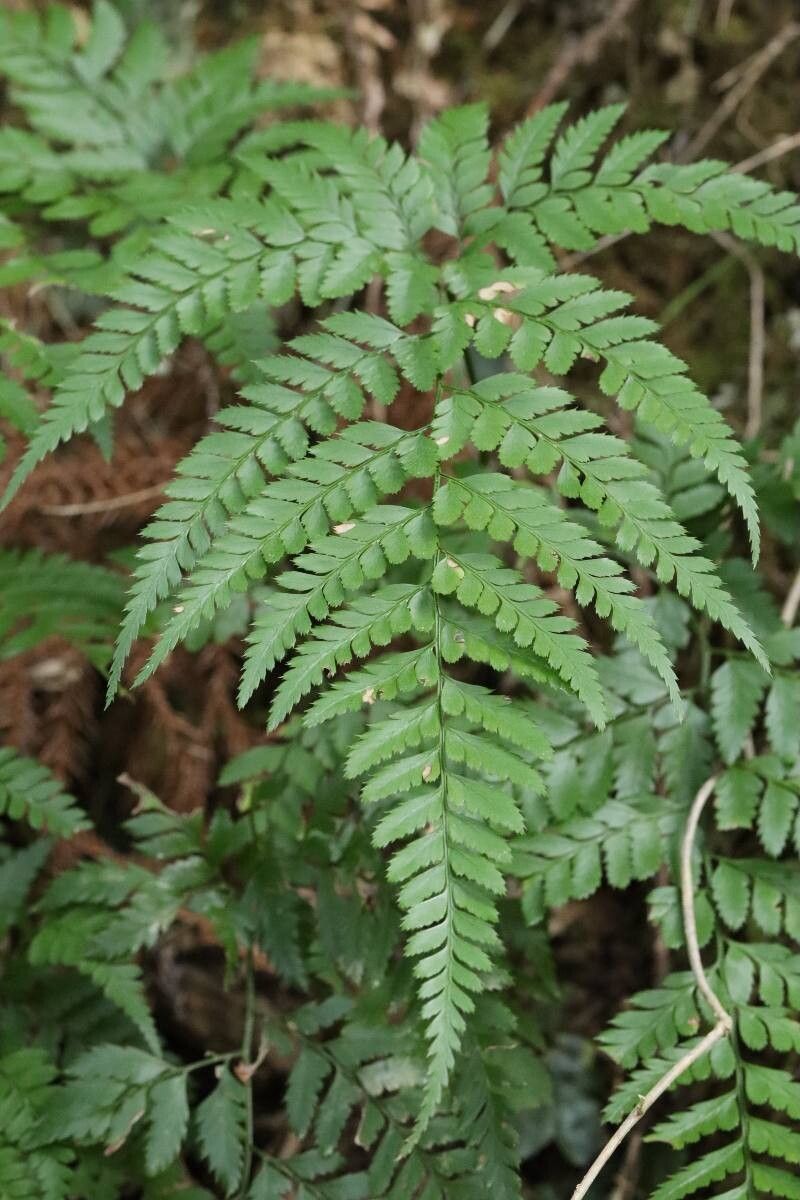
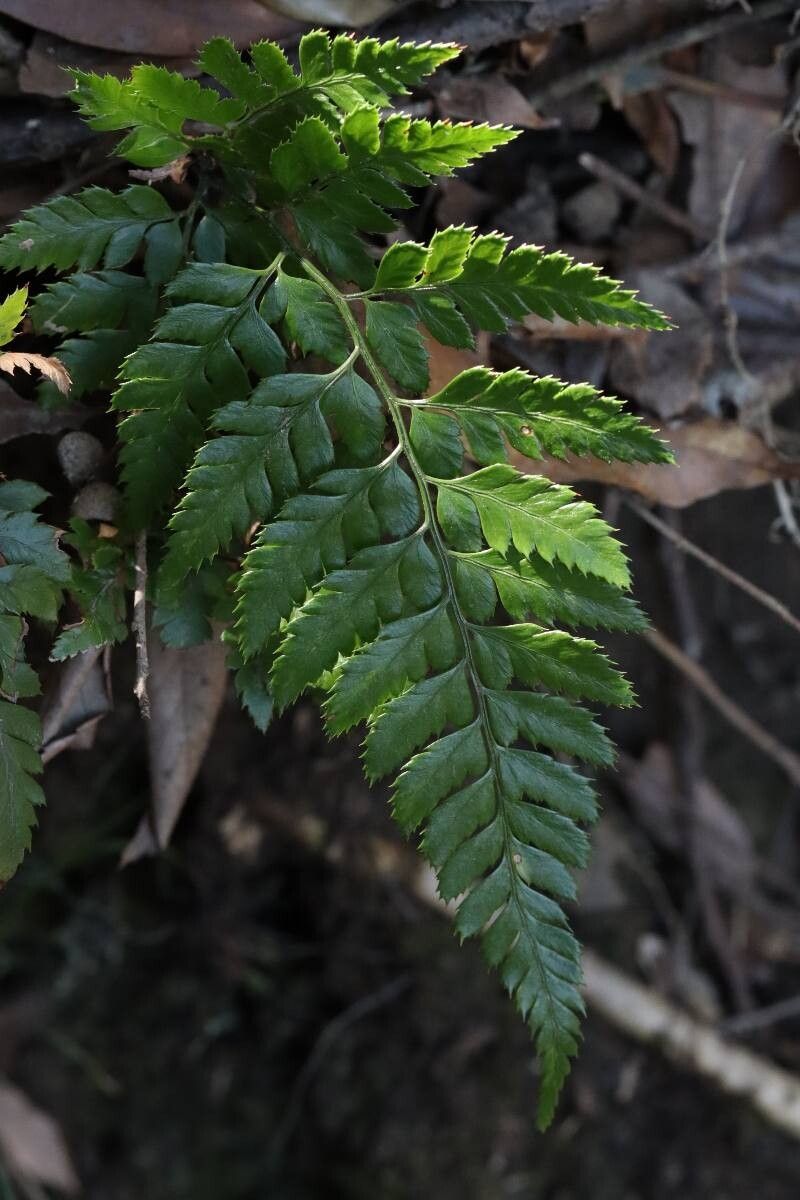
Arachniodes aristata is a species of fern in the family Dryopteridaceae. It is a glossy fern with fronds up to 1 m (3 ft 3 in) long. The type specimen was collected by George Forster at an unknown island in the Pacific Ocean, when travelling on the second voyage of James Cook. This plant was first formally named Polypodium aristatum in 1786 in the Florulae Insularum Australium Prodromus, published by his father Johann Reinhold Forster. The specific epithet "aristata" derives from Latin, meaning "bearing a bristle".
Prickly shield fern is generally resistant to disease and attracts relatively few insect pests. Its care is regarded as challenging because it needs a consistently moist environment and frequent watering. At the same time, its roots can rot if it is overwatered or kept in poor ventilation. This fern is best suited to people with some growing experience, since most growers can keep it alive for a period of time. Still, it may struggle to flourish and its fronds can dry out and become less healthy as time passes.
How to keep Arachniodes Aristata.
Light
The prickly shield fern is native to settings such as forest undergrowth and rock-covered regions, which provide natural shadow. It prefers Full Shade for sunlight exposure, but can also withstand Partial Sun.
Water
The prickly shield fern flourishes in the moist soils commonly found in the understories of East Asian forests, needing regular watering about twice a week. To increase humidity indoors, you can mist the fern or use a pebble tray filled with water, which is beneficial. As an evergreen plant, this fern depends on consistent moisture to maintain healthy foliage throughout the year.
Temperature
The Prickly shield fern flourishes in dense forest areas. It responds strongly to both temperature and moisture levels, with conditions such as high temperatures, arid surroundings, and strong sunlight causing discomfort to the plant. Throughout the summer months, it needs adequate shade and a moist environment. Although the Prickly shield fern doesn't necessitate specific attention in winter, extensive dry periods during this season can nevertheless lead to its demise.
Pruning
To maintain a healthy and well-shaped prickly shield fern, a plant known for its distinctive prickly fronds, prune it in early spring. Start by removing any dead or damaged fronds, and trim back old growth at the base. This helps promote healthy growth and improves air circulation, keeping the plant vigorous and thriving.
Botanical profile.
- Plant Type
- Fern
- Life Cycle
- Perennial
- Genus
- Arachniodes
- Family
- Polypodiaceae
- Hardiness Zone
- 6-10
- Mature Height
- 61 cm
- Mature Spread
- 61 cm
- Leaf Color
- Dark Green, Forest Green
- Leaf Type
- Evergreen
- Planting Time
- Spring, Summer, Autumn
- Native Area
- Fiji
Other names.
Reader questions.
What are the sunlight requirements for plants?
Plants have varying sunlight requirements to thrive. Partial sun plants need about 3-6 hours of sunlight daily, whereas full sun plants require more than 6 hours of sunlight. It's important to observe the movement of sunlight through your garden to find spots that offer the right balance of light and shade, ensuring your plants' health and happiness.
What is the common name of Arachniodes aristata?
The common name of Arachniodes aristata is Prickly shield fern.
What are the essentials for growing Prickly shield fern?
Prickly shield fern originates from environments like forest understories or rocky areas, which naturally offer shade. It prefers Full Shade but can tolerate Partial Sun. When natural sunlight is insufficient, especially in winter or in less sunny spaces, artificial lighting can support optimal growth. LED lights are recommended for indoor plants, with 30-50W/sq ft for full sun plants, 20-30W/sq ft for partial sun plants, and 10-20W/sq ft for full shade plants. The artificial light source should be placed 12-36 inches above the plant and provided for 8-12 hours per day.
What are the characteristics of Prickly shield fern?
The Prickly shield fern, or Arachniodes aristata, does not have specific characteristics included in the provided information. Further detail is needed to describe its attributes fully.
What are some important symptoms of light deficiency in Prickly shield fern?
Prickly shield fern may exhibit certain symptoms when there is insufficient light, such as smaller new leaves, leggy or sparse growth, faster leaf drop, slower or no new growth, lighter-colored new leaves, and chlorosis. Access to adequate light ensures optimal growth and health. Conditions like sunscald, leaf curling, wilting, and leaf scorching are symptoms of excessive sunlight exposure, which can harm the plant.
What solutions can be applied to address light deficiency or excessive sunlight in Prickly shield fern?
To optimize plant growth indoors, gradually increase sunlight exposure to 3-6 hours daily or use artificial lighting for at least 8 hours daily, particularly for plants that are large or difficult to move. Outdoor solutions include moving plants to sunnier spots weekly to adapt to light changes gently. Ground plants benefit from reducing obstructions like pruning trees or transplanting to sunnier locations. Remember, parts of the plant damaged by insufficient light may not recover, but new growth will be healthy following improved light exposure.