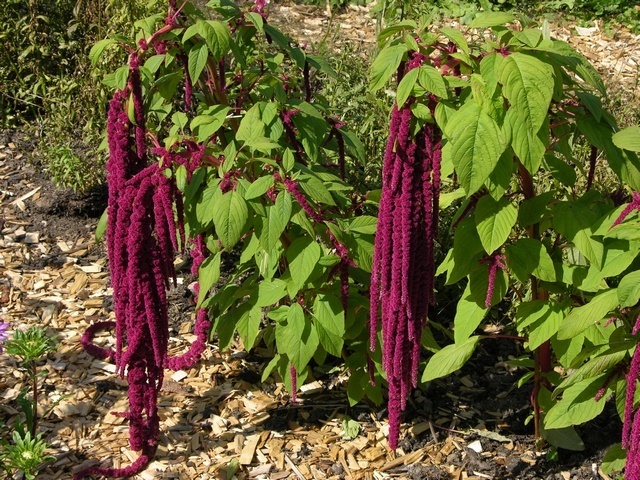
Amaranthus caudatus is a species of annual flowering plant. It goes by common names such as love-lies-bleeding, pendant amaranth, tassel flower, velvet flower, foxtail amaranth, and quilete.Many parts of the plant, including the leaves and seeds, are edible, and are frequently used as a source of food in India as well as in South America, where it is the most important Andean species of Amaranthus, known as kiwicha. (See also amaranth seed and Andean ancient plants.) This species, as with many other amaranths, is originally from the American tropics. The exact origin is unknown, as A. caudatus is believed to be a wild Amaranthus hybridus aggregate. The red color of the inflorescences is due to a high content of betacyanins, as in the related species known as "Hopi red dye" amaranth. Ornamental garden varieties sold under the latter name are either Amaranthus cruentus or a hybrid between A. cruentus and Amaranthus powellii. In indigenous agriculture, A. cruentus is the Central American counterpart to South American A. caudatus. During the Victorian era, specific flowers had different meanings. Love-lies-bleeding stood for hopeless love or hopelessness in the Victorian language of flowers.
Love-lies-bleeding: In the Victorian era, this particular flower held various meanings. In the language of flowers during that time, it symbolized hopeless love or a sense of despair. This is why it is called love-lies-bleeding.
Love-lies-bleeding is fairly resistant to disease and generally not susceptible to illnesses. Still, it can be vulnerable to pests and diseases present in its surroundings; these problems are usually mild. Regarding care, the plant requires moderate maintenance. It should be pruned regularly to keep a good appearance and support healthy growth. Fertilizing can also help encourage flowering. Love-lies-bleeding is suitable for anyone with outdoor space, such as a garden or patio, and does not demand much gardening experience. It may need more attention when grown indoors.
How to keep Amaranthus Caudatus.
Light
Love-lies-bleeding prefers abundant sunlight throughout the day for best growth. It does well where sunlight is unobstructed. Partial shade is tolerable but can slow its growth. Excessive sun exposure may lead to wilting, while too little light can impede its development. Its original habitat consists of well-lit environments.
Water
Love-lies-bleeding thrives in humid, moist environments and needs consistent moisture without becoming waterlogged. Water it twice a week to maintain evenly damp soil. Additional humidity from misting or using a pebble tray can promote growth, enhancing its vibrant foliage, which often cascades beautifully indoors.
Humidity
This plant needs special care because it loves high humidity levels of 60-80% or more. The best way to achieve this is by placing a humidifier near the plant. Daily misting is also essential! Make sure the room has good ventilation.
Temperature
Love-lies-bleeding is indigenous to a climate with temperatures between 68 to 95 °F (20 to 35 ℃). Favoring these warmer conditions, a drop in temperature can negatively impact its growth. It is advisable to adjust temperature levels for each season.
Fertilizer
Love-lies-bleeding responds well to regular, dilute fertilizer applications to encourage healthy leaf growth. You should feed Love-lies-bleeding about once a month during the summer. Nitrogen is important for foliage, and adding nitrogen-rich sources helps Love-lies-bleeding do well.
Pruning
Love-lies-bleeding is known for its vibrant, cascading red clusters of flowers. To keep the plant healthy and flourishing, it is best to prune it from early to late spring. The key to effective pruning is to remove dead stems and spent blooms, which helps improve growth and air circulation. Make sure to cut above the leaf nodes for the best results. Regular pruning will give the plant a vigorous and lively appearance.
Pot & Repot
When repotting Love-lies-bleeding, choose a pot 1–2 inches (2.5–5.1 cm) larger in diameter that has good drainage. Use a well-draining potting mix and consider adding perlite for extra drainage. Repot in spring or early summer, water thoroughly afterward, and keep it in a shady spot at first.
Toxicity
People learned that this plant was more than simply a gorgeous plant with beautiful blossoms and thick foliage from the beginning. It is also non-toxic and even edible. Its leaves and blooms are not poisonous to people or animals. The seeds are high in complete proteins and should be taken whole.
Further reading →
The toxicity and danger assessments provided are for reference only. We do not assure their accuracy, so it's crucial not to depend on them. Seek professional advice when necessary for accurate guidance.
Botanical profile.
- Plant Type
- Herb
- Life Cycle
- Annual
- Genus
- Amaranthus
- Family
- Amaranthaceae
- Hardiness Zone
- 4-9
- Mature Height
- 14.94 m
- Mature Spread
- 30 cm to 91 cm
- Leaf Color
- Green, Red
- Leaf Type
- Deciduous
- Flower Color
- Red, Yellow, Green
- Flower Size
- 1.02 cm
- Bloom Time
- Early summer, Mid summer
- Planting Time
- Spring, Summer
- Harvest Time
- Mid summer
- Native Area
- Colombia, Argentina, Bolivia, Peru, Brazil, Ecuador, Suriname
Other names.
Reader questions.
How should I water my Love-lies-bleeding plant?
Love-lies-bleeding can be watered using various tools like a garden hose with a spray nozzle or a watering can. It is not too particular about the type of water it receives, whether it's rainwater, tap water, or filtered water. It is best to avoid watering this plant from above to prevent damage to the leaves and flowers and avoid potential diseases. A drip irrigation system is often the most effective way to water Love-lies-bleeding, as it delivers water evenly and directly to the soil. For container-grown Love-lies-bleeding, you can use a cup, watering can, or tap water to water the soil directly.
Why should I put fertilizer on my Love-lies-bleeding plant?
Plants require nutrients to grow, but certain types are able to obtain their required nutrients without the need for additional fertilizers. Love-lies-bleeding, like other plants, also rely on nutrients to support growth and internal processes. Nitrogen, phosphorus, and potassium are essential nutrients for plants, with nitrogen being particularly important for foliage development. However, Love-lies-bleeding often struggles to obtain sufficient nitrogen from the soil alone. To address this issue, many gardeners choose to supplement Love-lies-bleeding with additional nitrogen through feeding.
What are the sunlight requirements for Love-lies-bleeding?
Love-lies-bleeding requires a significant amount of sunlight to flourish optimally, thriving under full sun conditions which means it needs more than 6 hours of direct sunlight per day. It can tolerate partial sun, about 3-6 hours of sunlight, but its growth may slow down. The plant is originally from well-lit environments, so ensuring it receives an ample amount of sunlight throughout the day is vital. In cases of overexposure, the plant might wilt, while insufficient light could impede its development. It's crucial to observe your garden's sun patterns and choose locations that offer a good balance of light and shade to ensure the plant's happiness.
What is the native climate for Love-lies-bleeding?
Love-lies-bleeding, known botanically as Amaranthus caudatus, thrives in warmer climates with temperatures ranging from 68 to 95 °F (20 to 35 °C). It naturally prefers these conditions, and any significant drop in temperature could potentially impact its growth. Given its preference for warmth, it's important to monitor and adjust the surrounding temperature levels appropriately with each changing season to ensure optimal growth.
What should I do if I give too much or too little water to my Love-lies-bleeding plant?
If you notice that your Love-lies-bleeding plant is not getting enough water, the solution is simple. Just start watering it regularly. However, overwatering can be a bigger issue that can lead to diseases and the death of the plant. To prevent this, make sure to choose a good location for your plant that gets enough sunlight and has proper drainage. If you have overwatered a potted Love-lies-bleeding plant, you may need to change the pot. The previous pot may not have had good drainage or enough drainage holes. When repotting, use loose soil and a pot that drains well.
What is the ideal time to fertilize my Love-lies-bleeding?
Love-lies-bleeding grows well and can benefit from monthly fertilization during its active growing period in spring and summer. The plant does not require fertilization during fall and winter when it is less active. Look out for new growth as a sign to begin fertilizing. Whether it is grown outdoors or in a container, the fertilization schedule remains the same. However, if your Love-lies-bleeding is in a container, it may not need fertilization for the first one to two months. Container plants are typically grown in potting soil that already contains nutrients, so you should only start fertilizing after the plant has been in the same soil for a while.
How can artificial lighting benefit Love-lies-bleeding, especially when natural sunlight is insufficient?
When natural sunlight is insufficient, particularly during winter or in less sunny spaces, artificial lighting can be a vital solution for Love-lies-bleeding's optimal growth. Artificial lights, especially LED, can be customized to provide specific wavelengths needed by the plant. For full sun plants, 30-50W per square foot is recommended, while partial sun plants need 20-30W per square foot, and full shade plants require 10-20W per square foot. Artificial lights should be placed 12-36 inches above the plant to mimic natural sunlight and kept on for 8-12 hours per day depending on the plant species' needs.
Does Love-lies-bleeding need protection from cold weather?
While Love-lies-bleeding exhibits strong resistance to cold, it generally does not require special frost protection measures during the winter months. However, if temperatures are anticipated to fall below -30°C, taking steps to protect the plant is advisable. This can be done by covering the plant with insulating materials like soil or straw. Additionally, before the arrival of the first freeze in autumn, watering the plant abundantly to keep the soil moist and in a frozen state throughout the winter is recommended. This practice helps prevent drought and water scarcity for the plant during the colder months and into early spring.
How often do I need to water my Love-lies-bleeding plant?
Love-lies-bleeding needs regular watering throughout its growing season. In spring, water it about once a week. As the season progresses and it gets warmer, increase watering to two or three times a week. However, be careful not to exceed this rate as it can harm the plant. It's important to keep the soil moist, but not wet, no matter how often you need to water. When watering love-lies-bleeding in a pot, you'll need to water it more frequently compared to when it's planted in the ground. Potted plants dry out faster, so water them a few times a week on average, while in-ground plants can be watered once a week.
When is it not a good time to fertilize my Love-lies-bleeding plant?
- Only fertilize your Love-lies-bleeding if it is healthy; avoid fertilizing if it has a disease or pests. - Don't fertilize a dehydrated plant as that can worsen the problem. - Avoid splashing fertilizer onto the leaves or stem while watering to prevent burned spots. - Be cautious about allowing direct contact between the fertilizer and the plant, unless using a specific foliage fertilizer.
What are the common symptoms of light deficiency in Love-lies-bleeding?
Love-lies-bleeding, when not receiving adequate light, may display several symptoms indicating light deficiency. These include smaller new leaves compared to older ones, leggy or sparse growth due to longer spaces between leaves or stems, faster drop of older leaves as the plant tries to conserve resources, delayed or halted growth as the plant enters survival mode, paler new leaves indicating a lack of chlorophyll and nutrients, chlorosis or yellowing of the leaves, sunscald characterized by pale or necrotic spots on leaves and stems, leaf curling as a defense against excessive sunlight, wilting due to increased water loss, and leaf scorching showing as brown, dry edges on leaves.
What should be done if Love-lies-bleeding experiences extremely low temperatures?
Love-lies-bleeding is fairly cold-tolerant, thriving best when temperatures stay above 20°C. It is essential to ensure that during winter, the temperature does not drop below 0°C. However, if temperatures plunge below -30°C, the plant might not show immediate distress, but you can expect a potential decrease in sprouting or even a complete lack of sprouting come spring. In such cases, in spring, any parts of the plant that have failed to sprout should be removed to encourage new growth and maintain the plant's health.