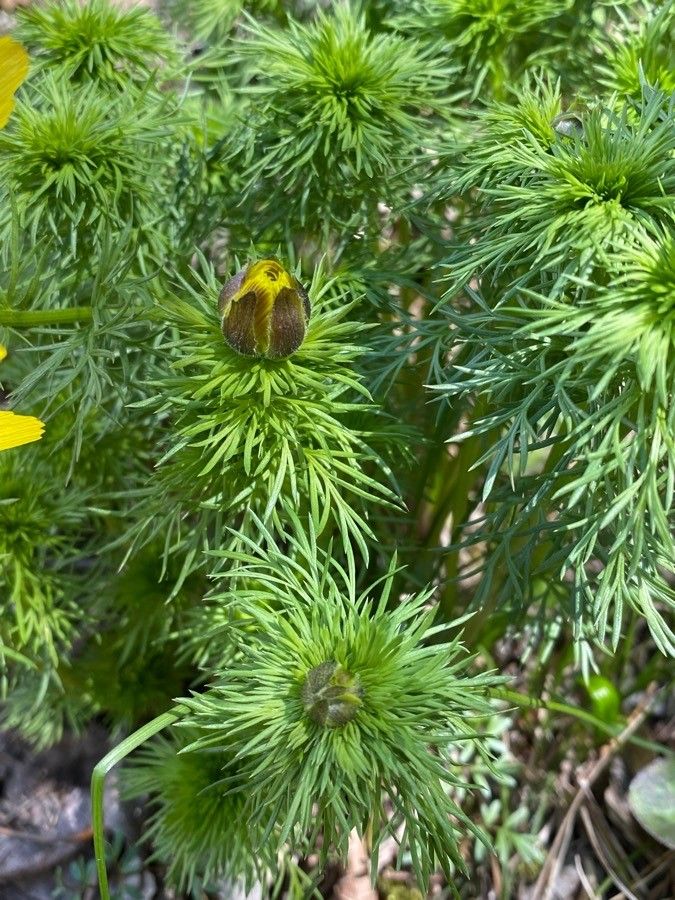
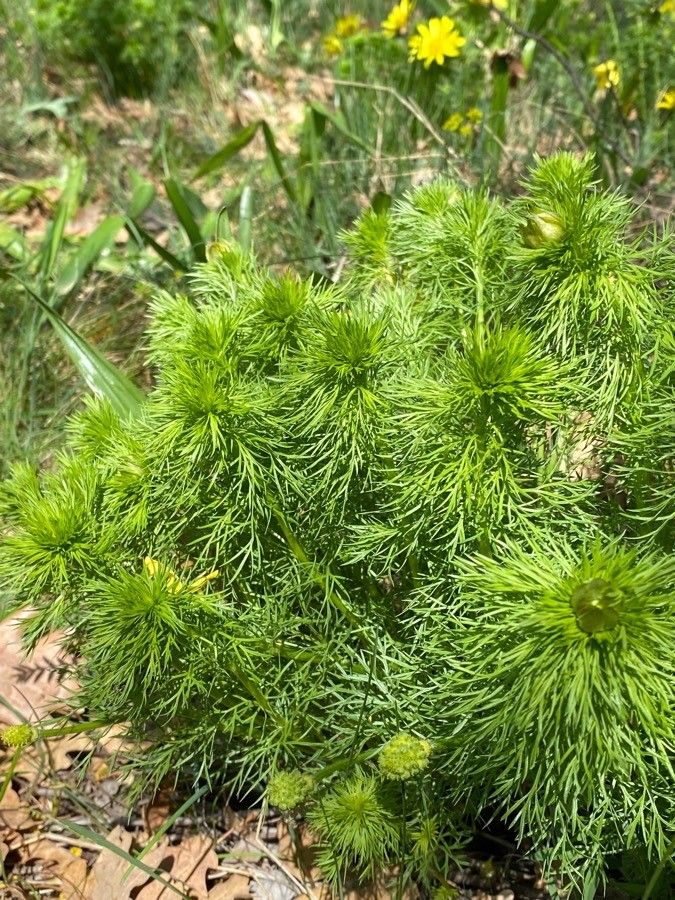
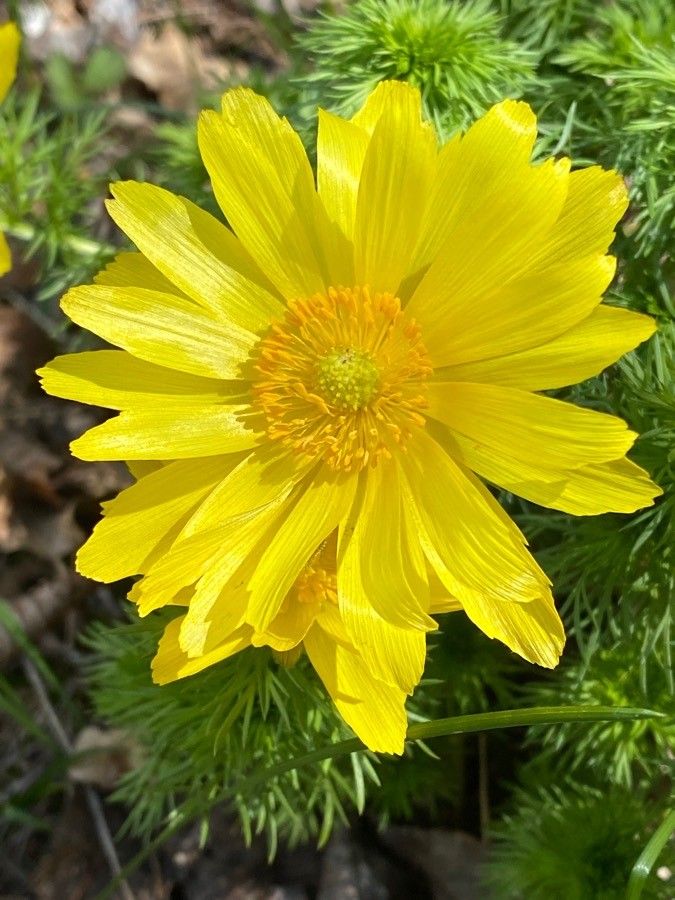
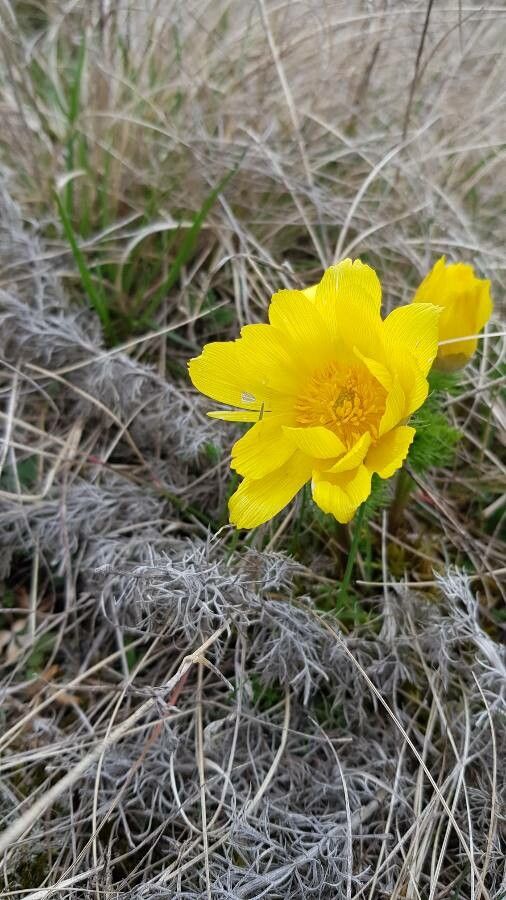
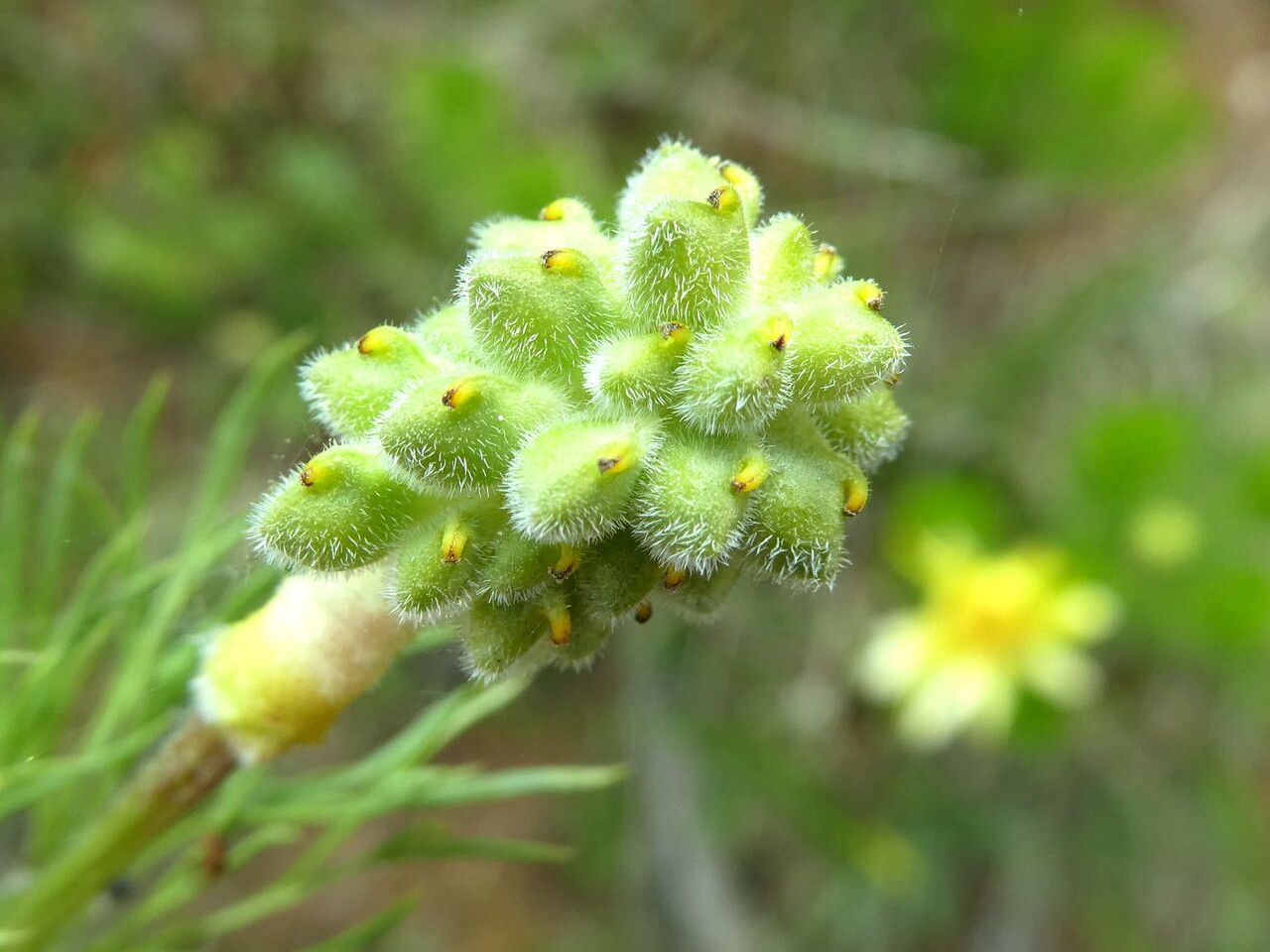
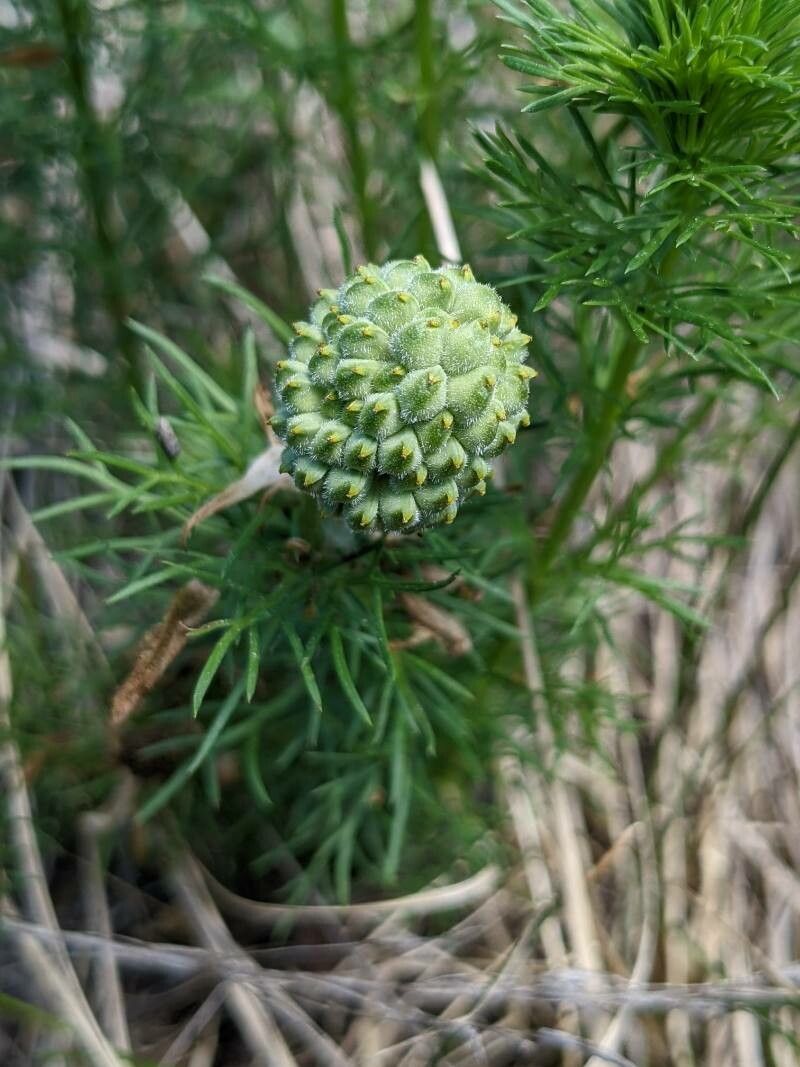
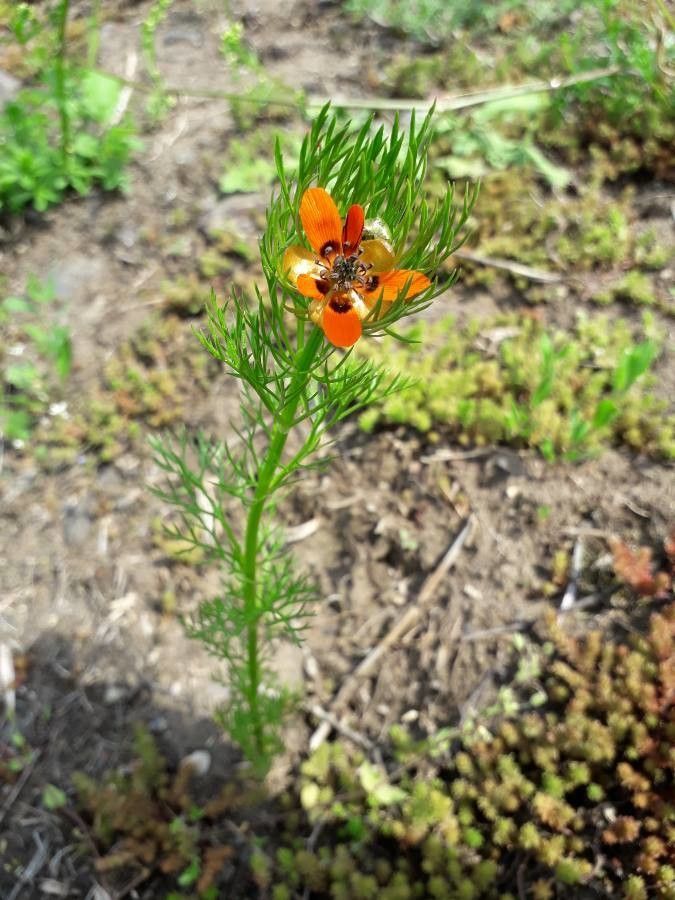
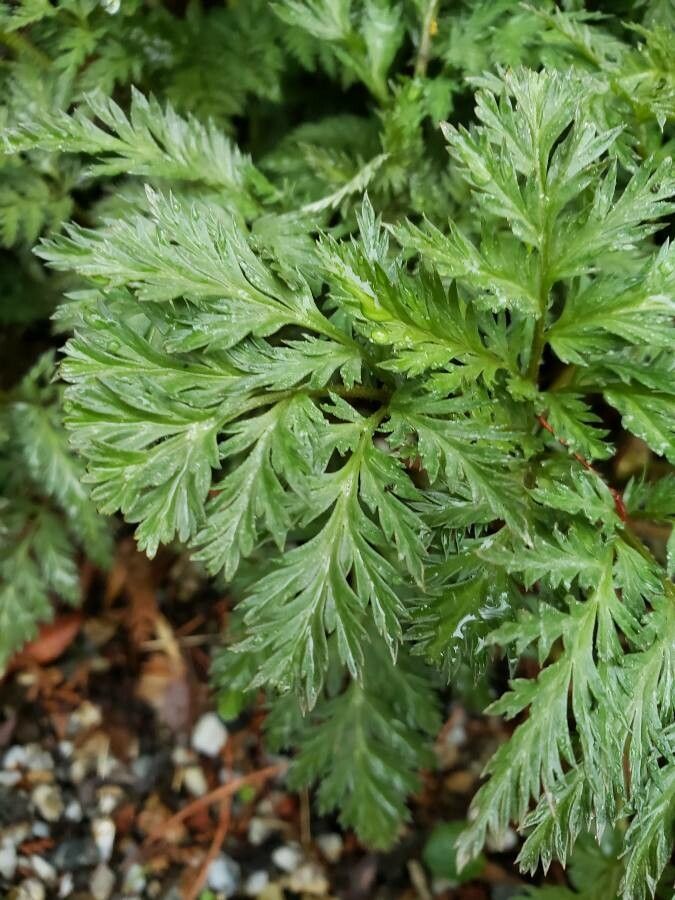
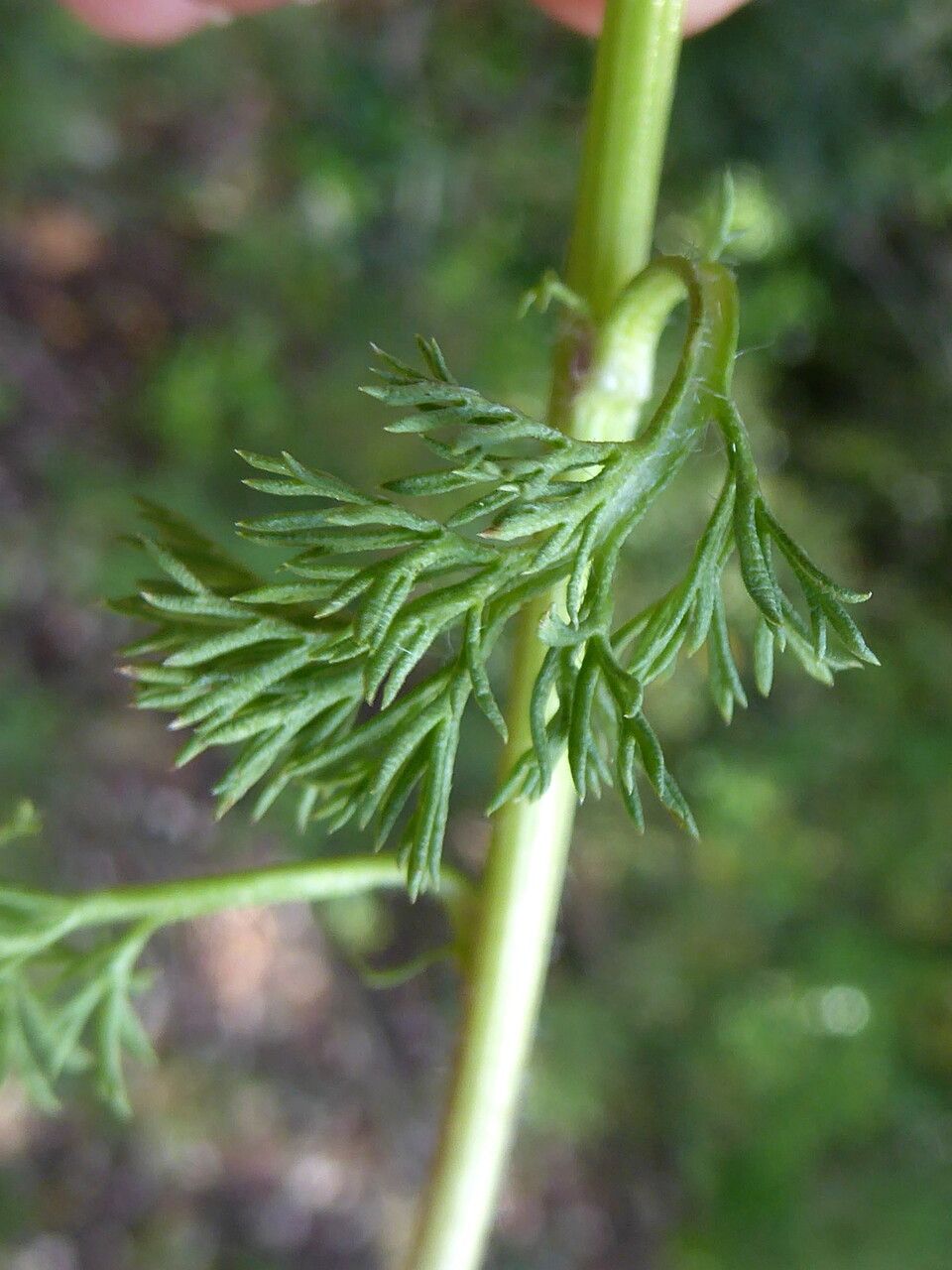
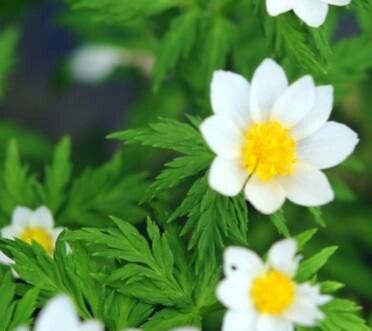
Adonis vernalis, known variously as pheasant's eye, spring pheasant's eye, yellow pheasant's eye and false hellebore, is a perennial flowering plant in the buttercup family Ranunculaceae. It is found in dry meadows and steppes in Eurasia. More specifically, this plant grows in a wide range of locations which include open forests, forest clearings, dry meadows, mesic steppe, and mostly calcareous soil. Isolated populations are found from Spain in the west across Central Europe with fine examples in Valais, Switzerland, and southern Europe, reaching southern Sweden in the north and Abruzzo in the south, with its main area of distribution being the Pannonian Basin and the West Siberian Plain. In contrast to most other European Adonis species, the flowers appear in springtime, and are up to 80 mm (3.1 in) in diameter, with up to 20 bright yellow petals. Not only do the flowers begin to grow, but so do the plants aerial organs, from around April to May.The plant is poisonous, containing cardiostimulant compounds, such as adonidin and aconitic acid. Infusions of the plant are used in the medicine Bekhterev's mixture.It is often used as an ornamental plant.
Spring pheasant's eye is fairly resistant to diseases and ordinarily does not suffer from them easily. Still, it can be affected by pests and illnesses found nearby. Such infections tend to be mild. Regarding maintenance, this plant needs a moderate level of care. It should be pruned on a regular basis to preserve its appearance and encourage healthy growth. Applying fertilizer can also aid in boosting flower production. Spring pheasant's eye is well suited for anyone who has outdoor space, like a garden or a patio, and does not demand extensive gardening experience. When cultivated indoors, it may need more attention.
How to keep Adonis Vernalis.
Light
The spring pheasant's eye flourishes when subjected to copious amounts of sunshine and can tolerate moderate levels of sun. It hails from environments where there's a high level of solar exposure, so it grows best in similar conditions. While excessive sunlight can lead to its withering, a lack of sufficient sunlight can hamper its growth.
Water
The Spring pheasant's eye, native to temperate grasslands, flourishes in conditions with moderate moisture and balanced water needs. To replicate its natural rainfall patterns, it should be watered weekly. This herbaceous perennial is best suited for outdoor cultivation and requires consistently moist soil during its active growing season.
Temperature
The spring pheasant's eye flourishes natively in areas with temperatures between 32 and 90 °F (0 to 32 ℃), indicating a preference for a climate that is somewhere between mild and warm. If temperatures are outside of this range, modifications to recreate these conditions are needed to ensure the best growth of the plant.
Fertilizer
The best period to apply fertilizer to a Spring pheasant's eye is during the early spring, when it transitions from dormancy to active growth. Feeding fertilizer is essential as it offers crucial nutrients for sturdy growth. While this plant doesn't require too much fertilization, it can gain benefits from annual fertilization, which may boost survival rates and improve the appearance and longevity of its flowers.
Pruning
Spring pheasant's eye is a perennial plant known for its vibrant yellow flowers and feathery foliage. To keep it thriving, it benefits from light pruning in the spring after it has finished blooming. By removing spent flowers and damaged stems, you can encourage new growth, reduce overcrowding, and improve air circulation. This care promotes healthy development and abundant flowering in the next season.
Botanical profile.
- Plant Type
- Herb
- Life Cycle
- Perennial
- Genus
- Adonis
- Family
- Ranunculaceae
- Hardiness Zone
- 3-7
- Mature Height
- 20 cm
- Mature Spread
- 30 cm
- Leaf Color
- Dark Green
- Leaf Type
- Deciduous
- Flower Color
- Yellow, Gold
- Flower Size
- 2.54 cm to 5.08 cm
- Bloom Time
- Mid spring, Late spring
- Planting Time
- Spring
- Harvest Time
- Late spring, Early summer
- Native Area
- Sweden, Austria, Czech Republic, Slovakia, Montenegro, Bulgaria, Poland, Croatia, Ukraine, Serbia, Russia, Hungary, Germany, Italy, Kazakhstan, Spain, Switzerland, Romania, France
Other names.
Reader questions.
What's the best way to water my Spring pheasant's eye plant?
When watering the Spring pheasant's eye, it is important to use filtered water at room temperature or slightly warmer. Tap water may contain harmful particles for this plant, so filtered water is recommended. The reason for using room temperature water is that the Spring pheasant's eye is accustomed to warm conditions, and cold water can be a shock to its system. It is also advised to avoid overhead watering, as it can cause problems with the leaves. Instead, you should apply filtered room temperature water directly to the soil until it is fully saturated. This will benefit the plant by providing moisture to the roots and allowing them to spread and collect necessary nutrients.
Why should I put fertilizer on my Spring pheasant's eye plant?
The Spring pheasant's eye relies on its leaves for structure, and fertilization is key to maintaining their appearance and function. Proper fertilization ensures that the leaves have a consistent color and healthy texture. Additionally, fertilization supports the growth of new roots and helps maintain existing roots, improving the plant's ability to absorb nutrients from the soil both now and in the future.
What are the sun requirements for Spring pheasant's eye?
Spring pheasant's eye requires full sun to thrive, meaning it needs more than 6 hours of sunlight per day. It can also grow under partial sun, which is about 3-6 hours of sunlight. Observing the movement of sunlight through your garden is crucial to find the perfect spots that offer a balance of light and shade, ensuring the plants' optimal growth.
What is the native temperature range for Spring Pheasant's Eye?
Spring Pheasant's Eye, also known by its botanical name Adonis vernalis, thrives in regions where temperatures fluctuate between 32 to 90 °F (0 to 32 °C). This indicates a preference for a mild to warm climate. For the plant to grow optimally, it's important to mimic these conditions if the natural climate falls outside this temperature range.
What should I do if I give my Spring pheasant's eye plant too much or too little water?
Overwatering is a common issue that can harm your Spring pheasant's eye plant. It causes the stems and leaves to wilt and turn yellow. Over time, it can also lead to diseases like root rot, mold, and mildew, which can be fatal to the plant. Underwatering is less common, but it can still happen. When it occurs, the leaves become brittle and brown. To prevent overwatering, it's important to watch for early signs and reduce watering immediately. If the soil drains poorly, replace it with a well-draining potting mix. If your plant is getting too little water, simply water more regularly until the signs improve.
When should I fertilize my Spring pheasant's eye?
If you grow your Spring pheasant's eye outdoors each year, it will start growing new leaves in early spring. This signals that it's time to fertilize the plant for the year. Usually, a single application of fertilizer in the spring is enough for the plant to thrive. However, if you want to promote maximum growth, you can fertilize it multiple times during the spring and early summer. In this case, you can feed your Spring pheasant's eye once every month to a month and a half.
What are the essential growing conditions for Spring pheasant's eye?
Originating from habitats with substantial solar exposure, Spring pheasant's eye thrives under a generous amount of sunlight. It can tolerate moderate amounts of sunlight but both overexposure and insufficient sunlight can be detrimental. Overexposure leads to wilting, while too little sunlight hampers growth. Indoor plants may require artificial lighting to grow optimally, especially in winter or less sunny spaces. LED lights, offering 30-50W/sq ft for full sun plants, 20-30W/sq ft for partial sun plants, and 10-20W/sq ft for full shade plants, are recommended. The light source should be placed 12-36 inches above the plant, ensuring 8-12 hours of light per day to mimic natural conditions.
How does Spring Pheasant's Eye cope with cold weather, and how should it be cared for before winter?
Spring Pheasant's Eye is highly cold-tolerant and does not need additional protection against frost during the winter months. Before the first freeze of autumn, it is advisable to water the plant abundantly. This practice ensures that the soil remains moist as it freezes, which helps prevent drought and water scarcity for the plant during the winter and early spring periods.
How much water does my Spring pheasant's eye plant need?
If your Spring pheasant's eye plant is in a pot, you can use the most precise method to determine if it needs water by sticking your finger into the soil. When you find that the top two to three inches of soil are dry, it's time to water it. If you grow your Spring pheasant's eye plant outdoors in the ground, you can use a similar method to test the soil. Once you notice that the first few inches of soil have dried out, it's time to give it some water. Typically, during the spring and early fall seasons, you would need to water this plant about once every week using this method. However, when it's extremely hot weather, you may need to increase the frequency to around twice per week or more. It's worth mentioning that mature and well-established Spring pheasant's eye plants have the admirable ability to withstand drought conditions.
When is it not a good idea to fertilize my Spring pheasant's eye?
During late fall and winter, your Spring pheasant's eye goes into a dormant phase and stops growing. So, it's best to avoid fertilizing it during this time. In spring and summer, if you decide to fertilize multiple times, start reducing the amount as summer approaches, because the growth rate of your Spring pheasant's eye will also slow down. In general, it's not a good idea to fertilize your Spring pheasant's eye when the weather is unusually hot or the soil is extremely dry. Fertilizing in these conditions can stress your Spring pheasant's eye and cause it to die prematurely.
What are the symptoms of inadequate lighting for Spring pheasant's eye?
Inadequate lighting can lead to various symptoms in Spring pheasant's eye, including smaller new leaves, leggy or sparse growth, faster leaf drop, delayed or stopped growth, lighter-colored new leaves, chlorosis (yellowing of leaves), sunscald, leaf curling, wilting, and leaf scorching. Each of these symptoms indicates stressed conditions that could be a result of too much or too little sunlight.
What should be done if the winter temperature drops below -35°C for Spring Pheasant's Eye?
Although Spring Pheasant's Eye is extremely tolerant of cold temperatures, it struggles to thrive if the temperature falls below -35°C. Under such conditions, while the plant may not show noticeable changes during the winter, there may be a decrease in sprouting or even a complete lack of sprouting in spring. If this happens, removing any parts that have failed to sprout in the spring is recommended.