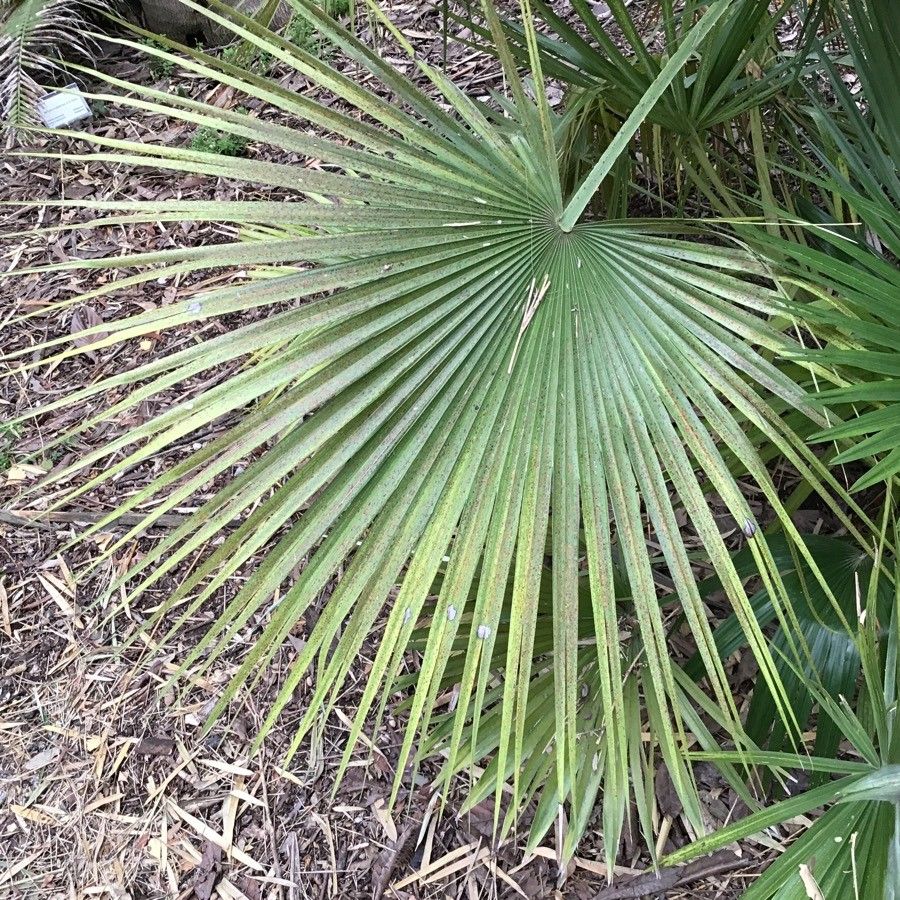
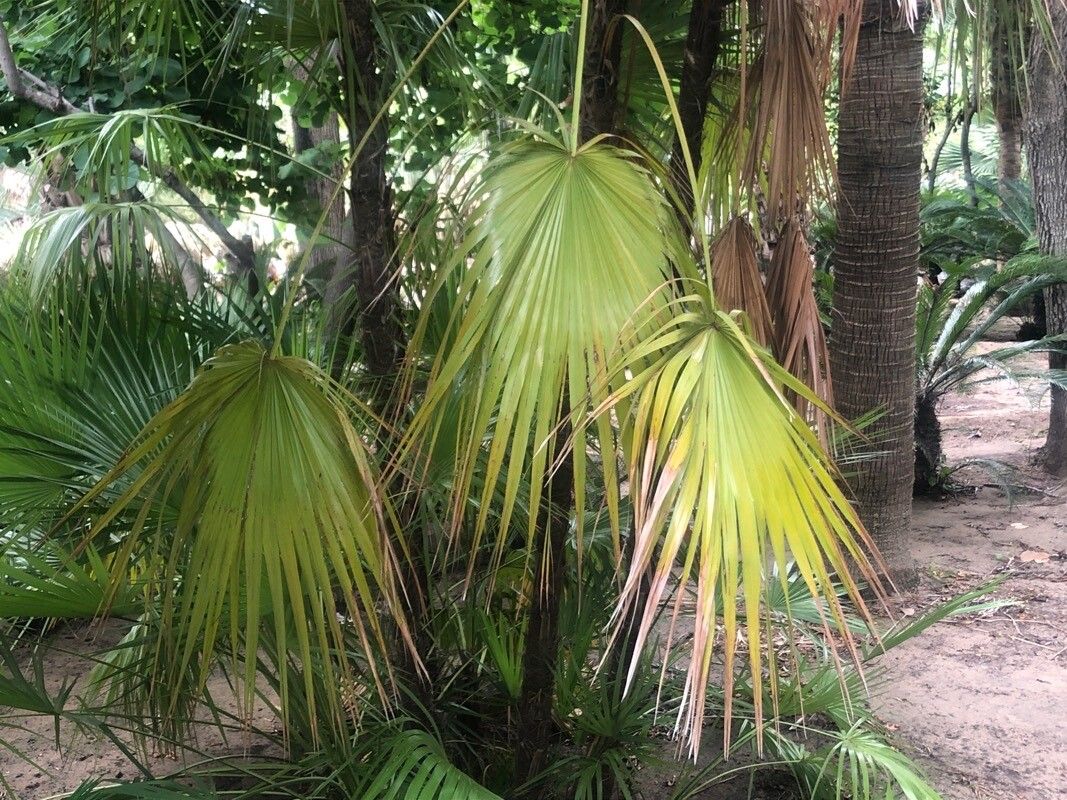
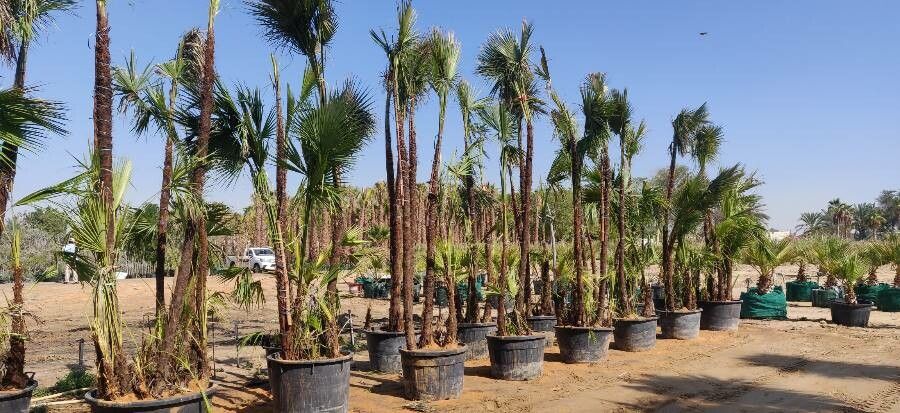
Acoelorrhaphe is a genus of palms with single species Acoelorrhaphe wrightii, known as the Paurotis palm, Everglades palm or Madeira palm in English and cubas, tique, and papta in Spanish.It is native to Central America, southeastern Mexico, the Caribbean, Colombia, the Bahamas, and extreme southern Florida where it grows in swamps and periodically flooded forests. It is a small to moderately tall palm that grows in clusters to 5–7 metres (16–23 ft), rarely 9 m (30 ft) tall, with slender stems less than 15 centimetres (5.9 in) diameter. The leaves are palmate (fan-shaped), with segments joined to each other for about half of their length, and are 1–2 m (3.3–6.6 ft) wide, light-green above, and silver underneath. The leaf petiole is 1–1.2 m (3.3–3.9 ft) long, and has orange, curved, sharp teeth along the edges. The flowers are minute, inconspicuous and greenish, with 6 stamens. The trunk is covered with fibrous matting. The fruit is pea-sized, starting orange and turning to black at maturity.The genus name is often cited as Acoelorraphe, a spelling error to be corrected under the provisions of the ICBN. The genus name is a combination of three Greek words meaning a- 'without', koilos 'hollow', and rhaphis 'needle', an allusion to the form of the fruit. The species is named after the American botanist Charles Wright.
The Everglades palm is resistant to disease and usually does not develop health problems. In terms of care, the plant is fairly low-maintenance. Planted outdoors it needs only light watering, and larger specimens typically do not require pruning. Smaller plants, however, should be pruned after they have bloomed. The Everglades palm is suitable for anyone with an outdoor area, such as a garden or deck, and does not demand extensive care experience.
How to keep Acoelorrhaphe Wrightii.
Light
The everglades palm flourishes when exposed to copious sunlight, however, it can also tolerate conditions with less light. Its development and wellbeing are heavily dependent on sunlight, considering its original habitat is accustomed to significant amounts of daylight. Insufficient sunlight could impede its growth, whereas too much sunlight may be detrimental to the plant.
Water
The Everglades palm thrives in high humidity and prefers consistent moisture. For optimal growth, it should be watered every 1 to 2 weeks. This plant requires a soil mix that retains moisture yet still allows for proper drainage to prevent root rot. During the growing season, providing adequate hydration is essential to maintain the vitality of the Everglades palm.
Temperature
The Everglades palm thrives in habitats where the usual temperatures fluctuate between 68 and 95 °F (20 to 35 ℃). It is a plant that favors hot weather and might require assistance in adapting to cooler periods.
Fertilizer
The moment at which you fertilize Everglades palm is of great significance. You should start fertilizing at the beginning of spring, and proceed to do so on a monthly basis until the start of summer. Fertilizer aids in creating beautiful blossoms and supplies energy during both resting and developing stages of growth.
Pruning
The Everglades palm is characterized by its clustering trunks and fan-shaped leaves. To promote healthy growth, prune this plant in early spring by removing any dead or damaged fronds. Regular pruning helps maintain the plant's shape, prevent overcrowding, improve air circulation, and reduce the risk of disease.
Botanical profile.
- Plant Type
- Tree, Shrub
- Life Cycle
- Perennial
- Genus
- Acoelorrhaphe
- Family
- Arecaceae
- Hardiness Zone
- 9
- Mature Height
- 9.14 m
- Mature Spread
- 5 cm to 8 cm
- Leaf Color
- Green
- Leaf Type
- Evergreen
- Flower Color
- White, Yellow, Green, Cream, Gray
- Flower Size
- 2.54 cm
- Bloom Time
- Summer
- Planting Time
- Spring, Summer, Autumn
- Harvest Time
- Late summer, Early fall, Mid fall
- Native Area
- Colombia, Bahamas, Belize, Cuba, Honduras, Mexico, Guatemala, Nicaragua, Costa Rica
Other names.
Reader questions.
How can I water my Everglades palm in the best way?
Your Everglades palm is not demanding when it comes to watering. You can use any common watering tool, like watering cans, hoses, or even cups, to water this plant. Regardless of the tool you choose, it's important to water directly onto the soil. Make sure to evenly moisten all areas of the soil to provide water to the entire root system. Using filtered water is recommended to avoid harmful particles present in tap water. Additionally, using water at or slightly above room temperature is beneficial, as extremely cold or hot water may shock the Everglades palm. However, the plant generally responds well to any type of water.
Why do I have to give my Everglades palm plant nutrients?
To ensure your Everglades palm thrives, it's important to regularly fertilize regardless of the type you have. Providing the right nutrients enhances its growth, making it more resilient and capable of resisting diseases and pests. Since the foliage is a highlight, it's crucial to maintain its beauty by following a specific fertilization schedule. This will result in vibrant, lush leaves that give your palm an appealing appearance.
How long does Everglades palm need sunlight to grow?
Tropical ornamental plants that thrive in full sun require at least 6 hours of direct sunlight each day. These plants are well-suited to areas with strong and direct sunlight, as they need this light to flourish. In their natural habitats, they tend to grow in open fields or along forest edges, where they can enjoy abundant sunlight all day long.
What temperature is best for Everglades palm?
Plants are affected by colder temperatures because they match the air temperature around them. Usually, when plants are in the sunlight, they can warm up. However, this doesn't happen in the winter. The ideal temperature range for Everglades palm is between 70 to 85℉ (21 to 30℃). They can tolerate temperatures as low as 20 to 30℉ (-6 to 0℃), or even as low as 15℉ (-10℃), but not for extended periods since frost damage may occur. To maintain their health, it's important to keep the maximum temperature within the range of 70 to 85℉ (21 to 30℃), provide regular water spraying, and offer shade to prevent wilting.
What should I do if I give my Everglades palm tree too much or too little water?
Outdoor plants, especially newly planted ones or seedlings, are susceptible to lack of watering. It is important to water them adequately for a few months while they are small or newly planted. Once the roots are established, Everglades palm can mostly rely on rain. When you have an Everglades palm in a pot, overwatering is more likely. If you accidentally overwater your palm, take immediate action to fix the situation. First, stop watering the plant to minimize the effects of overwatering. Then, remove the palm from its pot and inspect the roots. If you find no signs of root rot, you can return the plant to its container. If there is root rot, trim the affected roots and consider applying a fungicide to prevent further damage. Finally, repot the Everglades palm in well-draining soil. In the case of underwatering, simply water the Everglades palm more frequently. If you underwater, the leaves will droop, dry out, and fall off. Once you water it properly, the leaves will recover quickly. Adjust your watering frequency as soon as you notice underwatering.
When should I fertilize my Everglades palm tree?
To properly fertilize your Everglades palm, start during late winter or early spring to provide the necessary nutrients for healthy growth when the weather warms up. If you live in a warm climate region, it's beneficial to give your palm an extra fertilizer feeding in early fall. This will not only supply nutrients for the upcoming growing season but also help the palm withstand winter cold and prevent foliage damage. This early fertilization ensures that new branches have enough time to grow and be resilient in the face of the cold winter.
What happens if Everglades palm doesn't get enough sunlight?
Tropical ornamental plants that need full sun may face issues if they don't receive enough sunlight. They might become leggy and weak, and their leaves could turn yellow or pale. Furthermore, they may stop producing flowers. Ultimately, if these plants continue to lack the required amount of direct sunlight, there is a possibility that they may die.
Should I change the temperature for Everglades palm depending on its various stages of growth?
When growing Everglades palm, it is important to research and ensure the temperature is suitable. Some growers may choose to lower the plants' thermostat during the growing season to save on HVAC costs. However, it is crucial to understand that temperature can impact flowering, pest management, and plant quality. The Everglades palm will reach a point where it stops growing, which is more likely to occur during winter when certain species may enter a dormant state. As the seasons change and the temperatures rise, the base temperature for growth also increases, leading to faster growth of the Everglades palm. Species naturally found in warm habitats have higher optimum temperatures compared to those that prefer cooler climates. Exposing Everglades palm seeds to cool temperatures can cause decreased uniformity and delays. Lowering the temperature during flowering may be beneficial, but it is not recommended during other phases of growth. Cooler nighttime temperatures also require less water, so irrigation should be adjusted accordingly.
How often do I need to water my Everglades palm?
Most outdoor plants can grow adequately with rainfall, but if you have a lack of rainfall in your area, it's important to water your plants appropriately. In the spring and fall, watering every 2 weeks should be enough, while in the summer, more frequent watering is needed. During the winter when growth is slower, you can water less. In fact, you may not need to water at all during this time. If you have a young or newly planted Everglades palm, it's important to water it more often to help it establish and grow into a more adaptable and drought-tolerant plant. For potted plants, there are two main ways to determine watering frequency. The first is to have a set schedule, such as once a week or once every other week. However, this approach may not always be suitable as it doesn't consider the specific conditions of your Everglades palm. Another approach is to water based on soil moisture. It's best to wait until the top few inches of soil have completely dried out before watering again. This method allows you to adjust watering frequency according to the plant's needs, which can change depending on the season. During summer, for example, the plant may require more frequent watering.
When is the best time to not fertilize my Everglades palm?
There are specific times of the year when it is not recommended to fertilize your Everglades palm. The first is during the early and mid-winter months when the plant is dormant and does not require feeding. Additionally, it is not advisable to fertilize this plant during late spring and summer when the weather is typically hotter and drier. These conditions can have a negative impact on the plant if fertilized. To prevent any problems, it is best to follow a fertilization schedule that only involves feeding in early spring and early fall.
What happens if the Everglades palm gets too much sunlight?
Tropical ornamental plants that thrive in full sun require ample direct sunlight, but excessive exposure to intense sunlight can harm them. Prolonged periods of direct sunlight can cause sunburned leaves or the development of unsightly brown spots. Additionally, if the soil dries out too rapidly in full sun, these plants may become dehydrated.
How can I keep the palm trees in the Everglades warm during cold seasons?
To help the Everglades palm withstand colder temperatures, stop fertilizing the plant to prevent new growth and allow the existing ones to become hardy. Additionally, you can protect the palm by creating structures like cages or trellises around it. Another option is to use heat mats, which can gently warm the soil and maintain the ideal temperature range for the Everglades palm consistently.