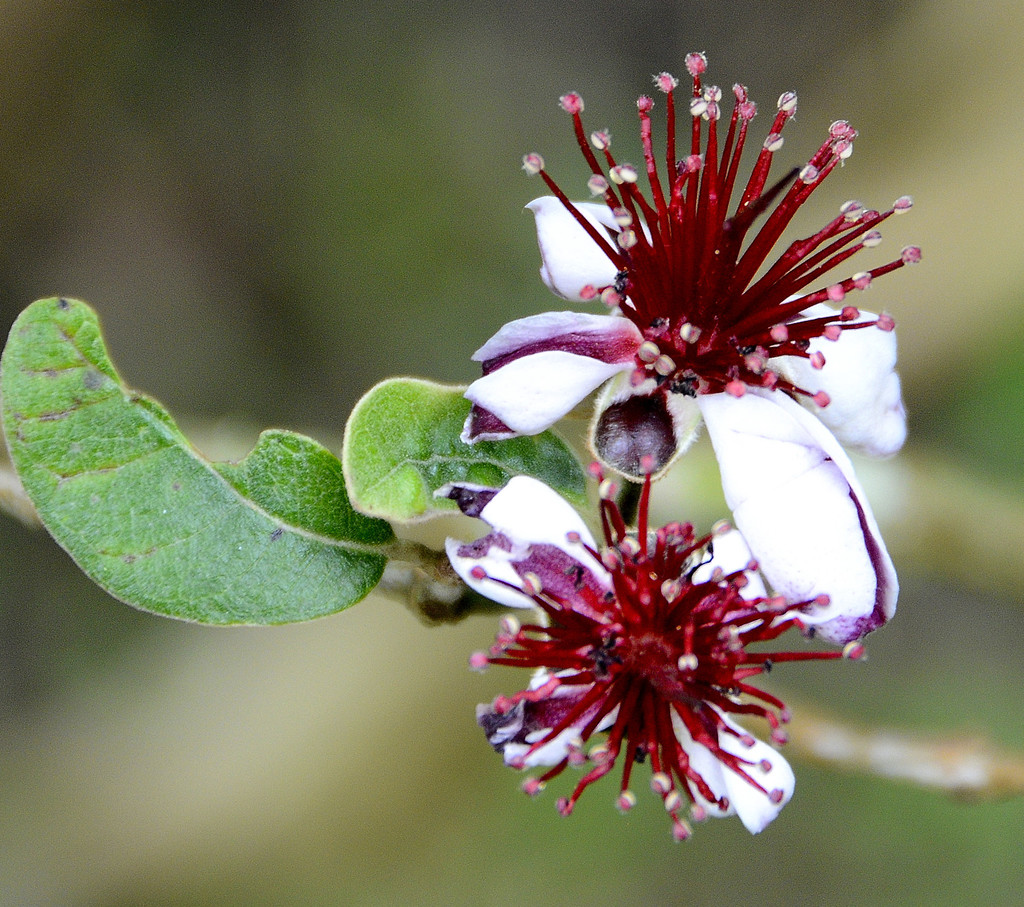
Acca sellowiana, commonly known as pineapple guava, is a small evergreen tree or shrub native to South America. Part of the myrtle family, it can grow up to 20 feet tall. The plant has a unique appearance, characterized by its gray-green leaves covered in fine hairs and its striking red or pink flowers with white stamens. The fruit of the Acca sellowiana is oval-shaped with a greenish-yellow skin when ripe and can be eaten raw or used in culinary applications like jams, jellies, and desserts.
The plant prefers well-drained soil and full sun exposure but can also tolerate partial shade. While drought-tolerant once established, it requires regular watering during its first few years of growth. Regular pruning helps maintain its shape.
Beyond being an attractive ornamental addition to gardens and landscapes, Acca sellowiana offers ecological benefits by attracting pollinators such as bees with its fragrant flowers. Its fruit is rich in antioxidants like vitamin C, making it beneficial for human consumption.
The Feijoa is an evergreen tree that bears a distinctive, egg-shaped fruit. The fruit's flesh is sweet, with a flavor that resembles a mix of guava, pineapple, and strawberry. While the skin is edible, most people prefer to cut the fruit in half and scoop out the sweet pulp with a spoon. FUN FACT · FROM THE LIBRARY
Overall, Acca sellowiana is an intriguing ornamental tree that provides aesthetic value to gardens and offers ecological benefits by attracting pollinators and producing nutritious fruit for human consumption.
Feijoa: The name "Feijoa" was given to the genus by the German botanist Ernst Berger, in honor of João da Silva Feijó, a Portuguese naturalist. The species name commemorates Friedrich Sellow, the German botanist who first collected feijoa specimens in southern Brazil.
Pineapple guava has relatively strong disease resistance and is generally not vulnerable to many illnesses. However, if it is kept in poor conditions it can become more prone to disease. The plant also has few insect pests. For care, it has moderate requirements. It needs plenty of sunlight; in inadequate light it may become susceptible to disease and develop thin, weak growth. Because it is often grown indoors, it may need to be moved regularly to a bright spot. It does not need frequent watering. Overall, Pineapple guava is suitable for most people, though it is best for those who can provide good light.
How to keep Acca Sellowiana.
Light
Pineapple guava does best in locations that receive abundant sunlight for most of the day, though it can also tolerate spots with partial shade. Excessive sun or insufficient sun can harm its growth, causing weak development or discoloration.
Water
Feijoa, a plant native to South America, requires moderate moisture and should be watered every 1-2 weeks. As an evergreen, it needs consistent hydration to keep its foliage healthy. It is well-suited for outdoor growth and thrives when its watering schedule aligns with the typical rainfall patterns of temperate climates.
Humidity
This plant prefers dry conditions, so don't mist it. However, watering it less often can also thrive in higher humidity.
Temperature
The pineapple guava is native to South America and needs a warm temperature range of 15 to 35 ℃ (59 to 95 ℉) to thrive. It prefers mild winters and hot, humid summers to achieve the best fruit yield. In regions with a consistently warm climate, altering temperatures between seasons may not be necessary.
Fertilizer
The pineapple guava plant needs adequate nutrients to achieve optimal fruit production. Fertilize in early spring to promote new growth and bloom development. Regular feeding keeps the plant healthy, produces more flavorful fruit, and prevents nutrient deficiency problems like yellowing leaves and poor fruit production.
Pruning
Feijoa benefits greatly from pruning in early spring. This process involves removing dead wood, thinning out crowded branches, and shaping the plant to manage its size. Such pruning promotes healthier growth, improves air circulation, and enhances fruit production. For the best results, aim to cut back one-third of the new growth and remove any branches that cross over each other.
Pot & Repot
When repotting Pineapple guava, select a pot 1–2 inches (2.5–5.1 cm) larger with ample drainage. Use a well-draining potting mix. Repot in spring or fall, ensuring that the root ball is slightly lower than the rim of the flower pot. Water thoroughly after repotting and place in a warm spot with indirect sunlight.
Botanical profile.
- Plant Type
- Shrub
- Life Cycle
- Perennial
- Genus
- Acca
- Family
- Myrtaceae
- Hardiness Zone
- 8-10
- Mature Height
- 3.96 m to 7.01 m
- Mature Spread
- 3.96 m to 6.1 m
- Leaf Color
- Green, Silver, Gray
- Leaf Type
- Evergreen
- Flower Color
- Red, White
- Flower Size
- 2.54 cm
- Bloom Time
- Late spring, Early summer
- Planting Time
- Spring, Autumn
- Harvest Time
- Mid summer, Late summer, Early fall
- Native Area
- Brazil, Uruguay
Other names.
Reader questions.
How should I water my Feijoa plant?
Your Feijoa plant is not picky about how you water it. You can use any common watering tool, such as a watering can, hose, or even a cup, to moisten its soil. When watering, it is important to apply the water directly to the soil and make sure all areas are equally moistened to provide water to the entire root system. Using filtered water is recommended as tap water may contain harmful particles. Additionally, using water at or slightly above room temperature is beneficial as extremely cold or hot water can shock the Feijoa plant. However, generally speaking, the Feijoa plant responds well to any kind of water it receives.
Why should I put fertilizer on my Feijoa plant?
Regular fertilization is important for the growth of plants, especially fast-growing types like Feijoa, as they deplete the soil of nutrients. By providing Feijoa with additional nutrients, not only will it remain healthy, but it will also produce more delicious fruit. However, if plants are not fertilized for a long time, they may face various problems. Nutrient deficiency can lead to issues with foliage, such as yellow leaves or leaves with a reddish color. It can also cause deformities in leaf shape, withered tips, or even large portions of the plant dying back. Additionally, certain nutrient deficiencies can result in bark disorders, slower growth, poor shoot development, and a lack of fruit production.
What are the sunlight requirements for Feijoa (Acca sellowiana)?
Feijoa, or Acca sellowiana, thrives best in environments that are rich in sunlight. The plant can flourish in full sun, needing more than 6 hours of sunlight daily, but it can also adapt to partial sun conditions, requiring about 3-6 hours of sunlight. It’s essential for the cultivation and growth of Feijoa to ensure it receives adequate sunlight, as both insufficient light and excessive exposure can affect its growth negatively, leading to weak development, discoloration, or even symptoms like chlorosis or sunscald. Observing how sunlight moves through your garden helps in choosing spots that offer a balance of light and shade, contributing to the plants' well-being.
What is the origin of the Feijoa plant and its preferred climate conditions?
The Feijoa plant, also known botanically as Acca sellowiana, originates from South America. It thrives in a warm temperature range of 15 to 35°C (59 to 95°F), favoring mild winters and hot, humid summers for optimal fruit production. Consistently warm climates are ideal as they negate the need for adjusting temperature conditions across different seasons. Feijoa exhibits some cold tolerance, usually requiring no additional cold protection measures if temperatures remain above -5°C. However, if temperatures are expected to drop below -5°C, temporary measures like wrapping the plant with plastic film, fabric, or other materials should be taken until warmer temperatures return.
What do I do if I give my Feijoa plant too much or too little water?
Outdoor plants, especially newly planted ones or seedlings, are prone to lack of watering. It is important to keep watering them regularly for a couple of months until they are established. Once the roots are developed, Feijoa plants can mostly rely on rainfall. If you have potted Feijoa plants, overwatering is a common mistake. If you accidentally overwater your plant, take immediate action to minimize the damage. Stop watering the plant and remove it from its pot to check the roots. If the roots are not affected by root rot, you can return the plant to its container. However, if root rot is present, trim the affected roots and consider applying a fungicide. Repot the Feijoa in well-draining soil. In the case of underwatering, simply water the Feijoa more frequently. Underwatering is usually easy to fix, as you may notice the leaves drooping and drying out. Once you water the plant sufficiently, the leaves will regain their fullness. Correct the watering frequency as soon as you notice underwatering.
When should I fertilize my Feijoa plant?
The best time to fertilize Feijoa is in early spring, before the buds start to appear. During this time, Feijoa uses the energy it stored up over winter to produce new growth. To support the development of blooms, it is recommended to fertilize about 2 to 4 weeks before the expected blooming period. This allows enough time for the nutrients to soak into the soil and be absorbed by the plant. Feijoa can be fed throughout the spring, but it is advised not to fertilize in autumn as it may cause excessive foliage growth late in the season, which can make the leaves vulnerable to damage during winter.
How can artificial lighting be used for Feijoa plants indoors?
For indoor Feijoa plants, when natural sunlight is insufficient, especially in winter or less sunny spaces, artificial lighting can be a crucial alternative. LED lights are recommended because they can be adjusted to provide specific wavelengths needed for the plant. For full sun plants, 30-50W/sq ft of artificial light is needed; partial sun plants require 20-30W/sq ft, and full shade plants need 10-20W/sq ft. The light source should be placed 12-36 inches above the plant to mimic natural sunlight conditions, and most plants will need 8-12 hours of light per day. This approach offers a viable solution to maintain optimal growth and health for Feijoa indoors.
How does the Feijoa plant respond to low temperatures, and what are the recommended solutions?
Feijoa has a moderate tolerance to low temperatures, performing best when conditions remain above 15°C. During winter, it's essential to keep the plant above -5°C to avoid damage. Exposure to temperatures below -10°C may cause the leaves to droop; while they may recover in mild cases, severe exposure can lead to wilting and leaf drop. The recommended solution for frost damage involves trimming off the affected parts. To prevent future damage when low temperatures are anticipated, wrapping the plant with non-woven fabric or cloth and constructing a wind barrier to protect against cold winds is advisable.
How frequently do I need to water my Feijoa plant?
Most outdoor plants grow fine with natural rainfall, but if your area lacks rainfall, you'll need to water your plants adequately. During spring and fall, watering every 2 weeks should be sufficient, but in summer you'll need to water more frequently. In winter, when plant growth slows down, water sparingly or not at all. If your Feijoa plant is young or newly planted, it will need more frequent watering to help it establish and become more adaptable to drought. For potted Feijoa plants, there are two main approaches to determine watering frequency. The first approach is to follow a set schedule, watering about once every week or every other week. However, this may not always work because it doesn't consider the specific growing conditions of your Feijoa plant. Another approach is to monitor soil moisture and water accordingly. Typically, it's best to wait until the top 2 to 4 inches of soil have completely dried out before watering again. This rule applies to pots, with soil depth being about 1/3 to 1/2 of the pot's total depth.
When should I not put fertilizer on my Feijoa?
Here are some tips to follow when it comes to fertilizing your Feijoa plant: - In the first year of growth, it's best to avoid fertilizing Feijoa altogether. If fertilizer is not necessary, be cautious about providing it. - If you pruned 20% or more of the plant in the previous year, refrain from fertilizing. - Avoid fertilizing plants that are diseased or damaged, as this can do more harm than good. Address the root cause of the issue before considering fertilizer. - Do not fertilize after the peak of summer, as this can cause excessive growth just before winter. - In hot and dry times of the year, Feijoa should not be fertilized. Dry soil does not effectively deliver fertilizer, and fertilizing can stimulate growth that requires more water, which may not be available. - It's best to apply fertilizer earlier in the season when temperatures are cooler. - Keep in mind that Feijoa can absorb fertilizer from nearby plants or lawns. So, be cautious to avoid inadvertently giving plants a double-dose of fertilizer.
What symptoms indicate Feijoa is receiving inadequate light?
Feijoa plants showing inadequate light symptoms may exhibit small, undeveloped leaves compared to previous growths, indicating insufficiency in light exposure. You may also notice leggy or sparse growth, denoting longer spaces between leaves or stems, giving the plant a stretched-out appearance. Other signs include faster leaf drop, slower or completely halted new growth, and lighter-colored or chlorotic leaves. Excessive sunlight, on the other hand, can lead to symptoms like sunscald, leaf curling, wilting, and leaf scorching. These symptoms highlight the plant's struggle with the current lighting conditions, whether too little or too much, impacting its overall health and growth.
What effects do high temperatures have on the Feijoa plant, and how can these issues be mitigated?
During summer, it is crucial to keep the Feijoa plant below 35°C as exceeding this threshold can lead to several problems. Temperatures above 41°C may cause the leaves to lighten in color, tips to dry and wither, leaves to curl, and increase susceptibility to sunburn. To manage this, trim away sunburned and dried parts. Relocate the plant to a shaded area, particularly away from the harsh midday and afternoon sun, or utilize a shade cloth. Ensuring the soil remains moist through morning and evening watering sessions can also help mitigate the effects of high temperatures.